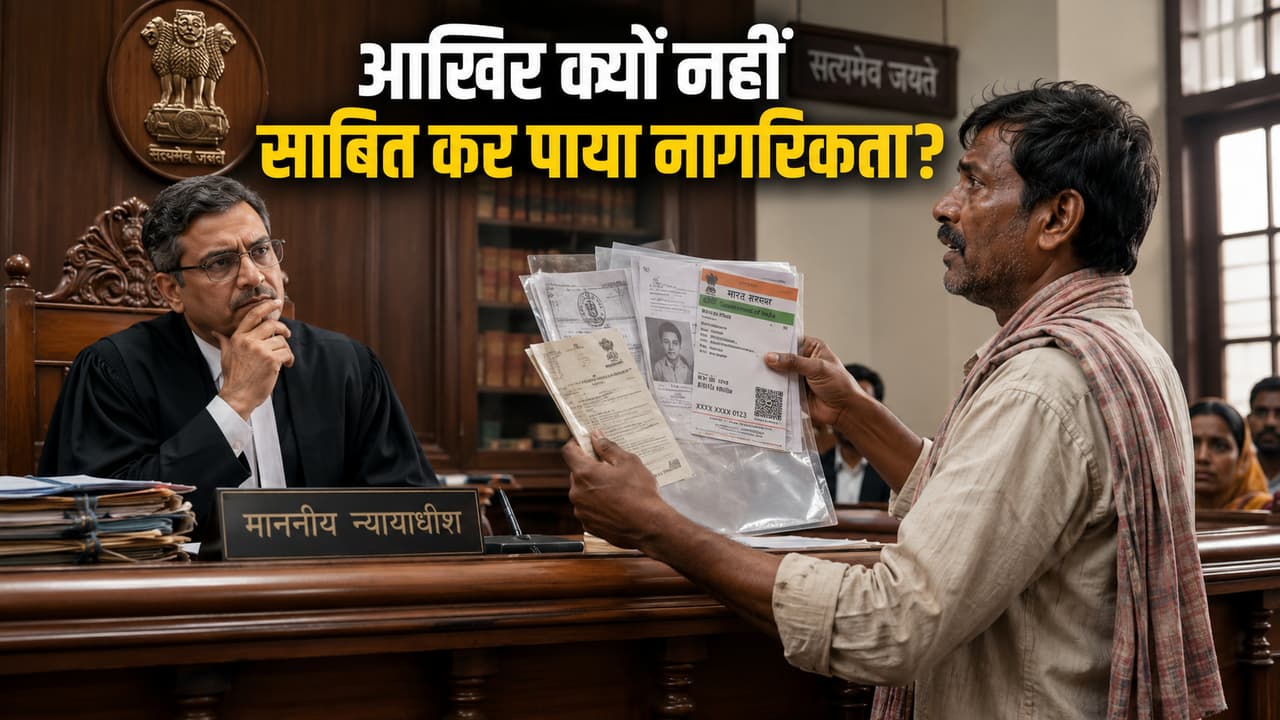
An Assam man produced 15 documents, 1951 NRC records and voter list, yet the Gauhati High Court upheld the Foreigners Tribunal’s decision, finding the evidence insufficient.
Assam Citizenship Case: This is the story of a daily wage laborer from Assam, who presented not just one or two but 15 documents in front of the court to prove that he has Indian blood in his veins and the history of his ancestors. She had the historic ‘National Register of Citizens’ ($NRC$) records from 1951, voter lists, and even her old father himself standing in the courtroom to testify. Despite this, the Gauhati High Court upheld the decision of the Foreigners Tribunal which had declared him a ‘foreigner’ in his own motherland. After all, what happened that despite having so many valid documents, an Indian citizen was deprived of his citizenship? The legal complexities hidden behind this court decision are no less than a suspense film. Let us know in detail.
What evidence did the petitioner present before the court?
The petitioner produced a total of 15 documents, including a computer generated copy of the 1951 NRC, voter lists of several years, land registry of 1973, school certificate, PAN card and voter ID, to prove his citizenship. He also gave his father’s oral testimony in court. But the Court found that the 1951 NRC record was merely a computer generated print, produced without a certificate under Section 65B as required under the Indian Evidence Act. The court clarified that such a document cannot be considered as legally admissible evidence. Also citing Section 15 of the Census Act, 1948, the court said that census records cannot be accepted as direct evidence.
Why did NRC of 1951 also not work?
The petitioner’s greatest reliance was on the 1951 $NRC$ record bearing the names of his grandparents and father. But this biggest weapon in the courtroom failed completely. The Division Bench of Justices Kalyan Rai Surana and Shamima Jahan observed that the paper produced was merely a computer generated statement with the inscription “Generated by DLDD Version 6.0” (Digitized Legacy Data Development). The court said in a strong tone that without the electronic certificate required under Section 65B of the Evidence Act, 1872 (which is equivalent to Section 63(4) of the new Indian Evidence Act, 2023), this digital copy has no legal value. Apart from this, the court, citing Section 15 of the Census Act, 1948, made it clear that no census record can be accepted as evidence to prove citizenship. This single technical setback grounded the petitioner’s entire claims to ancestral lineage.
The mystery of three villages and the trap of age: The voter list itself has set the trap!
The petitioner had presented several voter lists from 1966 to 2017 before the court. He argued that due to river erosion his family had to change their place of residence repeatedly. From Charai Khasara they reached Dhobakura, then Ghugudoba and finally Hashdoba village. But when the court examined these voter lists closely, a truth emerged that surprised the judges:
- identity crisis: No credible relationship or chain of linkage was found between the names in the voter lists of three different villages. It seemed as if these were people from three different families.
- Age mathematics failed: The family member whose age was shown as 25 years in the voter list of 1979, exactly 10 years later i.e. in the list of 1989, his age was shown to be only 29 years. This strange gap of 6 years brought the entire document under doubt.
Why did PAN, Voter Card and School Certificate also become ineffective?
The petitioner hoped that his PAN card, EPIC (Voter Card) and school certificate would prove his Indian identity. But the court clearly said that PAN card and Voter ID are not proof of citizenship. In the struggle to prove citizenship, the petitioner had also presented his school certificate of 2017 and the original deed of the land purchased by his grandfather in 1973. Both of them could not stand the test of law. The school certificate became invalid because the petitioner could not produce the headmaster of the school as a witness in the court nor could he show the original admission register of the school. At the same time, it was not clear in the land documents of 1973 as to how the land was transferred from the petitioner’s grandfather to his legal heirs (father or him). Since there was no record of the revenue of the land, it could not be proved that the petitioner had any direct blood relation with this land.
Why did the father’s oral testimony not become the basis?
Both the petitioner and his father gave oral testimony in the court, but the High Court said that in sensitive matters like citizenship, mere oral statements are not sufficient. According to the court, claims to ancestry and citizenship must be proven by documentary records, not mere statements. Even during cross-examination, several discrepancies came to light between the father’s testimony and the details recorded on record, further deepening the court’s suspicion.
What did the High Court say?
The Gauhati High Court clearly stated that it is a well-established law in India that PAN card and EPIC (Voter ID card) are mere identity documents and not proof of citizenship. Under Section 9 of the Foreigners Act, 1946, the entire responsibility of proving his citizenship rests on the citizen himself. Since this daily wage laborer completely failed to establish his legal link to his ancestors, the Gauhati High Court, while dismissing the writ petition, completely upheld the tribunal’s decision to declare him a ‘foreigner’.
Note: Asianet News, Digital is not disclosing the name of the petitioner as he has not yet exhausted his legal options.