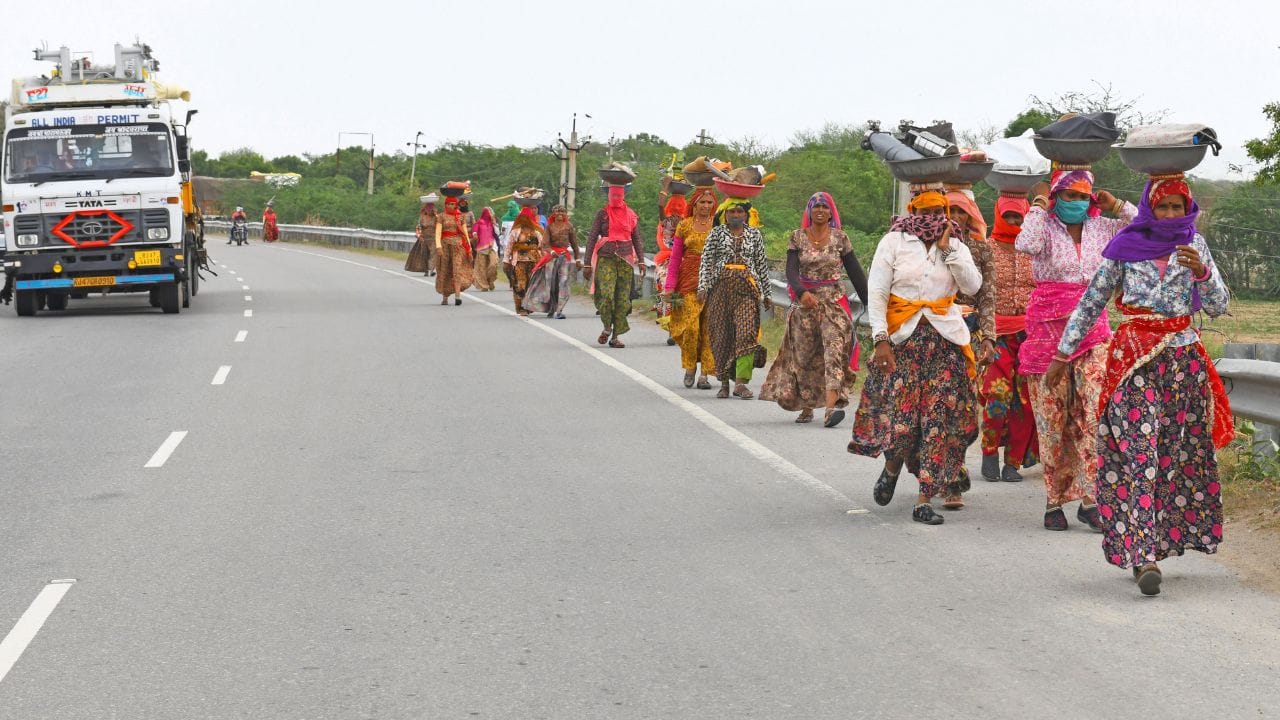
New Delhi: The Indian public is witnessing an unusual political moment, with the opposition Congress threatening to launch an agitation over the removal of Mahatma Gandhi’s name from a rural employment guarantee scheme of MGNREGA. However, both the political class and sections of the intelligentsia have largely refrained from undertaking an objective assessment of the scheme’s performance and structural limitations. This analysis seeks to offer a comprehensive, 360-degree examination of the rural employment guarantee programme, critically evaluating its outcomes while assessing the challenges confronting the newly introduced scheme under VB–G RAM G Act.
The principal opposition, the Congress, along with a large section of the intelligentsia, reacted sharply to the removal of Mahatma Gandhi’s name from the rural employment guarantee programme. The NDA government at the Centre has introduced the Viksit Bharat–Guarantee for Rozgar and Ajeevika Mission (Gramin) (VB–G RAM G Act), replacing the two-decade-old Mahatma Gandhi National Rural Employment Guarantee Scheme (MGNREGS) rolled out in 2005 and expanded nationwide by 2008. The Congress party has threatened to launch a nation-wide agitation against the Centre’s decision.
A Snapshot of History
It is not that India lacked livelihood-support programmes prior to 2005. Democratically elected governments at the Centre had experimented with several initiatives aimed at alleviating rural poverty. The Sampoorna Grameen Rozgar Yojana, launched in 2001, is a case in point. However, unlike its predecessors—which were implemented through executive orders—MGNREGA was enacted through Parliament, thereby acquiring a statutory status. More than merely an employment-generation programme, MGNREGA was designed to ensure minimum livelihood security for rural households. Since it was anchored through a legislation, the scheme could not be withdrawn through executive action by the present government and therefore required replacement through a new Act of Parliament, which subsequently received presidential assent.
Ever since its roll out, substantial studies were done on the impact of MGNREGA in rural India and almost all of them described this as a “game changer.” However, most of these studies were commissioned by government agencies and relied predominantly based on secondary data—that is, data generated and disseminated by the government authorities themselves. Therefore, this methodological limitation raises questions about the independence and analytical rigour of such assessments. While these studies inevitably emphasised programme achievements, a smaller but significant body of scholarship has sought to identify its structural and implementation-related shortcomings.
For instance, Satyanarayana Turangi questioned in 2022 why certain performance indicators markedly varied across states despite uniform programme design. Murty C. S. argued that evaluating MGNREGA solely through employment trends or Labour Force Participation Rates (LFPR), failed to capture its broader welfare implications. Similarly, Sangeeta Shroff and Jayanti Kajale in 2018 had observed that in Maharashtra, the annual employment generated under MGNREGS in recent years was significantly lower than that achieved under the earlier Employment Guarantee Scheme (EGS) prior to 2005–06.
Structural Lacunae in MGNREGA
Five critical shortcomings of MGNREGA merit closer scrutiny. First, most evaluations have examined the scheme in isolation rather than situating it within the broader framework of integrated rural development. Even after nearly 25 years, if MGNREGA has not achieved its twin objectives—empowering vulnerable households while contributing simultaneously to the creation of developed and self-sustaining villages—it suggests the persistence of deeper structural fault lines in in the programme. It is akin to India recording a per capita GDP of $12,000, yet failing to qualify as a developed nation because of inadequate and fragmented public infrastructure.
Second, in many districts such as Yadgir and several others in Karnataka, relatively strong performance in terms of employment provision under MGNREGA has not translated into reduced distress migration. This indicates that employment generated under the scheme has been insufficient to sustain livelihoods within villages, compelling rural households to migrate to urban centres and accept precarious forms of employment.
Third, the issue of corruption remains the “elephant in the room.” In many regions, MGNREGA became an avenue for entrenched local elites and sections of gram panchayat leadership to accumulate disproportionate wealth. Ironically, as the Centre introduced tighter guidelines and monitoring mechanisms, corrupt networks adapted with increasing sophistication. The quid pro quo arrangements between local oligarchs and panchayat officials have been in the public domain, undermining both efficiency and credibility of this programme besides other developmental programmes .
Fourth, the statutory wage rate—approximately ₹380 per day—has increasingly been perceived as uncompetitive, especially when compared to urban informal-sector wages of ₹1,000–₹1,200 per day in cities such as Bengaluru. This wage differential has further weakened the scheme’s ability to retain labour within rural areas.
Fifth, MGNREGA has had unintended consequences for the rural agricultural economy. The introduction of guaranteed public employment led to a sharp rise in agricultural wages, as labourers shifted to government-backed works. This resulted in acute labour shortages for the agricultural sector, particularly affecting small and medium farmers engaged in plantation and horticultural crops. Many cultivators were forced either to pay significantly higher wages or to scale down or abandon cultivation altogether.
These dimensions have not been adequately addressed in much of the mainstream social science literature or political discussion, which often adopts a linear, payment-centric approach to evaluating individual-level benefits while underplaying broader economic distortions and institutional failures.
Changing Rural Context and Emerging Challenges for New Law
The rural governance environment has since evolved, with corruption networks becoming more deeply institutionalised. Implementing any new employment guarantee programme under such conditions will pose formidable challenges. The new Act mandates state governments to contribute 40 per cent of the total programme outlay, a requirement that raises serious concerns. Post-GST roll out, revenue constraints have curtailed states’ fiscal autonomy, while the proliferation of electoral “freebie” programmes has further strained the state finances. Additionally, Centre–state relations are currently characterised by a significant trust deficit. Political parties aligned with both the NDA and UPA, despite electoral competition, have shown limited willingness to cooperate on governance reforms. In this context, the new rural employment guarantee scheme risks faltering at the implementation stage.
Last sip
The Congress party has focused its opposition primarily on the removal of Mahatma Gandhi’s name from the scheme. However, Gandhi—who had once suggested the dissolution of the Congress—might have expressed deeper concern over the entrenched corruption in a programme bearing his name. The scheme failed to realise the Gandhian ideal of gram swarajya by sustainably enhancing the livelihoods of the most vulnerable. A comprehensive reset of the programme was arguably long overdue and need not be viewed purely through an emotional lens. That said, the symbolic and ethical implications of dropping Gandhi’s name remain open to debate and are likely to continue occupying public discourse.