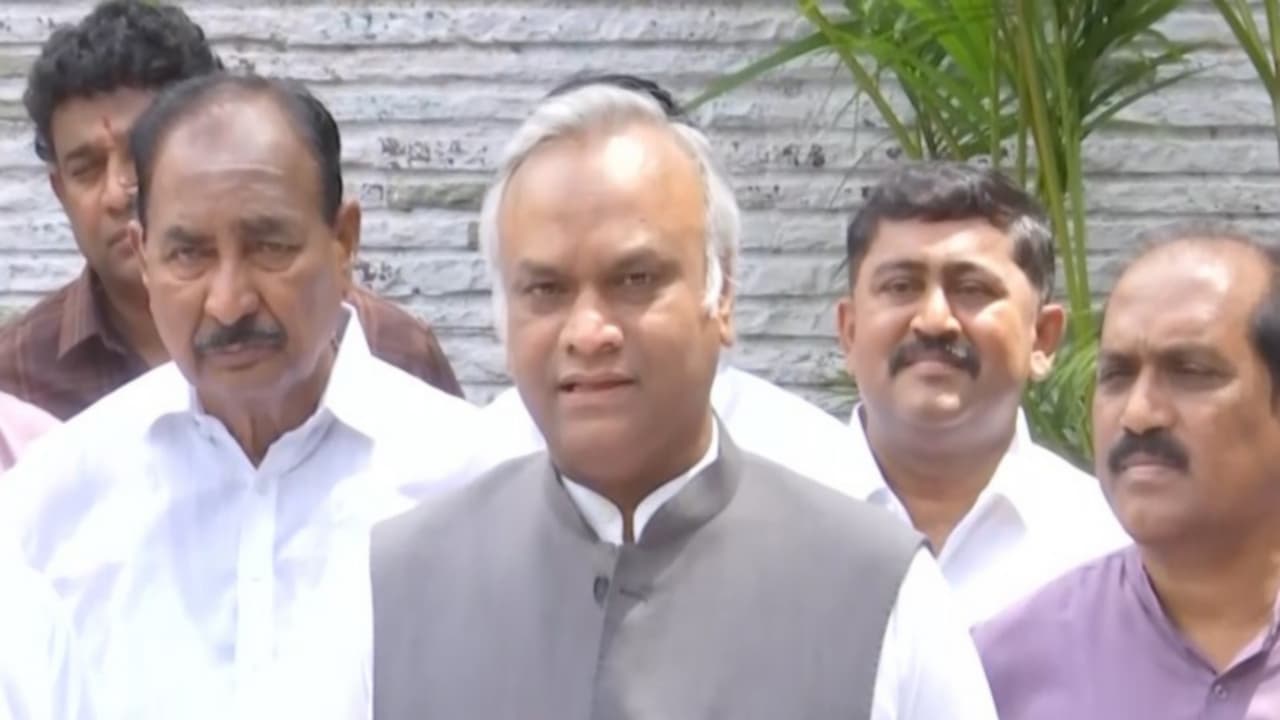
Uproar over Special Intensive Revision (SIR) of voter list in Karnataka. Home Minister Priyank Kharge accused the Election Commission of working under pressure from the Center and being a ‘puppet’. The state cabinet has raised 12 objections regarding the process.
Bengaluru (Karnataka) [भारत]June 30 (ANI): As the Special Intensive Review (SIR) begins in Karnataka, state Home Minister Priyank Kharge on Tuesday alleged that the Election Commission of India (ECI) is acting like a ‘puppet’ under political pressure from the Center instead of working independently.
Speaking to reporters, Kharge hit out at the election body for taking the process forward without responding to the demands of the state cabinet. He said, “We have raised 12 objections on the way the SIR was conducted. We were expecting the CEC to respond. Unfortunately, they have not responded. We will see what to do. The CEC and the Election Commission are puppets in the hands of the government. It is clear that the government does not have the popular vote of the people, so they want to do these things.”
Despite their objections, the revision exercise began as per schedule. Chief Minister DK Shivakumar launched the SIR of the voter list by filling the enumeration forms at his Sadashivnagar residence. The special intensive revision (SIR) of voter lists, which has started across the state, will continue till July 29.
Cabinet put these conditions before ECI
The Karnataka Cabinet passed a resolution laying down the conditions it wanted the ECI to fulfill before the exercise could begin in the state. The Cabinet asked the Commission to conduct a thorough independent review of the SIR process, including its legal basis, delisting criteria, supervisory structure, software systems and safeguards.
The Cabinet also wants the ECI to extend the deadline for submission of enumeration forms by at least three months to avoid undue pressure on BLOs and administration.
It also sought a detailed manual explaining every anomaly criterion, including so-called “logical anomalies”, including the underlying algorithms, software logic, SOPs and responsible officials at each stage.
Demanded these security measures for voters
Additionally, the Cabinet demanded concrete security for voters. This includes no challenge or notice without first field verification by the BLO, no deletion of minor spelling or clerical errors as grounds for objection, and no deletion of any existing voter without notice, hearing before an impartial authority and an express order.
It also called for clarity on the entire list of acceptable documents, asked the Commission to reconsider the exclusion of Voter ID and Aadhaar, demanded recognition of Karnataka’s own Kuthub ID, and demanded that the burden of proof not be unfairly placed on ordinary citizens.
Emphasis on administrative process and transparency
On the administrative process, the state cabinet wanted valid Form-6 applications to be processed along with Form-7 objections and to prevent bulk objections that could lead to mass deletion of names. It also wants machine-readable daily data on notices, additions, deletions and orders to be made publicly available.
It also wants the ECI to ensure that no opaque AI tools are used, and that all software for data entry, digitization, mapping and validation be publicly disclosed and independently tested.
Furthermore, it sought clear definition of the roles of special role observers and micro-observers, as well as ensuring that electoral registration officers maintain their independence to carry out their statutory duties.
Demand for security for special groups
The state cabinet also called for special protection measures for several groups, including women, migrant labourers, slum dwellers, nomadic and de-notified tribes, widows, persons with disabilities, orphans and transgender persons. (ANI)
(Except for the headline, this story has not been edited by Asianetnews Editorial staff and is published from a syndicated feed.)