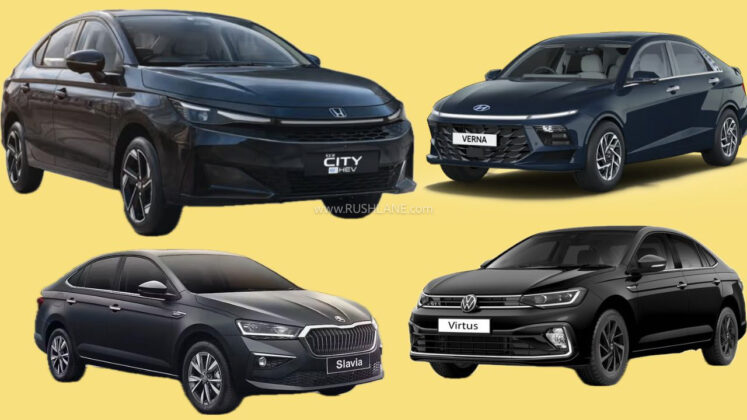
Honda Cars India Ltd has just in the country. In India’s sedan landscape, Honda City has always been a prominent vehicle and it currently rivals the likes of Hyundai Verna, which was just facelifted for 2026 model year along with Volkswagen Virtus and Skoda Slavia, both of which are expected to get a facelift in 2026.
Even with the new City facelift, Honda has a tough job on its hand to compete with these rivals as they all start from a lower price point and offer exciting and enthusiastic powertrains. On top of it, Hyundai Verna offers significantly more features and equipment over its rivals. Let’s see how they compare on paper.

Honda City Facelift vs Rivals
The mid-size (C Segment) sedans are growing in length and the City facelift is not the longest in this segment at 4,594 mm, which is cosmetic length as wheelbase is identical as its predecessor. In fact, City has the smallest wheelbase in this comparison while Verna’s is the largest at 2,670 mm. Verna is also the widest and has the largest boot space at 521L.
City is the only in this segment remaining to offer skinny 185-section tyres, while all rivals offer 205-sections. Interestingly, City and Verna do not disclose ground clearance, while the Europeans do, at 179 mm. Where pricing is concerned, City is the most expensive on offer here as it starts from Rs 12 lakh and goes till Rs 21 lakh for Hybrid variant. Slavia is the most affordable and Verna emerges as the most VFM, considering everything it offers.

In terms of safety, no one comes close to safety kit which includes radar-based Level-2 ADAS along with a stellar 5-Star Global NCAP rating. Virtus and Slavia also get 5-Star GNCAP rating, but miss out on Level-2 ADAS and 360-degree cameras. City offers a cameras-based Level-2 ADAS along with 360-degree cameras and Lane Watch Camera.
Powertrains is another area where the rivals eat cake as they come with powerful Turbo Petrol engines. Honda promises excitement too, especially with the e:HEV Hybrid system with torquey electric motors, but is priced at Rs 21 lakh (Ex-sh). Virtus and Slavia offer Turbo Petrol as standard with a smaller 1.0L engine and a more powerful 1.5L Turbo.

Verna offers a 1.5L NA Petrol and a 158 bhp and 253 Nm 1.5L Turbo Petrol, which is segment’s most performant (continuous) powertrain. Hyundai does not quote mileage figures, while others do. City’s NA Petrol mileage tops out at 17.97 km/l where Virtus and Slavia
Features & Equipment
This is one area where Hyundai Verna trounces everything in its path. LED connected headlights are common between City and Verna only Verna gets connected LED tail lights. All vehicles in this segment come with auto headlights and rain sensing wipers. Virtus and Slavia offer fog lights and only Virtus is advertised with cornering function. Both Slavia and Virtus miss out on 360-degree camera and front parking sensors.

Only Verna offers a dashcam, which is a great feature to have. Also, Verna is the only one to offer all-four disc brakes, while City only offers on e:HEV variant and the Europeans do not. Around 10-inch infotainment screens are common in this segment, but Verna is the only one with an adapter for wireless Android Auto and Apple CarPlay, while others support natively.
A fully-digital 10.2-inch TFT cluster is offered with Verna, while others offer smaller clusters and MIDs. All contenders offer single-zone climate control and a single-pane sunroof. All of them offer front ventilated seats too. Only City offers manually adjustable front seats, while others offer powered. Verna goes a step forward and offer a Boss Mode feature, which was unheard of in this segment.
Only Verna offers rear window blinds and only City offers rear windshield blind, whereas Virtus and Slavia offer neither. All rivals offer auto-dimming IRVM, rear AC vents, paddle shifters, leatherette upholstery, front and rear armrest, keyless entry with push-button start and telematics suite. City’s electric parking brake is only with e:HEV version.