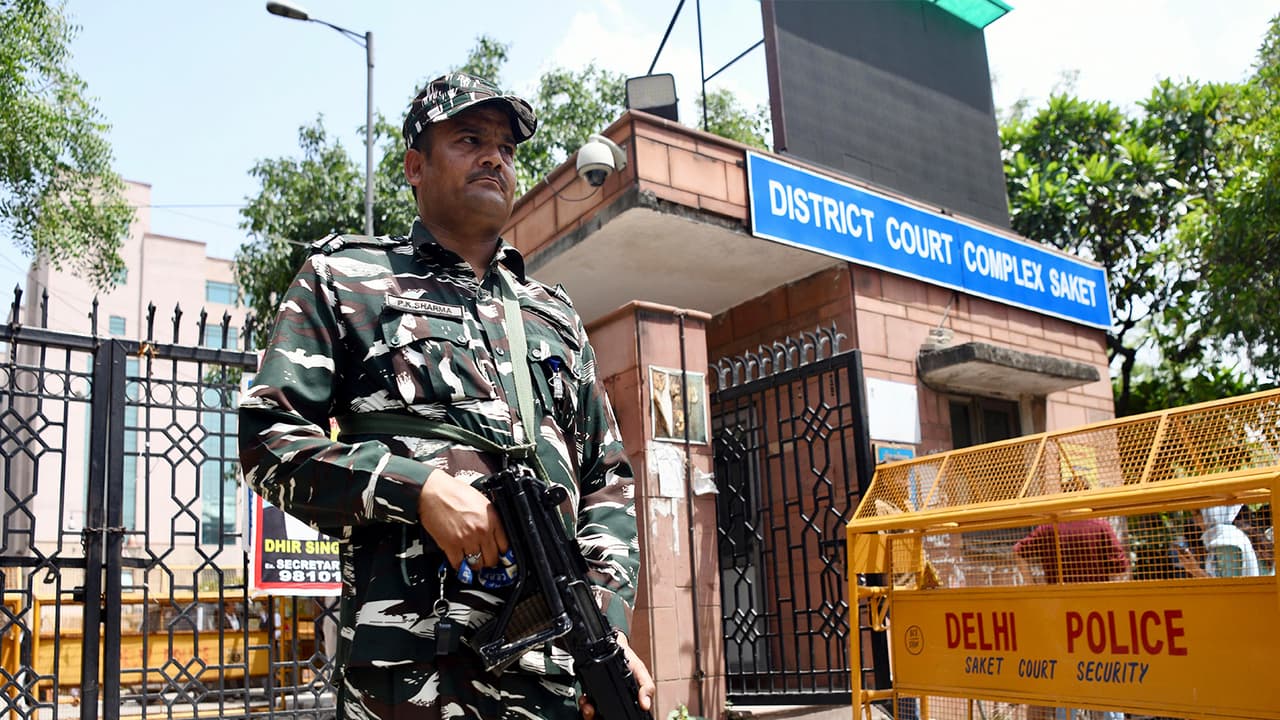
A Delhi court upheld the dismissal of a husband’s application to preserve his wife’s call records, stating that late-night calls don’t question a woman’s character. It ruled such a request invades privacy without specific, reasonable grounds.
A Delhi court has upheld the dismissal of an application filed by the husband, seeking preservation of a woman’s call detail records (CDRs), observing that merely speaking to someone over the phone at late-night hours cannot, by itself, cast doubt on a woman’s character or justify an invasion of her privacy.
Court Upholds Right to Privacy
Additional Sessions Judge (FTC) South District, Saket Courts, while dismissing a criminal appeal challenging the trial court’s order, held that any direction to preserve a person’s call records amounts to an interference with the fundamental right to privacy and, therefore, can only be granted when supported by specific and reasonable grounds.
The appeal arose from an order of the Mahila Court rejecting an application under Section 94 of the Bharatiya Nagarik Suraksha Sanhita (BNSS) seeking preservation of the complainant’s call detail records and location charts of certain mobile numbers.
The appellant husband contended that he was only seeking preservation of the call records and not their production before the court. It was argued that the records were necessary for his defence since they could otherwise be automatically deleted by the service provider with the passage of time.
The appellant also claimed that the complainant had regular conversations with certain persons during late-night hours and that preservation of the records was necessary for proper adjudication of the dispute. However, the appellate court noted that the trial court had rejected the application because it failed to disclose any specific ground explaining why preservation of the records was necessary. The appellate court found no infirmity in that reasoning.
‘Late-Night Calls Don’t Define Character’
The court observed that although the right to privacy is not absolute and may, in an appropriate case, yield to the right to a fair trial, a litigant seeking preservation of another person’s call records must clearly explain why such relief is necessary. The court held that such a prayer cannot be granted merely on the basis of vague assumptions or suspicions.
Relying on the Delhi High Court’s decision in Deepti Kapur v. Kunal Julka, the court reiterated that while an opposing party has a right to lead relevant evidence for a fair trial, any invasion of an individual’s privacy must be reasonably justified.
Making significant observations, the court said that talking to any person, even at odd hours, cannot by itself put a question mark on the character of a woman unless there are specific allegations of an illegal or adulterous relationship.
The court further observed that Indian society has evolved beyond the notion that a woman speaking with a man is taboo. It noted that women today work across all sectors, including multinational companies, and routinely interact with male colleagues. Therefore, merely because a woman is found talking on the phone at night, without any allegation of an unlawful relationship, cannot become a ground to seek preservation of her call records, as doing so would amount to an unjustified infringement of her fundamental right to privacy.
Holding that the application was founded only on vague allegations regarding late-night phone calls and lacked any specific or reasonable justification, the court concluded that there was no reason to interfere with the order of the trial court. (ANI)
(Except for the headline, this story has not been edited by Asianet Newsable English staff and is published from a syndicated feed.)