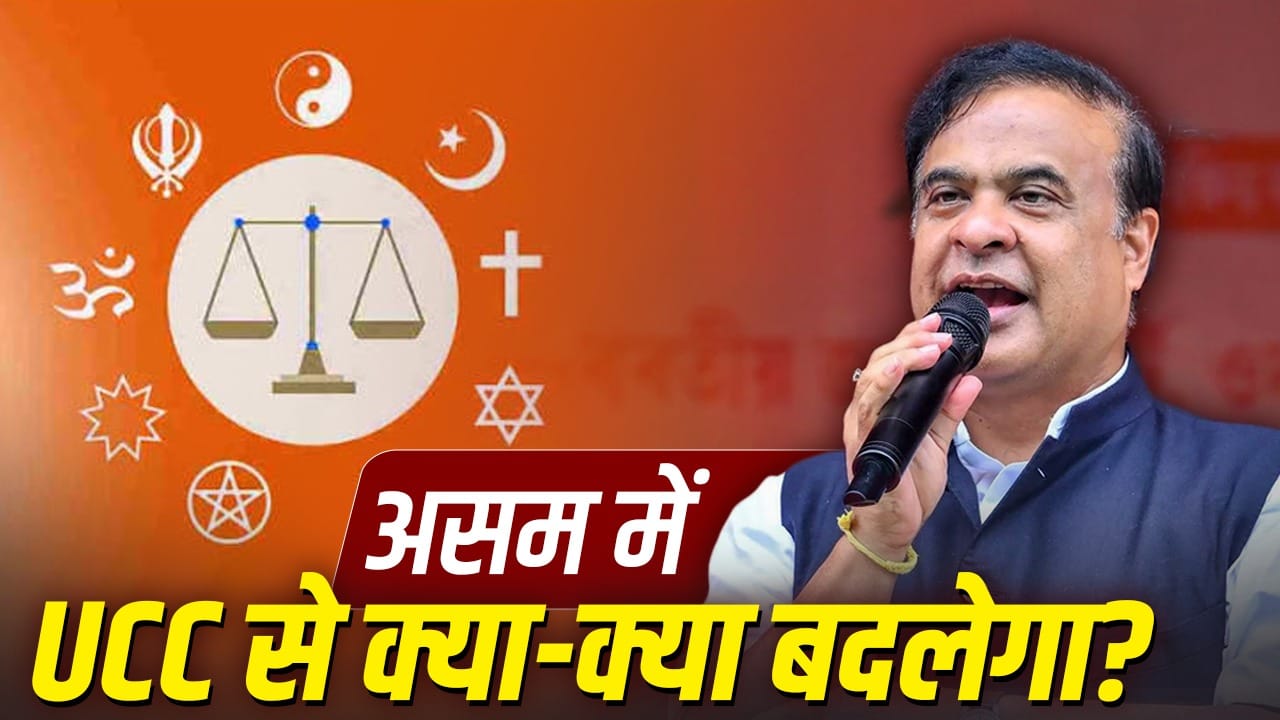
Assam government has introduced UCC bill in the assembly.
The new BJP government of Assam has decided to implement Uniform Civil Code in the state. In this way, Assam is preparing to become the third state after Uttarakhand and Gujarat, which has implemented UCC. The objective of all the three states is the same, but there are slight differences in the provisions made in the bill by the three states. Let us try to understand in the context of Assam how different this bill is from Uttarakhand and Gujarat? What is the difference between the three?
Uniform Civil Code is a proposed law in India that will bring personal matters like marriage, divorce, inheritance and adoption under uniform rules for all citizens, irrespective of their religion. Article 44 of the Indian Constitution directs the states to ensure a uniform civil code for their citizens. In recent years, many states have taken steps in this direction. Uttarakhand is the first state, which has implemented it. After that Gujarat and now Assam have also taken steps in this direction. It is to be expected that other BJP ruled states will also consider implementing this law.
Assam: Uniform Civil Code Bill, 2026
Assam has become the third state after Uttarakhand and Gujarat to introduce UCC bill. The purpose of this bill is also to bring reform and uniformity in personal laws. The Assam government approved the draft of the UCC bill this month on May 13, 2026. It was introduced in the state assembly on May 25, 2026.The main provisions of this bill are as follows.
- Marriage: The minimum age for marriage is 18 years for girls and 21 years for boys. A strict ban on polygamy is proposed, violation of which can lead to imprisonment of up to 7 years under the Indian Justice Code, 2023. Registration of all marriages and divorces within 60 days is mandatory.

- Divorce: Same grounds proposed for divorce
- Live-in Relationship: Registration of live-in relationships will be mandatory within a month. Failure to register can result in imprisonment of up to three months or a fine of Rs 10,000.
- Inheritance (property): Gender-equal rules for distribution of property are proposed, in which spouse, children and parents will have equal rights as Class-1 heirs.
- Legal changes: This bill will repeal the Assam Muslim Marriage and Divorce Registration Act, 2024. However, there is a saving clause in the bill, which provides legal protection to polygamous marriages that took place before the enactment of this law.
- special discount: Like Uttarakhand, Assam’s bill also completely excludes all the Scheduled Tribes of both the hill and plain areas of the state from its scope.
Uttarakhand: Uniform Civil Code Act, 2024
Uttarakhand is the first state in independent India to implement UCC as a law. This law is applicable to all residents of the state. It has been implemented in the entire state from January 27, 2025. The state government had constituted an expert committee under the chairmanship of former Supreme Court judge (retired) Ranjana Prakash Desai. The committee submitted its report on February 2, 2024. The bill was passed in the state assembly on February 7, 2024.
- Marriage: For all religions, the marriageable age for girls has been fixed at 18 years and for boys at 21 years. Polygamy has been completely banned. Registration of marriage is mandatory.
- Divorce: Same grounds have been fixed for divorce for all. No marriage can be dissolved without the order of the court. Practices like Triple Talaq, Nikah-Halala and Iddat have been banned and made punishable offences.

- Live-in Relationship: It is mandatory for live-in couples to register within a month. Failure to register can result in imprisonment of up to three months or a fine of Rs 10,000. Children born from such relationships have been given legal validity and the female partner has been given the right to maintenance.
- Inheritance (property): Sons and daughters have been given equal rights in ancestral and self-acquired property. This rule also applies to adopted and children born through surrogacy.
- special discount: The provisions of this law do not apply to members of the Scheduled Tribes, in order to protect their traditional practices and customs.
Gujarat: Uniform Civil Code Initiative
Gujarat has also decided to implement UCC. It has adopted the Uttarakhand model with very minor modifications. Gujarat government had constituted a committee for this. As soon as the report was received, this bill was introduced in the Legislative Assembly and it was passed in March 2026. Its implementation is underway but the draft shows that Gujarat’s UCC law is expected to be largely similar to the Uttarakhand law, with similar rules for marriage, divorce, inheritance and live-in relationships.

Live-in relationship.
What is common in the laws of the three states?
- A common goal: The main objective of the three states is to promote gender justice and equality by streamlining personal laws.
- Main improvements: Banning polygamy, equal age for marriage, and mandatory registration of marriages and divorces are central to the trio’s vision.
- Regulation of live-in relationships: All three states are bringing live-in relationships within the legal ambit so that children and women born from such relationships can get legal protection.
- Tribal Exemption: One of the most significant similarities is that all three states have respected the unique cultural and traditional practices of their tribal populations and kept them outside the scope of the UCC.
A proud and historic moment for Assam.
Tabled on the floor of the Assembly today, the UCC Bill secures equal rights, uncompromising justice and uniform protection for all citizens.
Fulfilling the legacy of our founding architects, this landmark legislation marks an pic.twitter.com/1zhxdi9nKa
— MANAB DEKA (@manabdeka) May 25, 2026
Here are some of the main differences
- Implementation phase: Uttarakhand has implemented the law, while Assam and Gujarat are still in the process.
- Specific legal context: Assam’s bill specifically repeals the Assam Muslim Marriage and Divorce Registration Act, 2024, as part of its state-specific legal reforms.
- Development of live-in rules: Uttarakhand has revised its live-in rules following a legal challenge and public debate, making it more sensitive to privacy. Assam’s bill initially appears to have stringent provisions.
- Saving Clause: A unique aspect of the Assam bill is the provision to provide legal protection to polygamous marriages that existed before the enactment of the UCC, which is not explicitly mentioned in the Uttarakhand law.
The steps taken towards Uniform Civil Code by Assam, Uttarakhand and Gujarat signal a new chapter of personal law reforms in India. The basic premise of these initiatives is gender equality, legal uniformity and social reform. Although there is considerable similarity in the approach of the three states, particularly in terms of the ban on polygamy and exemptions for tribal communities, some subtle differences exist, reflecting their local socio-legal contexts.
Also read: Why is China the largest buyer of Indian chilli? Know 5 big reasons