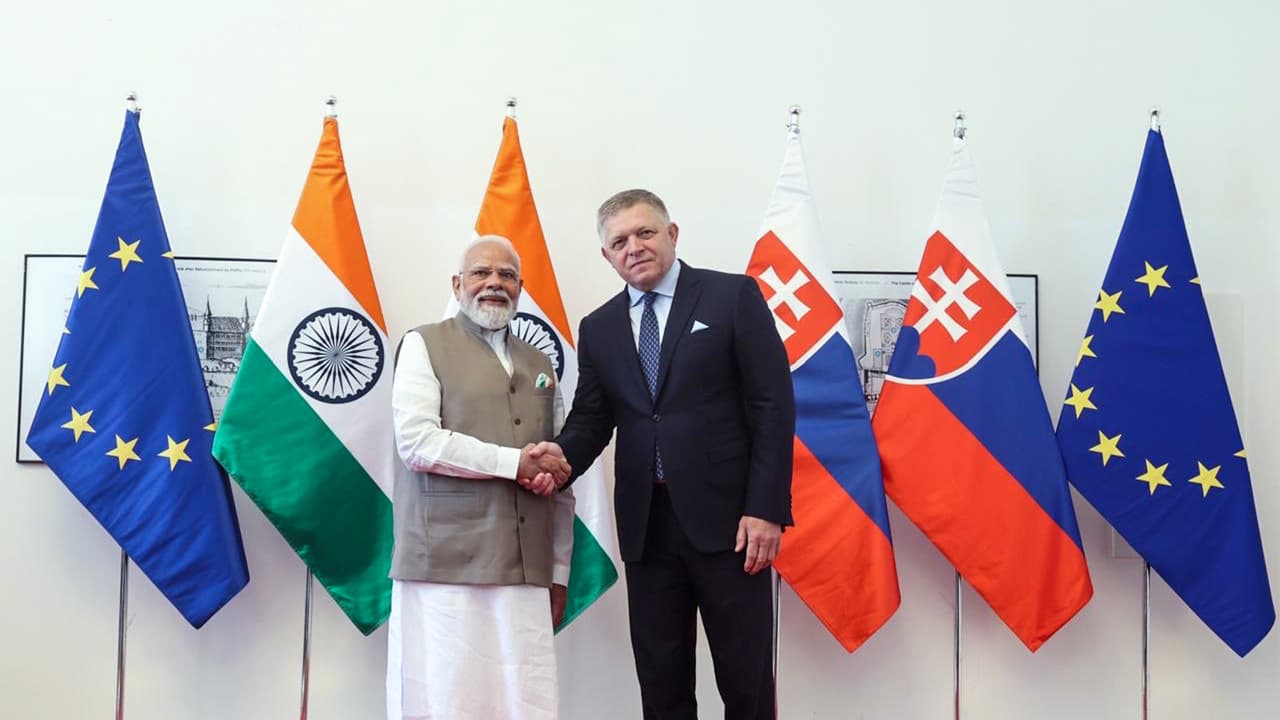
India and Slovakia signed multiple MoUs covering education, research, talent mobility, and technology during PM Modi’s visit to Bratislava. The agreements aim to facilitate legal labour migration and bolster academic and cultural partnerships.
India and Slovakia on Monday signed a series of Memoranda of Understanding (MoU) in the field of education, research, talent mobility, and technology. The agreements were formalised in a Joint Statement issued during Prime Minister Narendra Modi’s state visit to Bratislava, following delegation-level talks with Slovak Prime Minister Robert Fico. The initiatives heavily focus on talent mobility, professional safety, and institutional partnerships across the higher education and cultural sectors.
Strengthening Labour Mobility
The two leaders signed a Memorandum of Understanding (MoU) on Cooperation in the Field of Labour Migration. The agreement is designed to facilitate the orderly, safe, and legal movement of workers while streamlining information exchange between respective regulatory authorities.
“The leaders expressed support for the orderly, safe and legal mobility of skilled professionals. They took note of the Comprehensive Framework of Cooperation on Mobility agreed between India and the European Union in January 2026. They welcomed the signing of the Memorandum of Understanding on Cooperation in the Field of Labour Migration to facilitate mobility and promote the exchange of information between the relevant authorities of India and Slovakia,” the statement read.
To complement the new labour corridor, both sides have committed to the early conclusion of a Social Security Agreement, “which would contribute to safeguarding the welfare and social protection of working professionals engaged in mobility between India and Slovakia.”
Boosting Cultural and People-to-People Ties
To bolster soft-power connectivity, New Delhi and Bratislava also moved to enhance tourism and artistic collaborations, highlighted by the signing of an MoU on Audio-visual Creation, which the statement said will provide “a structured framework for collaboration in film and media production and further enhance cultural connectivity between the two countries.”
“The leaders agreed to further promote cultural exchanges, tourism and people-to-people contacts with a view to deepening mutual understanding and strengthening the bonds of friendship between the peoples of India and Slovakia. They emphasised the importance of expanding cultural cooperation through regular exchanges of artists and cultural troupes, the organisation of exhibitions and participation in festivals, as well as by encouraging greater tourism flows in both directions,” the statement read.
Deepening Academic and Research Collaboration
Deepening their academic footprint, the two nations also executed a separate MoU on Higher Education and Research. The pact provides a new structural foundation for student, researcher, and faculty exchanges, placing a strong emphasis on Science, Technology, Engineering, and Mathematics (STEM) alongside the humanities.
“The two sides also welcomed the conclusion of a Memorandum of Understanding between the respective Ministries of Education in the field of higher education and research, which would provide a structured framework for strengthening academic linkages and fostering long-term institutional partnerships,” the statement read.
“The two leaders agreed to encourage enhanced mobility of students, academics and researchers, with particular emphasis on STEM and humanities disciplines, in order to promote deeper educational and scientific exchanges. They took note of the existing arrangements and collaborations between higher education institutions of the two countries and encouraged their further expansion and diversification,” it added.
Prime Minister Narendra Modi, while announcing the MoU, said that the agreements will help enhance the mobility of professionals and skilled workers, lauding it as a step towards “close coordination” on the global platform. (ANI)
(Except for the headline, this story has not been edited by Asianet Newsable English staff and is published from a syndicated feed.)