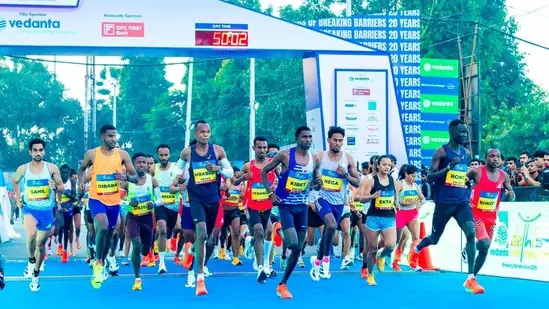
More than 41,000 people ran the Vedanta Delhi Half Marathon on October 18, up from 39,513 last year. Mumbai took a record 69,100 entries in January.
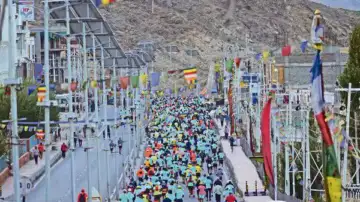
Ahmedabad’s field tripled from 8,000 in 2017 to over 24,000 in 2025. Even the Ladakh marathon, which arguably offers the most demanding course, saw 477 ultra runners participate in the 122-km Silk Route Ultra and the 72-km Khardung La Challenge this year.
It is clear that marathons have established an undeniable pull. Fitness is increasingly becoming a lifestyle choice in India, and the growing popularity of running encapsulates this shift. KPMG’s Sportlight report (September 2025) says marathons and running clubs have “exploded in popularity”. Sponsors have followed the boom like the north star.
India hosts 1,200+ running events annually, with flagship events in Mumbai, Delhi, and Bengaluru, creating an annual local business impact of INR 200-250 crore through hotels, travel, F&B, and retail. Procam International co-founder and joint managing director Vivek Singh estimates running sponsorship in India at about INR 800 crore, roughly 4% of the INR 18,525 crore (USD1.95 billion) sports sponsorship market in KPMG’s latest estimate.
The brand mix supporting marathons now runs well beyond sportswear and hydration to banks, airlines, hotels and batteries. The appeal is access: a marathon puts a brand in front of consumers as participants, not spectators. The appeal is access: a marathon puts a brand in front of consumers as participants, not spectators.
It was never an easy sell. Two decades ago, when Procam first took the idea to brands, Singh said, “people looked at us like we were dreamers from another planet”. The reaction, he recalled, was: “Why on earth would ordinary Indians pay money to run on asphalt at 5:30 in the morning?”
Today, brands pay to be on that asphalt.
From ‘favour’ to strategic marketing platform
The first backers of the marathon came on board through goodwill, personal relationships or corporate social responsibility initiatives. Around 2010, corporate leaders saw marathon running become more than just a hobby.
Three of India’s big races have roughly tripled their fields
Participants per edition at the Tata Mumbai Marathon, Tata Steel World 25K Kolkata and Adani Ahmedabad Marathon
3.1×Mumbai20,855 (2004) → 65,424 (2026)
3.4×Kolkata6,588 (2014) → 22,705 (2025)
3.0×Ahmedabad8,000 (2017) → 24,000+ (2025)
Latest edition, participants
Mumbai2026, on-ground65,424
Delhi Half2026, reported41,000+
Ahmedabad202524,000+
Kolkata 25K202522,705
How each race grew
Tata Mumbai Marathon on-ground participants, 2004-2026 (no figures for 2021-22)
20,855
55,322
65,424
’04’05’06’07’08’09’10’11’12’13’14’15’16’17’18’19’20’23’24’25’26
Tata Steel World 25K Kolkata 2014-2025 (no figures for 2020-21)
6,588
22,705
’14’15’16’17’18’19’22’23’24’25
Adani Ahmedabad Marathon 2017-2025
8,000
4,500
22,500
24,000+
’17’18’19’20’21’22’23’24’25
Ahmedabad’s 2020 edition (lighter bar) was a remote run, and 2024 dipped from 2023. Mumbai’s record 69,100 registered entries in January 2026 is an entries count; the chart shows on-ground participants. Delhi’s 2025 field was 39,513.
Source: Procam International (Mumbai, Kolkata); Adani Sportsline (Ahmedabad); Delhi 2026 (blue bar) is the reported turnout, not a Procam on-ground count. Growth multiples cover different spans (22, 11 and 8 years).
“Once brand custodians saw that their most coveted, high-income consumers were waking up at dawn to run 15 kilometres, the boardroom pitch changed completely. It went from asking for a favour to building a strategic marketing platform,” Singh said.
Ahmedabad, which entered the circuit in 2017, had a similar sponsorship journey. It was launched with the initial objective of testing the market — establishing marathons as a participatory sport and building a community around it. That has since changed.
“Brands today are looking beyond visibility to meaningful consumer engagement, opportunities to experience their products and a credible association with communities and causes,” said Sanjay Adesara, chief business officer of Adani Sportsline.
For Chewang Motup Goba, founder of the Ladakh Marathon and chairperson of the High Altitude Sports Foundation, the journey was considerably more challenging.
Few corporate sponsors were willing to back a marathon at an altitude of around 3,500 metres, let alone a 72-km ultra-marathon across the Khardung La region. When Goba started out in 2012, corporate interest was “virtually non-existent” and it was only in 2024 that registrations first enabled the event to break even.
 The sponsor’s playbook
Brands get involved with racers well before the marathon begins. Runners make multiple decisions during their preparation, selecting smartwatches, buying footwear, taking electrolytes, refining nutrition and leaning on recovery services daily. These habits create sustained opportunities for brands to engage with consumers who are already invested in their products and the wider running ecosystem. The race day, as Vivek put it, is “the finale,” where the touchpoints are physical.
Amaron took its first step into participatory sports at this year’s TCS World 10K Bengaluru in April. At the Vedanta Delhi Half Marathon, it set up kinetic floor tiles that turned footfalls into stored electricity for a lighting display.
Other partnerships address more immediate participant needs. Bajaj Allianz brought in mandatory insurance coverage for all Ladakh Marathon participants, given the high altitude of the race, where the oxygen levels drop.
Vedanta Delhi Half Marathon sponsor Air India Express had announced up to 20% savings on flights, ₹5,000 flight voucher giveaways and opportunities to enrol in the Maharaja Club loyalty programme for all participants.
Bisleri, associated with over 20 major marathons in India, including Procam events, Ahmedabad and Ladakh, brings in an intrinsic factor associated with running. In 2024, Puma India partnered with dating app Bumble for a singles-only running event in Bengaluru, blending fitness with social connection. In 2025, Nike turned the Mumbai Marathon into an Out-Of-Home (OOH) campaign through messages on hoardings, building camaraderie between the runners and the brand.
Sponsorship returns are, however, not measured through consumer reach or on-ground activations. For Meena Bhatia, Vice President & General Manager, Le Meridien New Delhi, the greater value lies in seeing colleagues unite around a shared purpose. “It is a return no number can fully capture, and it is the one we value most,” she said.
Running is a small slice of India’s sports money
Where marathon sponsorship sits against the sports economy and cricket
₹1.99 lakh crIndia’s sports economy, 2025-26About US$21 billion, growing 12-14% a year75-80%Cricket’s share of that economyThe rest is split across every other sport ₹18,525 crSports sponsorship marketUS$1.95 billion, 2024 ₹800 crRunning sponsorshipVivek Singh’s estimate: about 4% of the sponsorship market
Cricket versus everything else, share of sports economy
Cricket 75-80%Other
Cricket (midpoint shown)All other sports
Running sponsorship inside the sponsorship market
All sports sponsorship, ₹18,525 cr
Running, ₹800 cr (4.3%)
What one race adds up to: Procam’s socio-economic impact
Mumbai2026 ₹663.22 cr
Delhi Half2025 ₹433.88 cr
Bengaluru 10K2025 ₹262.43 cr
Tata Mumbai Marathon impact, rupees crore
2020 ₹202.78 cr
2023 ₹290.08 cr
2024 ₹367 cr
2025 ₹530.59 cr
2026 ₹663.22 cr
Of Mumbai’s ₹663.22 crore in 2026, ₹602.54 crore is health and economic impact and ₹60.68 crore is social impact.
Source: KPMG, Strengthening India’s Sports Ecosystem (Oct 2026) for the economy, cricket and sponsorship figures; running sponsorship is Singh’s estimate, not confirmed by another source, and the two figures are not measured the same way. Impact figures are supplied by Procam and are not independently verified.
Measuring ROI
Measuring the return on investment (ROI) of marathon sponsorship remains a challenge. Indranil Das Blah, founder of AMP Sports & Entertainment, reckons participation rate shows how valuable a platform is.
Adesara said he evaluates partnerships against each brand’s goals, including participation scale and profile, on-the-ground engagement, brand integration, digital reach, and opportunities to interact with runners.
With no metric available, the challenge for organisers remains to translate these different objectives into measurable outcomes without reducing the value of the association to impressions alone.
Long-term bets
The way sponsors structure the deal also speaks volumes about the confidence they place in the property.
For example, Bisleri, which partnered with Procam in 2017 and has committed until 2031, believes sports marketing “is not a one-off exercise, but a long-term investment in building relevance, recognition and trust”.
Certain deals went on to become synonymous with the race itself, like Standard Chartered, who served as the Mumbai marathon’s title sponsor from 2004 to 2017.
“Given the scale of these events, you will usually find big-ticket brands sponsoring them. Take the Delhi Half Marathon, which was sponsored by Airtel for a long time before Vedanta came on board. TCS is another example. It has a global mandate and sponsors the Boston Marathon, one of the world’s leading marathons,” Blah said.
Multi-year deals also work well for associating with runners. However, not every brand, is ready to make that commitment from the outset.
Amaron is evaluating its participation on a year-to-year basis for now. “We’ve treated this season as our learning year,” Dhawan said. “Each city is teaching us something about what runners respond to, and what our own people and partners get out of it. That will shape what a longer commitment looks like.”
At Ahmedabad, Adesara says all existing sponsors have partnerships of at least three years. Bisleri and BMW Gallops Autohaus have both signed multi-year deals there. Reebok is new this year, and Axis Bank joined last year.
However, the Ahmedabad model differs from Procam. Adani Sportsline is both organiser and title sponsor of the Ahmedabad race, which started in 2017. The event, which now has a place on the World Athletics calendar and will be hosting its 10th edition next month, sees this as an advantage, “because we have a long-term stake in building the property,” said Adesara. However, he understands that for the event to grow as a property, it has to look beyond its own group.
How does it compare to cricket?
KPMG’s report, Strengthening India’s Sports Ecosystem, published in October 2026, estimates the sports economy at ₹1.99 lakh crore (approximately US$21 billion) in 2025-26, with annual growth of 12-14%. Cricket continues to command an estimated 75-80% share of the market.
The report also puts the overall sports sponsorship market at US$1.95 billion, or ₹18,525 crore. Singh has estimated the value of running sponsorship at around ₹800 crore, equivalent to nearly 5% of the overall sponsorship market.
Despite the disparity in scale, Blah rejects the idea that marathon sponsorship has fallen short of its potential. Comparing it with cricket, he argues, is a case of “apples and oranges”.
Cricket is a media-driven property, with the high entry cost posing as a barrier for many, while benefiting those who want a national audience. Marathon is about the community. Amaron, which has more recently gained exposure in cricket through its partnerships with IPL franchises Kolkata Knight Riders and Delhi Capitals during the 2026 season, outlined the difference more clearly.
“Cricket gives us reach. Amaron is on the back of the batting helmet, and millions of people see it. Running gave us something cricket can’t: people taking part with us,” said Dhawan.
Blah identified another advantage: the ability to cut through the clutter. Viewers may struggle to recall brands associated with the current Indian team series. At a marathon, the opportunity to interact directly with participants can help sponsors establish more distinctive associations and stronger emotional connections.
Most believe, more brands will prefer long-term associations. However, since the return on these deals is still unknown, marathon sponsorship will stay what it is today: a bet that runners will remember who stood beside them at the finish line.