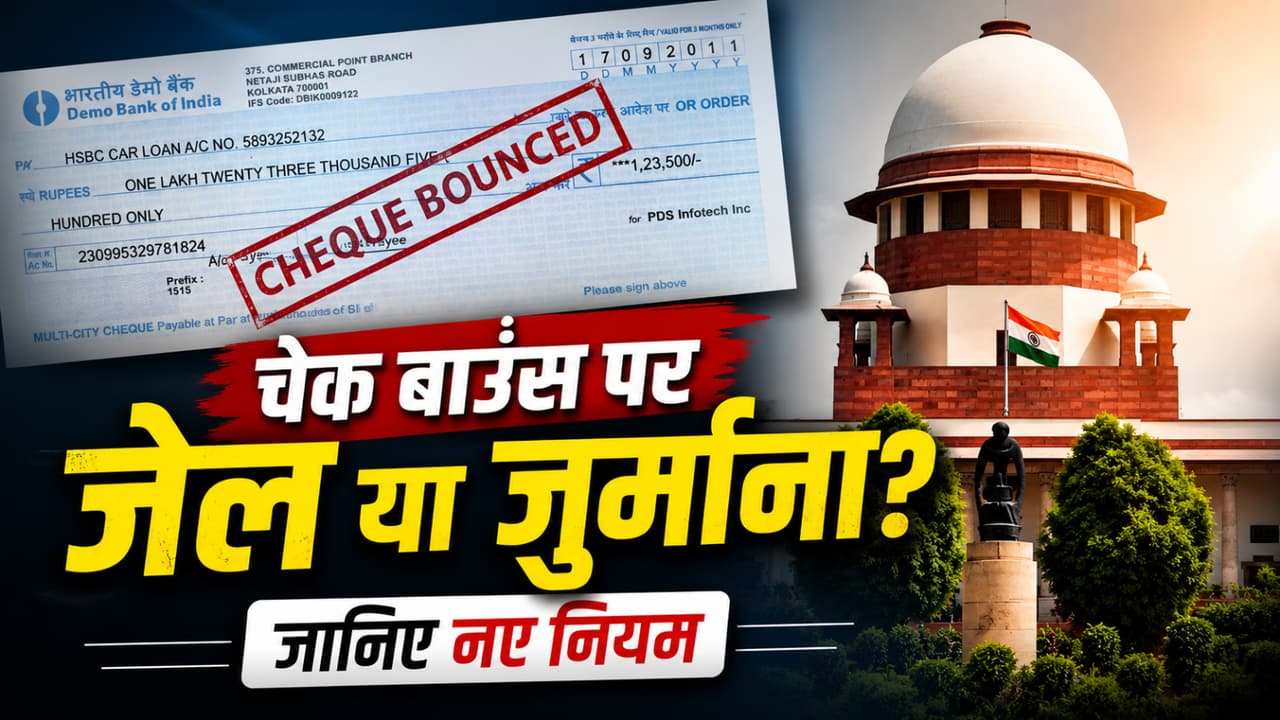
Check Bounce Rules in India: Within how many days does a legal notice have to be sent to the complainant after the check bounces? What is the maximum punishment that can be imposed in a check bounce case under Section 138 of the Negotiable Instruments Act? According to the Supreme Court, in which court will the check bounce case be filed now?
Check Bounce New Rules: India is rapidly moving towards digital payments. UPI, net banking and digital wallets have changed the way transactions are done. Despite this, when it comes to large business deals, property buying and selling or business payments, checks still remain an important medium of trust.
However, as easy as it seems to use cheques, the legal rules related to it are equally strict. If the check issued does not clear the bank, it can lead not only to financial trouble but also to legal action. This is why courts take check bounce cases seriously and constant emphasis is being laid on their quick disposal.
Also read: How many times more than the annual salary of an IAS does Khan Sir earn?
What is check bounce?
If we understand in simple language, when a check issued by any person or organization is not cleared when presented in the bank, then it is called check bounce. There can be many reasons behind this-
- insufficient funds in account
- Signature mismatch
- bank account closure
- Instructions to stop payment (Stop Payment)
- technical or banking errors
In such a situation, the person issuing the check may have to face legal notice and court proceedings.
Under which law is the case registered?
In India, cases related to check bounce are mainly dealt with under Section 138 of the Negotiable Instruments Act, 1881. The objective of this law is to maintain trust in financial transactions and provide legal protection to payments made through cheques.
What is the legal process after a check bounces?
After a check bounces, it is necessary to follow certain legal procedures.
Step 1: Bank Return Memo
When a check is not cleared, the bank issues a Check Return Memo, in which the reason for dishonor is recorded.
Step 2: Legal notice
The person receiving the check has to send a legal notice to the person issuing the check within 30 days after receiving the return memo from the bank.
Step Three: Payment Opportunity
After receiving the notice, the accused is given 15 days to pay the outstanding amount.
Step 4: Complaint to the court
If payment is not made within 15 days, the complainant can file a case in the court. According to legal experts, if the prescribed deadline is not followed, the case may become weak.
What is the punishment for check bounce?
On being found guilty under section 138, the court will punish the accused-
- Jail up to two years,
- Fine up to double the check amount,
- Or both punishments can be given together.
However, in many cases, if the accused makes the payment on time and both parties reach a settlement, the court may end the case. But the court can take a strict stance in cases of non-payment despite repeated notices.
What changed after BNS?
The Indian Justice Code (BNS), effective from July 1, 2024, has implemented many new provisions regarding crimes related to fraud and forgery.
If the investigation proves that there was an intention to cheat or forgery while issuing the cheque, then the provisions of Section 318 and 319 of BNS may also apply. In such a situation, the accused may have to face jail up to 7 years and fine.
What important instructions has the Supreme Court given?
In view of the increasing check bounce cases in the country, the Supreme Court has issued many important guidelines.
- Jurisdiction dispute over: Now the check bounce case will be filed in the same court where the complainant’s bank account is located. This has made the process of lawsuits more clear.
- Interim Compensation: The court may direct the accused to deposit interim compensation up to 20 percent of the check amount during the trial.
- Amount to be deposited on appeal: If the accused appeals against the decision of the lower court, it will be mandatory for him to deposit at least 20 percent of the fine or check amount in the court.
- ‘Stop payment’ can also become a crime: The Supreme Court has made it clear that if despite sufficient money in the account, the bank is instructed to stop payment with the intention of fraud, then this can also be considered a legal offence.
- Emphasis on speedy disposal of cases: Courts have been directed to speed up trials on the basis of affidavits and documentary evidence of witnesses so that the number of cases pending for years can be reduced.
What may change in the future?
Experts believe that the scope of digital payments will increase further in the coming years, due to which the dependence on checks can gradually reduce. Nevertheless, the role of check remains important in big business deals and formal transactions. In such a situation, both the government and the judiciary are trying to ensure that check bounce related cases are resolved quickly and business confidence is maintained. Systems like online hearing, e-summons and digital records are being considered important steps taken in this direction.
Also read: What happened to Mohammed Siraj? Everyone was surprised to see the T20 avatar in the test match!