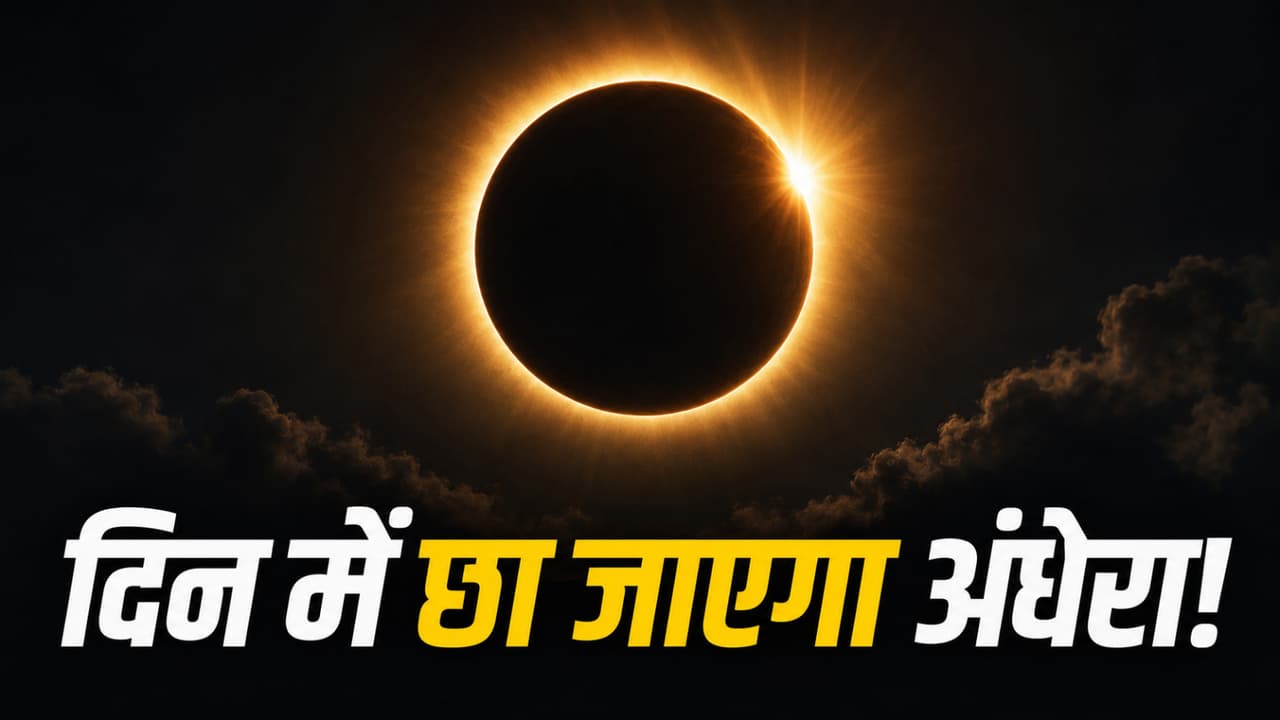
Total Solar Eclipse 2026: When will the Total Solar Eclipse 2026 occur and in which countries will it be completely visible? According to NASA, why is it considered dangerous to view the solar eclipse with naked eyes? Why is the solar eclipse of August 12, 2026 being considered so special as compared to previous years?
Total Solar Eclipse: A big news has come for those interested in space and astronomy. After a wait of more than two years, the world is once again going to witness a rare Total Solar Eclipse. On August 12, 2026, the Moon will come between the Earth and the Sun while rotating in its orbit, due to which the Sun will be completely covered in some areas and there will be darkness for a few minutes during the day.
American space agency NASA and European Space Agency (ESA) have confirmed this astronomical event. Scientists believe that this will be one of the most important astronomical events of 2026.
Also read: What happened to Mohammed Siraj? Everyone was surprised to see the T20 avatar in the test match!
What is total solar eclipse?
According to NASA, a total solar eclipse occurs when the Moon comes exactly between the Earth and the Sun and its shadow falls completely on some part of the Earth. During this time the sun stops being visible completely and the day sky becomes as dark as night for some time. This phenomenon is visible in full form only from a limited part of the Earth, while the rest of the areas see a partial solar eclipse.
From which countries will the total solar eclipse be visible?
This time the most attractive part of the eclipse i.e. “totality” will be visible from some selected areas.
- Greenland: People living in Greenland will have the opportunity to see a total solar eclipse for the longest period. Here the sun will be completely covered for more than two minutes.
- Iceland: This rare sight will be seen in many parts of Iceland. This is being considered an important occasion for astronomy lovers.
- Spain: The total solar eclipse will be visible for about 20 seconds in the northern part of Spain. Interestingly, such a total solar eclipse was last seen in mainland Spain in the year 1905.
- Portugal: This rare astronomical phenomenon can also be seen from some areas of North-Eastern Portugal.
In which parts of the world will the partial solar eclipse be visible?
Although the total solar eclipse will be visible in limited areas, a partial solar eclipse will be visible in large parts of Europe, Africa and North America. In these regions the Moon will cover only a portion of the Sun, causing the Sun’s shape to appear partially cropped. According to experts, the last total solar eclipse in mainland Europe was visible in the year 2006. In such a situation, this eclipse of 2026 has special importance for Europe.
What precautions should be taken while watching solar eclipse?
NASA and scientists have issued a strict warning regarding viewing the solar eclipse. Viewing the eclipse in the wrong way can cause permanent damage to the eyes.
- Do not look directly at the sun: Looking directly at the sun can be dangerous without special safety equipment. This can cause permanent damage to the retina of the eyes.
- Use only certified Eclipse Glasses: To view the solar eclipse, use only international standards Solar Eclipse Glasses or certified solar filters.
- Normal sunglasses are not enough: According to NASA, normal sunglasses are not safe for viewing the solar eclipse. They are not able to completely block harmful rays.
- Do not use damaged or scratched glasses: If the eclipse viewing glasses have scratches, cracks or any damage then they should not be used.
Be careful with cameras and binoculars
NASA has warned that one should not try to view the Sun with a camera, binoculars or telescope without a special solar filter. Lenses can cause serious damage to the eyes by focusing sunlight.
Why is the total solar eclipse of 2026 special?
- Major total solar eclipse visible after more than two years.
- Totality in Greenland by more than two minutes.
- Rare sight in Spain after 121 years.
- Partial eclipse over large parts of Europe, Africa and North America.
- Astronomical event specially monitored by NASA and ESA.
The total solar eclipse of August 12, 2026 will not be just an astronomical event, but a wonderful confluence of science and nature. Millions of people around the world are excited to see this rare sight. However, it is extremely important to follow safety rules while enjoying this exciting experience. Scientists say that a solar eclipse viewed with the right equipment can be an experience to be remembered for a lifetime.
Also read: Check Bounce New Rules: If the check bounces, you may be in big trouble! Know the new rules