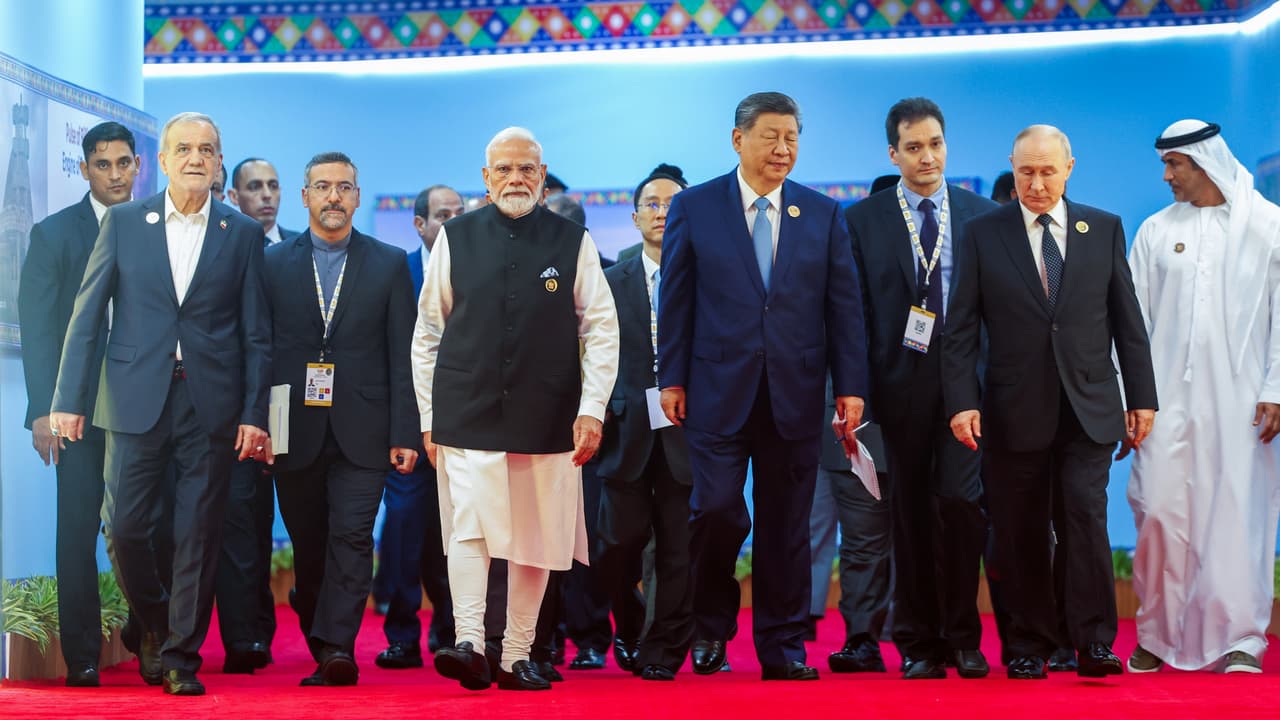
As BRICS expands to include nations like Egypt, Ethiopia, Iran, and the UAE, internal disputes over resources, maritime boundaries, and regional proxy conflicts inevitably increase. However, the bloc’s strength relies on pragmatic diplomacy, allowing member countries to compartmentalize geopolitical disagreements.
By Ann Elsa Monica
New Delhi: BRICS brings together some of the world’s biggest emerging economies. However, behind the meetings on trade, investment and development between these nations lie some very complex relationships with one another. BRICS is composed of 11 member states – Brazil, Russia, India, China, South Africa, Egypt, Ethiopia, Iran, Saudi Arabia, UAE, and Indonesia. While the inclusion of new members has increased its economic importance, it has added many disputes and conflicting interests among the member nations.
BRICS and India-China Diplomacy
India-China is perhaps the most obvious example of such relationship. The two countries not only have unresolved disputes on borders, but also were at war in 1962. Moreover, there were confrontations between their troops in Galwan Valley back in 2020. Simultaneously, both the nations are competing for influence in Asia and developing world. Yet, the two nations are taking part in the BRICS discussions and are cooperating in various spheres of mutual interest like trade, development, and institutional reform.
The West Asia Conflict
The same can be observed in West Asia, where the rivalry between Iran and Saudi Arabia has been going on for many years. It is determined by ideological factors (Sunni-Shia Conflict), but has also been demonstrated by countries’ confrontations within other states. Yemen is considered one of the best examples. On the one side, Iran has been backing the Houthis. At the same time, Saudi Arabia has been backing the Yemeni government recognized internationally. Therefore, Yemen has become one of the most crucial areas of clash for these two countries. The Syrian civil war can be considered yet another example where the rivalry of the two countries made them participants of the war. Iran backed the government of Bashar al-Assad, providing it with military, financial and political support. At the same time, Saudi Arabia backed the groups opposing Assad. The Syrian civil war is another case when the rivalry of the two countries led to the proxy conflict. Iran had supported the government of Bashar al-Assad and supplied it with military, and financial support. Whereas, Saudi Arabia supported the opposition groups that opposed Assad.
Economies and Resources
Political and security challenges in the relation of Iran and the UAE are also very similar. The matter was aggravated by the recent conflict related to Iran because of the impact of attacks by Iran on Gulf countries. Nevertheless, Iran and the UAE are still members of BRICS and they share common economic interests that make them negotiate and deliberate at the same table. There is another dispute between Egypt and Ethiopia regarding the Great Ethiopian Renaissance Dam . Ethiopia claims that building the dam is crucial for developing its energy sector. However, Egypt claims that the construction is threatening its water resources that are provided by the Nile.
The BRICS Paradox
This means that there are countries that do not share the same national interests. There are several areas where there are tensions between BRICS countries. China and Indonesia have disagreements over maritime claims in the South China Sea. The countries have had a different stand with regard to several international issues such as the Ukraine-Russia war and Iran issues. This means that it is not easy for BRICS to adopt a similar position regarding geopolitical issues. Disagreement about Iran crisis has again revealed the weakness of political unity. However, It is clear that political unity is not what BRICS seeks. In contrast to a military alliance, it does not need to help each other in all the cases of conflicts. It serves as a platform for collaboration of states whose interests coincide in certain issues, particularly in economics.
The growth of BRICS has brought additional challenges to this balancing act. As the number of members increases, the number of disputes increases as well as the number of markets, resources and economic interests. So, in the case of BRICS, it is more important whether its members are able to prevent their mutual disagreements from influencing cooperation than how much they agree on some issues. Those very states which could have conflicts or disagreements with each other beyond the organization cooperate within it not because there were no disagreements at all, but due to enough coinciding interests.