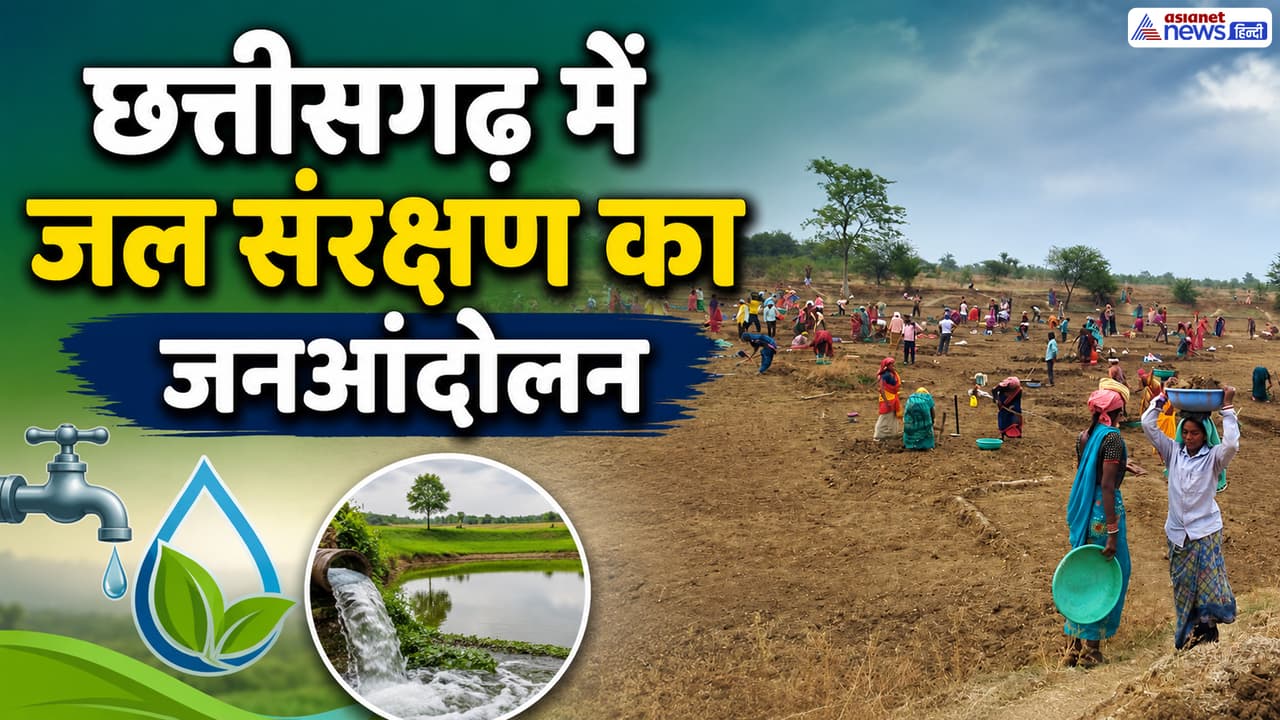
Chhattisgarh News: Has Chhattisgarh’s ‘Mor Gaon-Mor Paani’ campaign become a new model for the country? How are 11 lakh people getting employment? Why is 57% women participation in discussion? How much will 1 lakh water structures change the future of villages? Will water conservation increase rural income? Know the whole story.
Raipur. In the era of climate change and ever-increasing water crisis, Chhattisgarh has set a new example of development by linking water conservation with public participation. Water conservation, employment generation and livelihood promotion are being simultaneously promoted under the Mahatma Gandhi National Rural Employment Guarantee Scheme (MNREGA) through the ‘Mor Gaon-Mor Paani’ campaign launched from 24 April 2025.
Under this campaign, more than one lakh permanent water conservation and promotion assets are being created across the state at a cost of approximately Rs 1,610 crore. On one hand, these works are strengthening water security, while on the other hand, more than 11 lakh rural workers are also getting employment every day. The noteworthy thing is that about 57 percent of these are women. In this way, this model of water conservation and women empowerment is giving a new direction to rural development.
Income of villagers increasing due to water conservation
The state government has not limited water conservation to mere environmental necessity but has also linked it to rural livelihoods. In this direction, construction of 13,065 livelihood stalls on private land of weaker and sensitive sections of the society has been completed.
Through these Dabris, additional income opportunities are being provided to rural families, especially women, by connecting them with fishing, horticulture and other income generating activities. This is promoting water conservation as well as economic empowerment.
624 community ponds are being built under ‘Nava Tariya-Means of Income’ scheme.
To strengthen water conservation at the community level, 624 community ponds are being developed under the ‘Nava Tariya-Aay ke Zaria’ initiative. Women of self-help groups are being connected to these water structures, so that they get long-term livelihood opportunities. This initiative is becoming an effective medium to link water conservation with rural economy and employment generation.
Water harvesting systems installed in more than 1.5 lakh rural houses
Under the campaign, other water conservation works are also being done with wide public participation. In more than 1.50 lakh houses constructed under the Pradhan Mantri Awas Gramin Yojana, the beneficiaries have installed water harvesting systems at their own expense. This initiative not only promotes rain water harvesting but also shows people’s awareness and responsibility towards water conservation.
Water conservation gets new strength from modern technology
Key features of the ‘Mor Gaon-Mor Paani’ campaign include the use of modern technologies. For better planning and quality implementation of water conservation works, GIS based stream planning, site selection through CLART app and watershed principles are being used. With the help of these technologies, water structures are being constructed in a more scientific and effective manner.
Monitoring of ground water level through Jaldoot system
Jaldoot system has been implemented for regular monitoring of ground water level in the state. Through this, the water level of open wells is being measured from time to time. Apart from this, ground water level information is being recorded on the walls of Gram Panchayat buildings, which is helping in preparing water budget at the local level and making water management more effective.
Technology based system to increase transparency
To ensure transparency in MNREGA works, the state government has implemented several technology-based innovations. QR codes have been installed in every Gram Panchayat, with the help of which villagers can easily get information about the approved and completed works in their village. Besides, transparency and public trust in the operation of schemes is being strengthened through Employment Day, Housing Day, Social Audit and Public Dialogue programmes.
‘Mor Gaon-Mor Pani’ campaign became a mass movement with public participation
The biggest achievement of this campaign is the active participation of various sections of the society. Public representatives, Panchayats, self-help groups, youth, social organizations, non-governmental organizations and rural communities are together making this campaign successful. Continuous efforts are being made to make water conservation a part of people’s daily life and behavior through gram sabhas, awareness campaigns and dialogue programs.
Successful model of water conservation, women empowerment and technological innovation
Chhattisgarh’s ‘Mor Gaon-Mor Paani’ campaign seems to be realizing the idea of ’Sabka Saath, Sabka Vikas, Sabka Prayas’ at the grassroots level. This model of water conservation, employment generation, women empowerment, technological innovation, transparency and public participation is not only strengthening environmental protection but is also writing a new chapter towards rural prosperity and sustainable development.