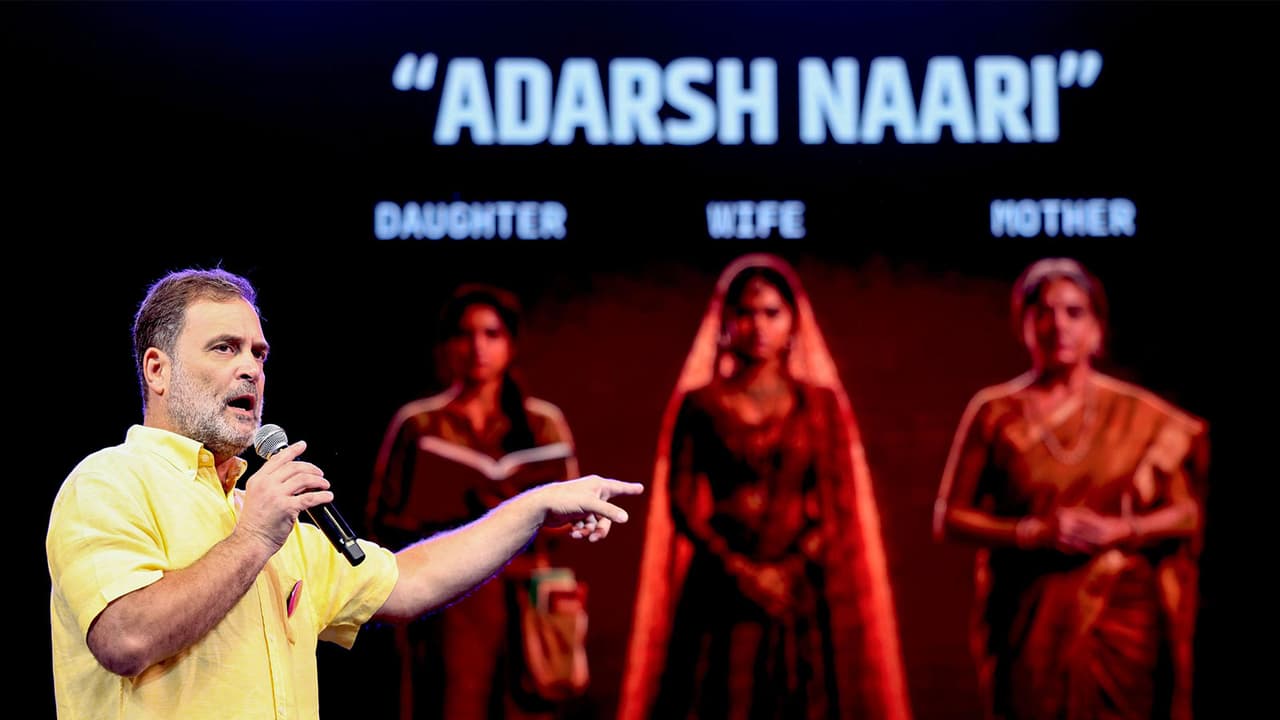
Addressing students in Pune, Rahul Gandhi highlighted issues of women’s safety, asserting that violence and social control, often disguised as care, are tools of oppression that limit women’s educational and employment opportunities.
Congress MP and Leader of Opposition in the Lok Sabha Rahul Gandhi on Saturday addressed the Pune leg of the ‘Chhatron Ki Goonj’ campaign, highlighting issues concerning women’s safety, rights and social control, and asserting that violence, disrespect and concerns disguised as care can become tools of oppression.
Gandhi on Violence and its Impact on Women
Addressing the programme, Gandhi said women face multiple forms of violence and that safety concerns also lead to loss of educational and employment opportunities. “Let’s talk a bit about violence. That thought–‘What if something happens?’… Family members tell you, ‘Don’t go there; something might happen.’ There are three types of violence,” Gandhi said.
He cited figures on female foeticide, harassment and physical violence, claiming that millions of women face restrictions and safety-related challenges. “Every year, 4,50,000 girls are killed before they are even born. That is the first form of violence,” he said.
Gandhi further said, “Among the women here, 80% have faced harassment at some point–on the street, on the bus, in restaurants, at school, or in college.” He also claimed that around 29-30 per cent of women experience physical violence and said, “6 out of every 100 women in India are raped.”
Gandhi said violence also affects women indirectly by limiting their access to education and employment. “50% of women forgo education or employment due to safety concerns. To avoid violence, half of all women drop out of school or quit their jobs,” he said.
He also spoke about the financial burden associated with women’s safety, claiming that an average Indian woman spends an additional Rs 17,500 annually on safety measures.
‘Oppression Disguised as Concern’
Gandhi then spoke about what he described as four methods of controlling women. “We came up with an interesting word–‘control’. Do you feel that society tries to control you, men try to control you, in everything that you do? So, here is a trap, and there are four methods of control. The first method of control, violence. The second method of control–disrespect,” he said.
“Time is used against you, and in every single sphere of life, in some way or the other, men and the system are trying to control you. And very interestingly, this oppression is disguised as concern. We are very concerned about you. That is why we need to control you,” Gandhi added.
India’s Strength and Women’s Identity
Earlier, Gandhi said India’s greatest strength lies in the aspirations and potential of its women. “Many times, people ask me, ‘What is India’s biggest strength?’ You get many answers when you ask this question. Somebody will say our economy. Somebody will say our military. Somebody will say our medical system. Somebody might even say our people, but I am very clear on what is India’s biggest strength, our biggest asset, and that strength is 70 crore unique journeys, unique imaginations, unique dreams that the women of India are living,” he said.
Gandhi also criticised the tendency to define women primarily through their relationships. “Whenever I speak to a man, women are put in three boxes. You are seen as a daughter, a wife, or a mother. Now, there is nothing wrong with being seen as a wife, daughter, or mother. But this cannot be your only identity,” he said.
He said women who excel as professionals, sportspersons and in other fields deserve recognition beyond traditional roles.
Gandhi also referred to the Manusmriti while discussing historical attitudes towards women and quoted a passage that, he alleged, denies women independence.
About the ‘Chhatron Ki Goonj’ Campaign
The ‘Chhatron Ki Goonj’ campaign, launched by Gandhi in 2026, seeks to provide a platform for student concerns, including examination irregularities, paper leaks, rising education costs, recruitment-related issues and unemployment. The campaign has previously been held in Kota, Dehradun and Prayagraj and is aimed at bringing student grievances into the national political discourse. (ANI)
(Except for the headline, this story has not been edited by Asianetnews Editorial staff and is published from a syndicated feed.)