
Global investors are increasingly focused on the U.S. fixed-income market this August as ballooning federal debt, Treasury buyback operations, and a flood of high-grade corporate bond sales drive long-duration yields higher.
- The U.S. national debt crossed $40 trillion this week, a record high.
- The U.S. 30-year Treasury yield resumed its climb on Friday after hitting its highest level since 2007 earlier this week.
- Major tech firms, semiconductor manufacturers, and AI operators are flocking to the investment-grade bond market to fund capital-intensive artificial intelligence infrastructure.
Fixed-income markets have captured the spotlight this August as global investors pivot toward elevated U.S. long-duration bond yields, widening federal deficits, and a massive wave of corporate debt issuance.
The U.S. Treasury market remains under close scrutiny as the national debt crosses the $40-trillion threshold. The Treasury Department announced buyback operations to bolster secondary-market liquidity and temper volatility as 30-year bond yields hit levels last seen in 2007.
This sovereign supply overhang has significantly reshaped market sentiment, drawing capital into long-term bonds while raising the floor for borrowing costs across the U.S. economy.
The iShares 20+ Year Treasury Bond ETF (TLT) fell about 0.4% to close around $82 on Friday, erasing earlier gains and lingering near its 52-week lows.
AI Buildout Puts Corporate Debt Issuances In Focus
Simultaneously, the U.S. high-grade corporate bond market has experienced a surge in volume, marking one of its busiest stretches for deal activity since early this year. Semiconductor manufacturers, technology giants, and specialized digital infrastructure operators have descended on primary bond markets to secure fixed-rate financing.
For instance, Advanced Micro Devices (AMD), Nvidia (NVDA), and Alphabet (GOOG, GOOGL) are all ramping up debt offerings to fund their escalating AI capital expenditure plans this month.
According to research and data analysis by Carson Group, the financial architecture supporting the global expansion of AI infrastructure has fundamentally transformed. Carson Group macro strategist Sonu Varghese highlighted that capital expenditure by major tech hyperscalers—such as Meta (META), Amazon (AMZN), Alphabet, Microsoft (MSFT), and Oracle (ORCL)—is projected to reach 2.5% to 2.8% of U.S. GDP in 2026 and 2027, with 2026 capex estimates revised upward from $515 billion to $775 billion.
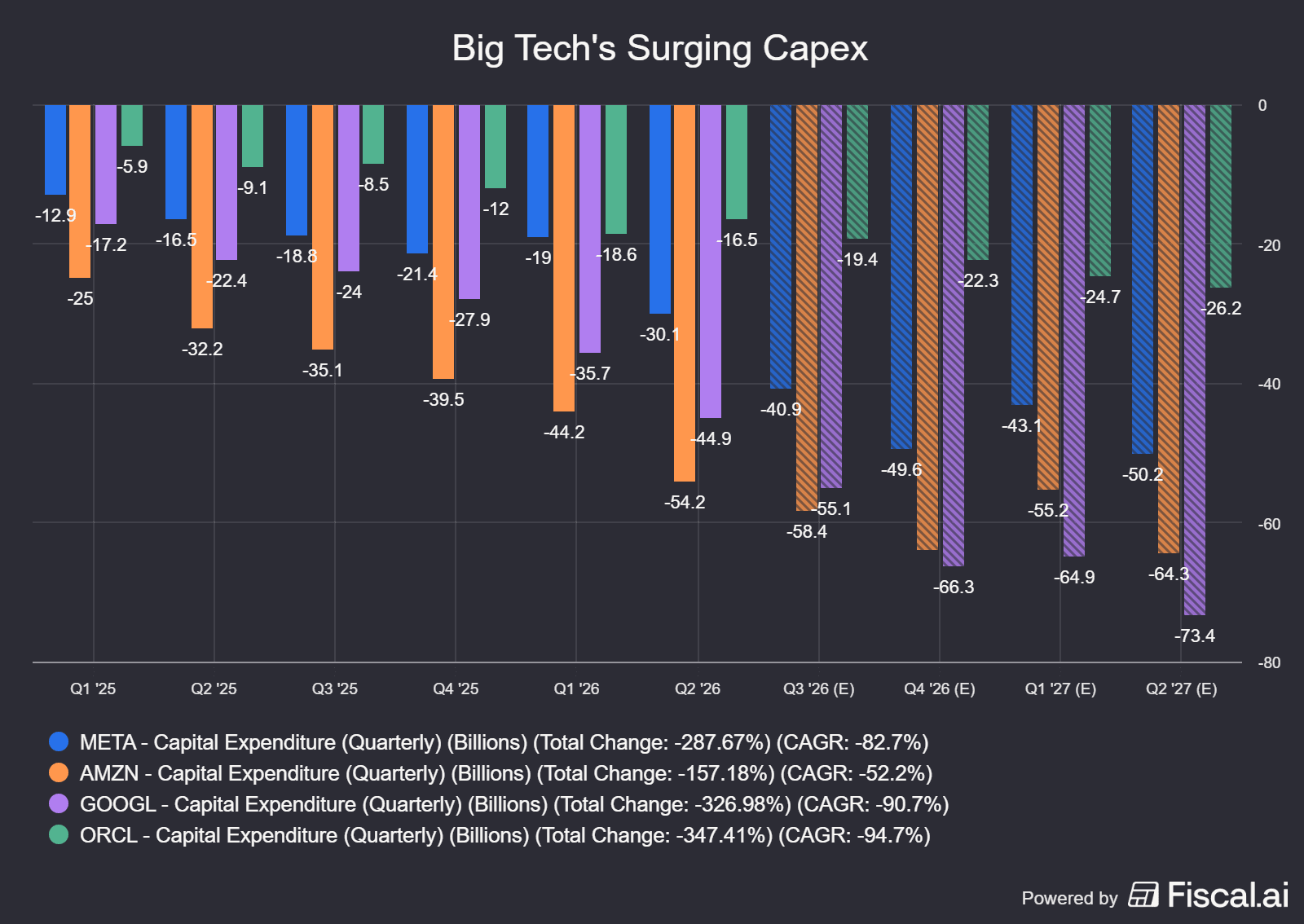
Technology companies are increasingly turning to complex debt financing. Carson Group estimates show that incremental debt funded roughly 32% of hyperscaler capital expenditures on a trailing basis by mid-2026, up from just 9% in fiscal 2024. U.S. data center debt issuance roughly doubled to about $182 billion in 2025 alone.
Tech companies are also borrowing billions to buy AI microchips (GPUs) without putting that debt on their own balance sheets. As a result, private capital consortiums and specialized deal structures are rapidly expanding to fund these long-term commitments.
For instance, Nvidia’s partnership with KKR, BlackRock, Apollo, Blackstone, Brookfield, and Goldman Sachs in August 2026 aims to mobilize more than half a trillion dollars.
Confluence Of Capital Demands
Simultaneous demand for capital from the federal government and corporate America is placing fixed-income dynamics at the center of the financial market. As corporate borrowers compete for long-term institutional capital, bondholders are exerting greater influence over corporate strategy and fiscal sustainability.
With both government deficits and corporate AI investments showing few signs of slowing, fixed-income yields and credit spreads are expected to remain the primary drivers of global market direction through the remainder of the year.
For updates and corrections, email newsroom[at]stocktwits[dot]com.<