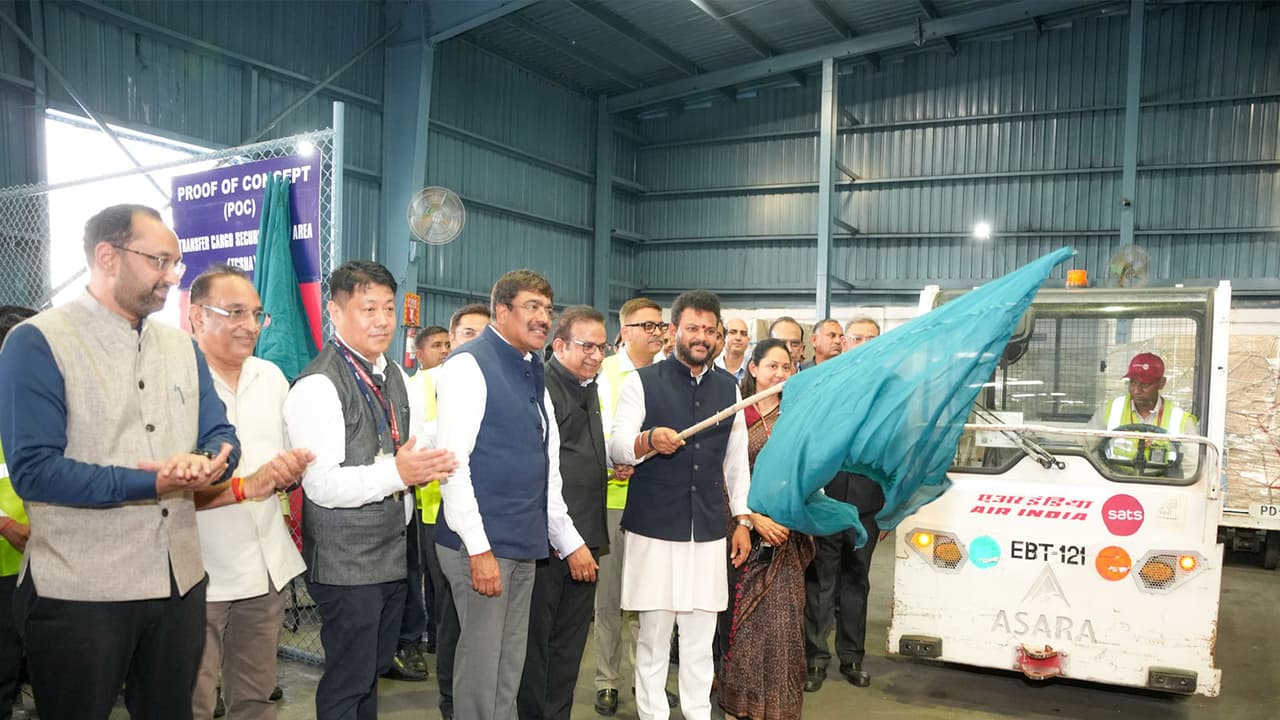
Union Minister Ram Mohan Naidu launched the scaled-up transshipment cargo reform at Delhi Airport. This reform eliminates mandatory re-screening, cutting transit time from 60 to 20 hours and aims to make India a global cargo hub.
Union Minister for Civil Aviation Ram Mohan Naidu on Wednesday flagged off the scaled-up phase of India’s transshipment (TP) cargo reform at Delhi International Airport Limited’s (DIAL) Transshipment Excellence Centre (TEC) at IGI Airport, Terminal 2.
Speaking on the occasion, Ram Mohan Naidu said the government was continuously working to strengthen ease of doing business in the aviation sector under the leadership of Prime Minister Narendra Modi. “Under the visionary leadership of Prime Minister Narendra Modi, we are continuously working to strengthen Ease of Doing Business in the aviation sector. Based on industry feedback, we identified a long-standing requirement for mandatory re-screening of transshipment cargo as a key bottleneck. By doing away with it, we can significantly reduce turnaround time, handling costs, and congestion at cargo terminals. And Proof of Concept exercise on the Chennai-Delhi-Frankfurt route has successfully established that by reducing average end-to-end transit time from 60 hours to just 20 hours,” he said.
Successful PoC and Scaled-Up Operations
The Proof of Concept for Domestic-to-International transshipment commenced on June 20, 2026, on the Chennai-Delhi-Frankfurt sector using DIAL’s TEC, with Air India operating the service end-to-end. Since its launch, the PoC has transshipped 280 MT of cargo, with aircraft capacity utilisation rising from 75 per cent to nearly 100 per cent, the Ministry of Civil Aviation said in an official statement.
Based on the success of the PoC, the network was today expanded to four additional domestic origin stations: Bengaluru, Ahmedabad, Mumbai, and Hyderabad, along with two new international destinations: London and Copenhagen. The expanded network is projected to increase Air India’s monthly cargo carriage on these lanes from 1,763 MT to 3,183 MT, an increase of nearly 80 percent, as per the ministry.
Vision for a Global Cargo Hub
Ram Mohan Naidu said, as per the release, “We are now scaling up this successful model by connecting four more major domestic cargo markets and two new international destinations. While our immediate focus is on Domestic-to-International transshipment, our larger ambition is to position India as a global cargo transshipment hub by leveraging our strategic location between the East and the West. Subsequently, we will expand this framework to International-to-International and International-to-Domestic transshipment as well.”
The Minister added, “The reform is part of the Government’s broader vision of developing major Indian airports into global transit hubs. Following the strengthening of hub-and-spoke operations for passengers, the Government is now taking similar steps to build India’s air cargo hub capabilities.”
Framework and Future Plans
Earlier, through the revised framework, notified through Addendum-II to AVSEC Circular No. 6/2024 by the Bureau of Civil Aviation Security (BCAS) on July 21, 2025, it was permitted to move secured transshipment cargo through dedicated Transfer Cargo Security Hold Areas (TCSHAs) without re-screening, subject to prescribed security safeguards.
The Minister congratulated all stakeholders involved in the successful rollout, including DIAL, BCAS, CISF, airlines, and Customs, for working together to remove a critical bottleneck and improve the competitiveness of India’s air cargo ecosystem.
Additional origin stations and international destinations are planned to be brought under the framework in the coming months, further strengthening India’s position as a globally competitive aviation and cargo hub.
The event was attended by Secretary, Ministry of Civil Aviation, Samir Kumar Sinha; Airports Authority of India (AAI) Chairman Vipin Kumar; Joint Secretary, Ministry of Civil Aviation, Asangba Chuba Ao; Joint DG, Bureau of Civil Aviation Security (BCAS), Pratibha Ambedkar; and senior officials from MoCA, AAI, BCAS, DIAL, Air India, and other stakeholders. (ANI)
(Except for the headline, this story has not been edited by Asianetnews Editorial staff and is published from a syndicated feed.)