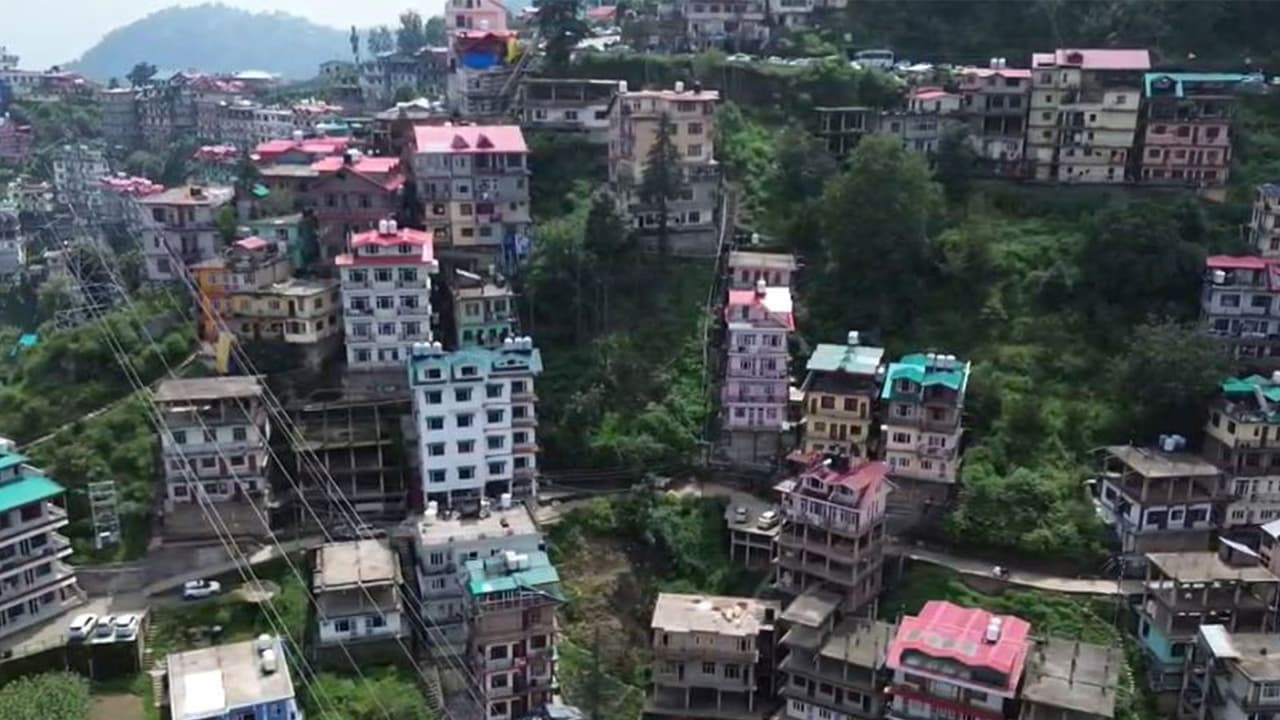
Families in Shakrala village, Shimla, are living in fear as the land sinks, causing cracks in their homes. The issue, affecting 100-150 houses, has worsened during the monsoon, prompting residents to demand a geological assessment and a solution.
Several families in Shakrala village near Shimla are living under constant fear as the hillside beneath and around their homes continues to sink, causing cracks in houses and walls and raising concerns over the safety of residents.
The affected area falls in the Shakrala-Malyana region. Residents said the land has been gradually sinking for several years, while the problem has intensified during the monsoon. They have urged the administration to conduct a detailed soil and geological assessment and put in place an effective engineering and drainage solution.
According to residents, nearly 100 to 150 houses are located in the wider affected area. They said cracks have repeatedly appeared in their houses and walls, forcing families to spend large amounts of money on repairs.
Residents’ Plight and Financial Burden
Local resident Ram Krishna Sharma told ANI that the land had been continuously sinking for the past two to three years. “For the last two to three years, the land has been continuously sinking. Cracks keep appearing again and again. We repair them, but after some time the cracks return. We still do not know the exact reason, whether it is because of the four-lane construction, rainwater from the roofs or wastewater from toilets.” He said.
Sharma said a team had visited the area earlier following complaints to the administration, but residents were still awaiting a clear assessment of the cause. “We have already informed the administration and a team had also visited earlier, but so far no concrete result has come out about why the land is repeatedly sinking,” he said.
He said he had spent around Rs 2.5 lakh to Rs 3 lakh on repairing his house, but the cracks continued to reappear. “I have spent around Rs 2.5 to 3 lakh again on repairs. After repairing, the cracks appear again, and we have to spend money once more. Almost everyone here is facing the same problem,” Sharma said.
He said residents were living in fear, particularly during heavy rainfall. “We want the government to find a permanent solution and determine the reason for the land sinking. We have invested our lifetime savings in these houses. If our houses are getting damaged repeatedly, we should also be given compensation,” he said.
Another resident, Gulab Singh, said he had been observing the problem since around 2010 and feared that the situation could worsen. “We have been facing this problem for years. I have a four-storey house with a fifth-floor roof, and there is always a fear that something may happen. We repeatedly have to carry out repairs. There has been a lot of damage in the lower part of the area, and now the land here has also started sinking,” Singh told ANI.
Singh said residents were worried about their safety and some families had even discussed shifting from the area. “We are definitely scared. People in the family say that we should shift from here, but what can we do? We have invested everything here. As long as we can stay, we are staying,” he said.
Suspected Causes: Road Work and Poor Drainage
Residents said they were unable to conclusively attribute the land movement to a single factor, but alleged that the problem had become more pronounced after four-lane road construction began in the vicinity.
Another resident told ANI that cracks had existed earlier but had widened after the four-lane work started. “The cracks had started earlier, but after the four-lane cutting work began here, they doubled. The wastewater coming out of our houses is also a problem. We cannot say that the four-lane construction alone is responsible, but after the work started, the cracks became much wider. Heavy rain has made the situation worse,” the resident said.
Priya Chauhan, another local resident, said uncontrolled wastewater and rainwater were among the major concerns. “The main reason for the cracks in the houses is the wastewater that is flowing openly here. Rainwater is also flowing openly. Since the excavation work for the four-lane project started two to three years ago, the cracks have doubled,” Chauhan told ANI.
Residents’ Self-Funded Efforts
She said residents had collectively spent around Rs 7-8 lakh from their own pockets to improve drainage and divert wastewater. “We have spent at least Rs 7 to 8 lakh ourselves to manage the wastewater and rainwater. In some houses, we have installed pipelines and started diverting the water, but many houses are still not connected,” she said.
Chauhan said the problem was more severe in houses located downhill, with residents reporting cracks in walls and settlement of basements and floors. “Almost every house has this problem. The houses closer to the road have fewer cracks, but as you go downhill, the cracks become more prominent. Our basement is also sinking,” she said.
Recalling last year’s heavy rainfall, Chauhan said families had been forced to remain outside their homes during intense rain. “Last year, when there was so much rain, the cracks increased significantly. We spent entire nights outside on the road. Even this year, despite comparatively less rain so far, we remain frightened because the cracks are still there,” she said.
Demand for Scientific Intervention and Compensation
Chauhan said residents had approached officials and engineers and were advised to manage wastewater to prevent further deterioration. “A few months ago, we called engineers from the four-lane project. They told us that settlement was taking place across the entire area from the road downhill and advised us to manage our wastewater as quickly as possible. Following that advice, we started laying pipelines privately,” she said.
She also said residents had been told that drainage or sewerage-related pipelines would be installed, but the work had yet to materialise on the ground.
Residents have now demanded a scientific soil and geological investigation, proper drainage and engineering intervention, along with compensation for damage to their homes. They fear that continued land movement during the monsoon could further weaken structures and pose a serious risk to life and property.
With cracks appearing repeatedly and the hillside continuing to settle, residents say they are being forced to spend their savings on repairs while remaining uncertain about the safety of their homes. (ANI)
(Except for the headline, this story has not been edited by Asianet Newsable English staff and is published from a syndicated feed.)