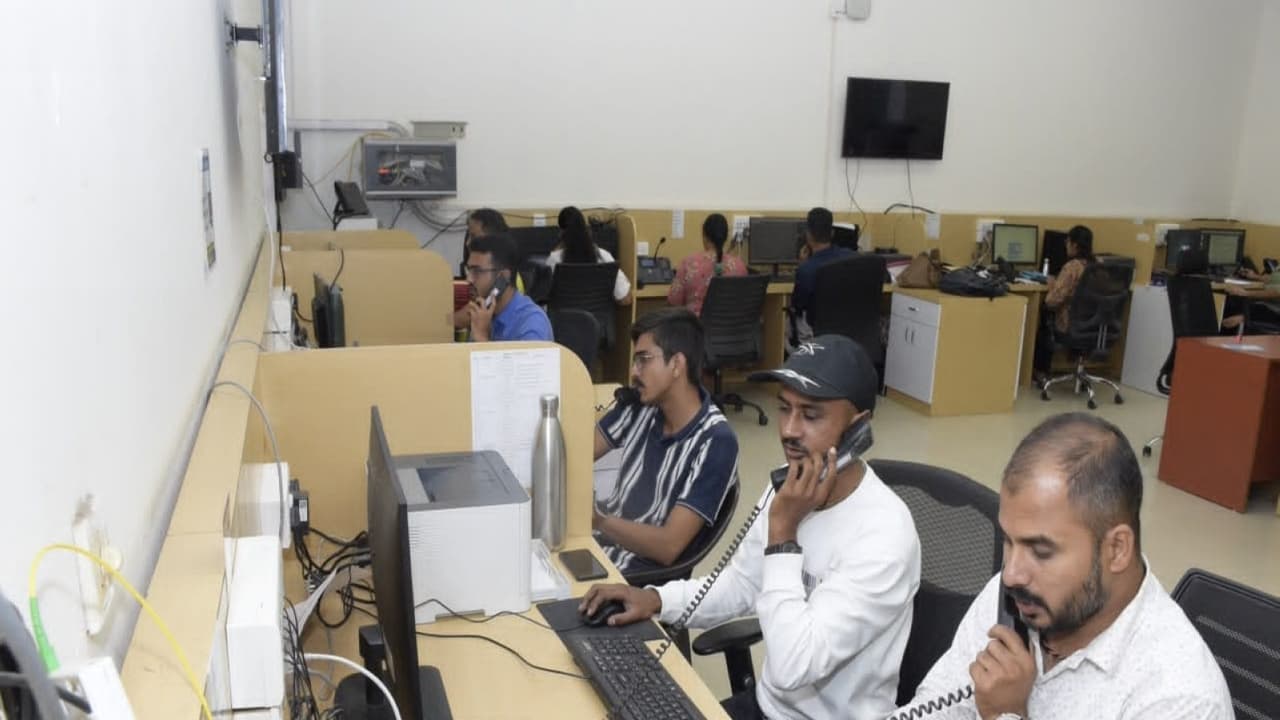
Gujarat’s State Emergency Operations Centre (SEOC) is a 24/7 command hub for disaster response, having sent over 286.4 crore SMS alerts. It mobilizes state machinery within minutes of a calamity to ensure public safety across the state.
The State Emergency Operations Centre (SEOC) in Gandhinagar has emerged as Gujarat’s primary 24/7 command and control hub for disaster response, having sent over 286.4 crore SMS alerts to citizens through the advanced ‘SACHET’ system to date.
Functioning as an invisible shield, the SEOC mobilises the entire state administrative machinery within minutes of a natural calamity or unforeseen emergency to ensure public safety.
According to a press release issued by the Chief Minister’s Office (CMO), the devastating Kutch earthquake of 2001 taught Gujarat valuable lessons in disaster management. Building on that experience and using modern technology, the Government of Gujarat has developed a strong disaster management system. At the centre of this system is the State Emergency Operations Centre (SEOC), which functions 24×7 as the Central Command and Control Hub during natural and man-made disasters, including earthquakes, cyclones, and heavy rainfall. Through real-time coordination, timely alerts, and quick relief and rescue operations, it helps ensure the safety of citizens across the state.
Advanced Communication and Network Infrastructure
Maintaining communication during emergencies is one of the biggest challenges. To address this, the SEOC uses multiple communication channels, including the GSWAN hotline, satellite phones, landlines, e-mail, WhatsApp, and social media. During the monsoon season, it also makes special use of police wireless sets and Ham Radio as alternative communication systems. In addition, the advanced “Sachet Portal” has been developed to provide timely alerts to citizens. Through this portal, Mass SMS alerts are sent to people in affected areas. So far, more than 286.4 crore SMS alerts have been sent through this system. Moreover, the Centre has successfully safeguarded citizens through access by more than 6 crore mobile app users and over 5.3 lakh web browser users.
This Centre, functioning under Gujarat’s disaster management framework, is a well-structured system developed to ensure seamless coordination across the state, district, and taluka levels through an advanced network. At present, 33 District Emergency Operations Centres (DEOCs), 5 Emergency Response Centres, and 248 Taluka Emergency Operations Centres are functioning continuously. With the support of Gujarat State Wide Area Network (GSWAN) connectivity and a well-established 24×7 monitoring mechanism, the Centre ensures disaster preparedness before emergencies and enables rapid response during disasters. All these centres function continuously under the guidance of the Relief Commissioner and the supervision of the Director of Relief.
Multi-Agency Coordination and Emergency Response
To enable every citizen to receive immediate assistance during emergencies, dedicated 24-hour helpline numbers have been made available. Any citizen of the state can seek help by contacting the state-level helpline numbers 51900 or 1070, and the district-level toll-free helpline number 1077.
The Government of Gujarat’s well-equipped State Emergency Operations Centre stands as a strong shield of protection for citizens against every disaster. Depending on the nature and severity of a disaster, the SEOC maintains close coordination with specialised technical agencies. During earthquakes or seismic activities, it coordinates with the Institute of Seismological Research (ISR). During floods and cyclones, it works in real time with the India Meteorological Department (IMD), the Irrigation Department, and ISRO. In the event of a possible tsunami, coordinated operations are carried out with the IMD, INCOIS, and ISR. In addition, for drought and heatwave situations, coordination is maintained with the Agriculture Department; for epidemic control, with the Health and Family Welfare Department; for chemical accidents, with the Directorate of Industrial Safety and Health (DISH) and the Labour and Employment Department; and for fire incidents, with the Fire and Emergency Services.
Simultaneously, to ensure swift relief and rescue operations, 17 teams of the National Disaster Response Force (NDRF) and 32 teams of the State Disaster Response Force (SDRF) are kept on constant standby. Whenever required, assistance from the Army, Air Force, and Navy is also mobilised.
(Except for the headline, this story has not been edited by Asianet Newsable English staff and is published from a syndicated feed.)