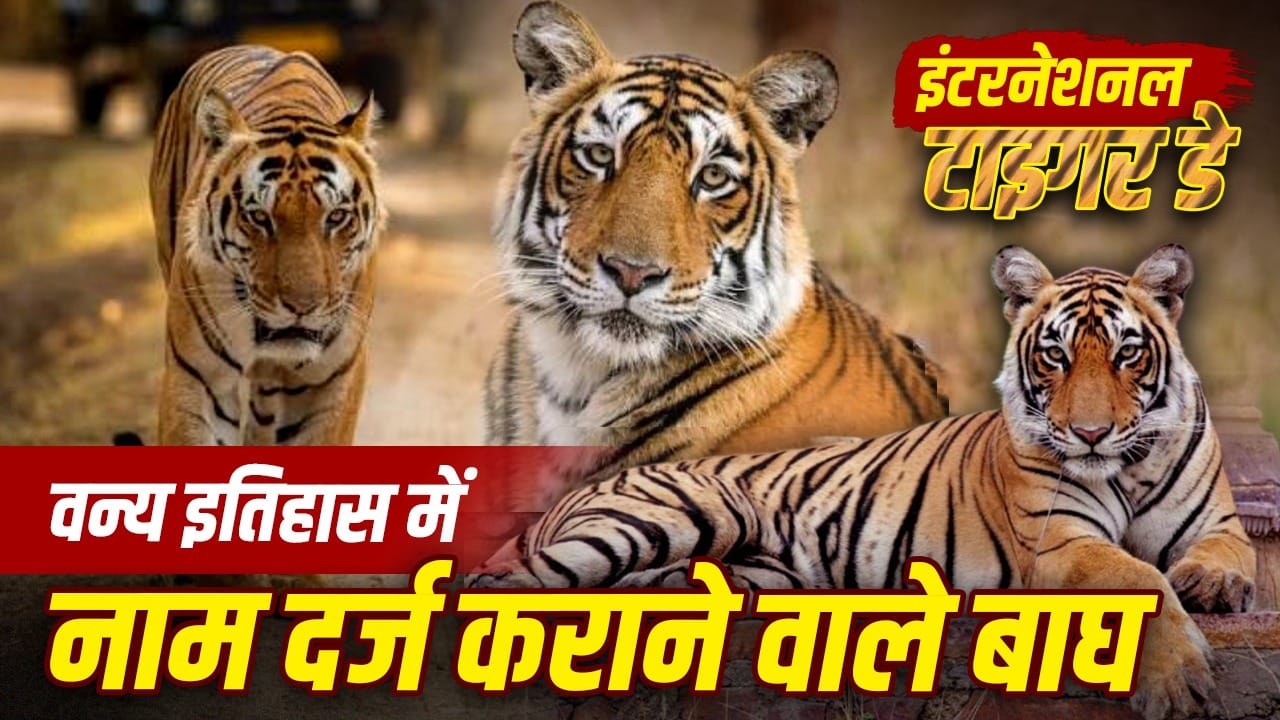
In the country, tigers were given names like Maya, Munna, Matkasur, Chhota Munna, Arrowhead and Machli.
There has been a trend in the country to technically give codes like T15, T84, T12 to tigers, but they were also given human names based on their characteristics. Sometimes by the forest guards and sometimes by the villagers living nearby. Sometimes their name was given because of the stripes present on their body and sometimes their special habit was used as the basis for deciding the names. They were given many names including Maya, Munna, Matkasur, Chhota Munna, Arrowhead and Machli. On the occasion of World Tiger Day, know what names the tigers got in the country and what was the reason behind them.
The most special name in the list of most interesting names of tigers is Machli. She has been a tigress of Ranthambore National Park in Rajasthan. Its next generations also attracted a lot of discussion.
How did the fish tigress get its name?
The tigress of Ranthambore National Park in Rajasthan used to hunt fishes, but it did not get this name only because of hunting fishes. The reason for this was the fish shaped marks present on the face. The fish is said to be the most photographed tigress in the world. Its daughter, named T-16, had taken over the area near water bodies in Ranthambore National Park and continued its existence under the same name.

Fish tigress.
Queen Mother, Goddess of the Lake and Arrowhead
The tigress also got names like Queen Mother and Goddess of the Lake. This too has a story. A story that is often repeated is from June 2003. Ranthambore National Park was in the grip of drought and a crocodile was roaming near a lake. The fish was with her cubs, whom she carried to safety and then returned to fight the 14-foot crocodile. The fight lasted for one and a half hours and the tigress won.
Machli died in August 2018 when she was about 20 years old. The average age of tigers is eight to ten years, the age of the fish was much more than that. It generated revenue of about 10 million dollars in the tourism sector of Rajasthan. She was neither afraid of tourists nor ran away when safari vehicles entered the park. She used to stand comfortably in front of the camera.

Arrowhead Tigress.
One of the most famous tigresses of Ranthambore was Arrowhead, the granddaughter of Fish, who faced male tigers and even killed a crocodile in front of spectators. If you look carefully, you will find that the tigress has an arrow-like mark on her forehead and this is how she got her name.
Arrowhead, the child of Krishna, the fish’s daughter, looks just like her grandmother. A blog on the website of Ranthambore National Park has described him as ‘fish junior’. He has not faced the crocodile yet, but still he is very courageous. She challenged her mother Krishna and captured the major area of the lake, which was also dominated by fish and was later called the “Queen of Lakes”.

Tadoba of Maharashtra became famous by the name of Maya.
Maya’s story
There is some special tigress in every tiger reserve. Tadoba of Maharashtra became famous by the name of Maya. Her number in the records is T-12, but in the wildlife world she is known as Maya. There is a mark like the letter M on her shoulder, hence her name was Maya.
Wildlife filmmaker Aishwarya Sridhar has depicted the life of this tigress in the film “Tiger Queen of Taru”, made over six years. In the Indian Express report, he said, when I saw Maya for the first time, she was 15 years old. She was a cub who had lost her mother and was separated from her two siblings. Over time, I have watched him grow and take care of himself in the wild. She is fearless, charming and friendly towards tourists. After fish, she is the most popular tigress.

Matkasur.
The name Matkasur got its name from the story of liquor.
There is also a famous tiger named Matkasur in Tadoba, it is also called Madakasur. It is named after the area of the forest where it was first seen. People who regularly visit the forest claim that the tribals used to make liquor and keep it in pots. This myth was spread that a spirit comes to that place and drinks liquor from them. This was done to scare people and keep the officials away from the illegal liquor being manufactured by them. That spirit was called Matkasura and the main tiger of that area was named after him.

Munna who was also known as T-17.
Munna of Madhya Pradesh
In Kanha, Madhya Pradesh, a crowd used to gather to see a tiger named T-17, whose stripes were very famous. The word ‘CAT’ was formed from the unique stripes on his forehead. This tiger, who ruled the Kisli area of the park, was fondly called Munna. The story of his naming is also heart touching.
Munna had been injured in a territorial fight with another tiger and the guides had noticed him not being able to walk properly. This reminded him of one of his friends, who had polio and who also walked the same way. After this, the name of T-17 was changed to Munna, which name got associated with it forever. He lived for about 21 years, but could no longer walk after his arms and legs were paralyzed. She was shifted to Van Vihar National Park in October 2019 and died under the care of veterinary staff a year later. His son’s name is Chhota Munna.
Also read: How does the warning system alert seconds before an earthquake in Japan?