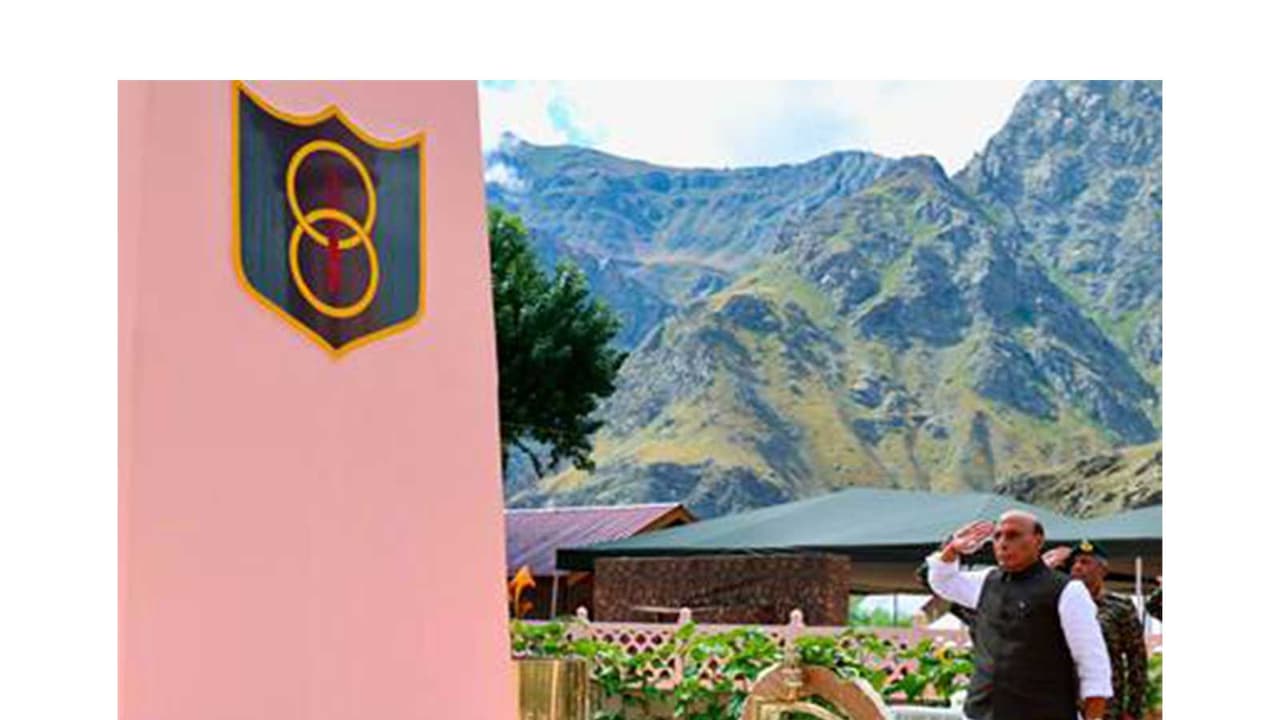
On Kargil Vijay Diwas, Defence Minister Rajnath Singh stated that talks with Pakistan would only concern PoJK. Army Chief General Dhiraj Seth assured the nation of the army’s commitment, while PM Modi and President Murmu paid tribute to war heroes.
‘No Talks with Pakistan Except on PoJK’: Rajnath Singh
Defence Minister Rajnath Singh on Sunday asserted that India would hold no talks with Pakistan except on Pakistan-occupied Jammu and Kashmir (PoJK), while Chief of the Army Staff (COAS) General Dhiraj Seth reaffirmed the Indian Army’s unwavering commitment to national security, saying it would continue to “hoist the nation’s flag even higher” as the country commemorated the 27th Kargil Vijay Diwas with tributes to the soldiers who made the supreme sacrifice during the 1999 Kargil War. At the same time, Prime Minister Narendra Modi hailed the “extraordinary courage” of the armed forces.
Addressing the Kargil Vijay Diwas celebrations at the Dras War Memorial in Ladakh, Rajnath Singh said the success of Operation Sindoor had demonstrated India’s resolve and capability to respond decisively to terrorism and cross-border aggression. “The success of Operation Sindoor is proof that India possesses the capability to respond to Pakistan’s every misadventure with a severity far beyond its imagination. He reiterated that there would be no talks with Pakistan, and any dialogue would focus solely on PoK, which, he described, is an integral part of India illegally occupied by Pakistan,” he said.
The Defence Minister accused Pakistan of making terrorism an instrument of state policy, alleging that its military and terrorist organisations work in tandem. “Pakistan’s military not only shelters terrorist organisations but also works with them. That is why, during Op Sindoor, we made it clear that India no longer views terrorists and the governments that nurture them as separate entities,” he added.
Drawing a contrast between the trajectories of the two countries since the Kargil War, Singh said India had focused on innovation, technology and economic growth, while Pakistan continued to foster terrorism. “While India is exploring new avenues of innovation, Pakistan is seeking new routes for infiltration. India is engaged in chip design, whereas Pakistan is busy designing terror. India is building a start-up ecosystem, while Pakistan is constructing a terror ecosystem. India is manufacturing semiconductors; Pakistan is preparing suicide bombers. India is recognised for space missions, while Pakistan is running proxy missions. India is sending satellites into space, whereas Pakistan focuses on sending terrorists across the border,” he said.
He added, “India is providing software to the world, while Pakistan is exporting sleeper cells. India is establishing data centers; Pakistan is setting up radicalisation centres. India is connecting the world through UPI, while Pakistan is linking terrorism with hawala networks. In short, our paths diverge; should Pakistan attempt to obstruct our path to prosperity with its nefarious designs, our defence forces stand ready to deliver a befitting response.”
Singh said the government possesses the political will to give the armed forces a free hand to respond to security threats and reiterated its commitment to strengthening national security and the welfare of soldiers.
Paying tribute to the heroes of the Kargil War, including Param Vir Chakra awardees Captain Vikram Batra and Captain Manoj Kumar Pandey, the Defence Minister described Kargil Vijay Diwas as a reminder of the values of sacrifice and service. “Kargil War has taught us that we must remain ever-vigilant at our borders in every season and under all circumstances,” he said, adding that the government was continuously strengthening border infrastructure and modernising the armed forces to enhance operational capability.
‘Yeh Dil Maange More’: India’s Defence Self-Reliance
On defence self-reliance, Singh said India had undergone a major transformation in defence manufacturing. “When our government assumed office, India used to import 65 to 70 per cent of defence equipment. Today, we’re manufacturing 65 per cent of our defence equipment on Indian soil. Today, our soldiers possess the indigenously developed air defence control system ‘Akash-Teer’. We have developed the next-generation Akash missile. India’s first indigenous aircraft carrier ‘INS Vikrant’, Light Combat Aircraft ‘Tejas’, Light Combat Helicopter ‘Prachand’, Advanced Light Helicopter ‘Dhruv’, Main Battle Tank ‘Arjun’, ‘Pinaka’ multi-barrel rocket launcher, ‘Astra’ air-to-air missile, and modern drones & counter-drone systems are also strengthening the combat readiness of the defence forces. But, ‘Yeh Dil Maange More’. We will continue working to manufacture even more modern weapons, next-generation fighter aircraft, submarines, and missiles right in India,” he said.
Tributes and Commemorations at Dras
During the ceremony, Singh laid a wreath at the Cenotaph and observed a moment of silence in memory of the soldiers who laid down their lives during Operation Vijay. He also inaugurated the Virtual Walkthrough Portal, visited the Hut of Remembrance and paid homage at Veer Bhoomi. Lieutenant Governor of Ladakh Vinai Kumar Saxena, Chief of the Army Staff General Dhiraj Seth, General Officer Commanding-in-Chief, Northern Command Lieutenant General Pratik Sharma, GOC 14 Corps Lieutenant General Madanraj Pande, GOC 8 Mountain Division Major General AP Singh, Kargil War veterans, gallantry awardees, Veer Naris and families of the fallen attended the commemorative event. The event also featured an operational capability demonstration and a static display showcasing the Indian Army’s mobility, surveillance and drone systems.
Army Chief Reaffirms Commitment
Army Chief General Dhiraj Seth paid tribute to the Kargil martyrs and their families, saying the Indian Army’s soldiers are unmatched in their courage and professionalism. “I feel a renewed sense of energy and pride. On this occasion, I pay my humble tribute to our brave martyrs and offer my heartfelt respects to their families…I simply want to say that the warriors of the Indian Army are superior to the soldiers of any other army in the world and cannot be matched. On this occasion, I want to assure the nation that the Indian Army is fully with you in the nation’s progress, and in the times to come, we will hoist the nation’s flag even higher,” he said.
Kargil War veteran Colonel Rajesh Jindal (Retd.) highlighted India’s growing defence capabilities and increasing self-reliance, saying Operation Sindoor had demonstrated the country’s technological progress and precision strike capability.
PM Modi, President Murmu Pay Tribute
Meanwhile, Prime Minister Narendra Modi, during the 136th episode of his monthly radio programme Mann Ki Baat, paid tribute to the Kargil heroes and said their bravery continues to inspire every Indian. “The towering peaks of Kargil, the harsh weather, the enemy’s challenge – every circumstance stood before our soldiers, but their resolve was greater than every challenge,” the Prime Minister said.
Highlighting the Shaurya Vijay Yatra, Modi said the motorcycle expedition carried the message of “One Ride, One Nation, One Salute” and served as a reminder that the sacrifices made by the nation’s soldiers can never be forgotten.
President Droupadi Murmu also paid homage to the fallen soldiers, saying their “unparalleled valour, unwavering resolve and patriotism” would continue to inspire generations.
About Kargil Vijay Diwas
Kargil Vijay Diwas is observed every year on July 26 to commemorate India’s victory in the 1999 Kargil War, honouring the courage, sacrifice and unwavering commitment of the armed forces in defending the country’s sovereignty and territorial integrity. (ANI)
(Except for the headline, this story has not been edited by Asianetnews Editorial staff and is published from a syndicated feed.)