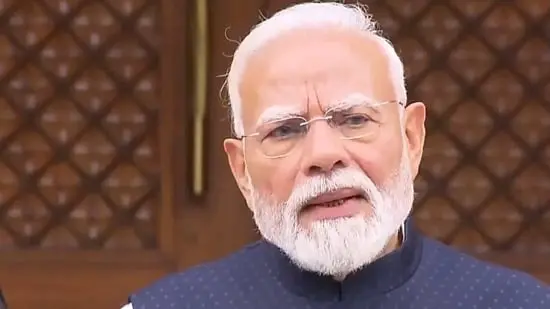
Prime Minister Narendra Modi on Sunday announced that the central government has constituted a six-member high-powered task force headed by Infosys co-founder and technology expert Nandan Nilekani to recommend technological interventions and structural reforms for overhauling the National Testing Agency’s (NTA) examination system.
The latest announcement made by PM Modi in his third Instagram video since July 23, comes a day before the Union government will move a bill in Parliament to implement harsher punishment up to 10 years and heavier penalty of up to ₹10 crore for those convicted of paper leaks.
What did PM Modi say?
In the latest and his first video message after the resignation of Dharmendra Pradhan as education minister following student protests over National Eligibility cum Entrance Test Undergraduate (NEET-UG) irregularities and paper leaks, and the appointment of Pralhad Joshi as the new education minister, PM Modi said that while the government has announced fast-track courts to try cases of examination malpractices and is preparing a bill on the issue, the newly constituted task force will focus on long-term, comprehensive reforms of the examination system.
“The Government of India is continuously taking various measures for the future of students. Those who tampered with the students’ future are languishing in jail. We have already established fast-track courts. We are also moving towards enacting new legislation in Parliament that incorporates stringent legal provisions. However, we must look to the future,” he said.
“Our examination system needs to be reliable and transparent, and it must make maximum use of technology. Keeping all these factors in mind, we have decided to constitute a high-powered task force under the leadership of the world-renowned technology expert Nandan Nilekani. This task force will focus on examination reforms, and based on its report, steps will be taken to ensure the credibility of upcoming examinations at the earliest,” he added.
Apart from Nilekani, the panel includes former Indian Space Research Organisation (ISRO) chairman S Somnath, former Intelligence Bureau (IB) director Tapan Deka, Indian Institute of Technology (IIT) Madras director V Kamakoti, former education secretary Anita Karwal and logistics expert Amrit Lal Meena.
“The multidisciplinary group of domain experts will help revamp National Testing Agency (NTA) examination, especially from a technology perspective and for structural reforms in the system,” according to a person familiar with the development said.
Modi addressed youth
PM Modi addressed the youth regarding paper leaks and student protests in two consecutive late-night, Gen Z-style Instagram videos on July 23 and July 24, 2026.
In the first video, he acknowledged the pain caused by the NEET controversy, promised strict anti-leak laws, and emphasised a transparent examination system and in the second video he thanked the youth for their feedback.
To be sure, Nilekani contested the 2014 Lok Sabha election as an Indian National Congress candidate from the Bangalore South constituency, where he lost to the Bharatiya Janata Party (BJP) candidate Ananth Kumar.
After coming to power in 2014, PM Modi was initially skeptical about Aadhaar – an unique 12-digit digital identity, launched in 2009 by the Congress-led United Progressive Alliance (UPA) government. Nilekani’s presentation to PM Modi and then finance minister Arun Jaitley changed PM’s stance. Aadhaar later became the backbone of the JAM trinity (Jan Dhan, Aadhaar, Mobile), making it possible to open bank accounts for hundreds of millions of poor Indians.
Meanwhile, the opposition strongly questioned the Central government’s decision to constitute a new high-powered task force on examination reforms, pointing out that a similar expert committee had already been formed just two years ago.
They referred to the Radhakrishnan committee – a seven-member panel headed by former ISRO chairman Dr K Radhakrishnan, constituted in June 2024 after the NEET-UG 2024 controversy in May.
Its report, submitted on October 21, recommended structural strengthening of NTA, closer coordination with states, tighter oversight of outsourced vendors, and stronger safeguards for both pen-and-paper and computer-based tests – including encrypted digital transmission of question papers, multi-layer access controls, real-time audit trails and enhanced CCTV surveillance.
Congress MP and party’s general secretary in-charge communications Jairam Ramesh in a post on X alleged that the government has still not implemented the K Radhakrishnan Committee’s 101 recommendations.
“Indeed, for most of the two years between the 2024 and 2026 paper leaks, it didn’t even appoint a full-time Director General for the National Testing Agency. This is ultimately only a High-Powered attempt to fix the Pradhan Mantri’s irretrievably compromised image,” he alleged.
After Subodh Kumar Singh was removed as NTA director general in June 2024 following NEET-UG 2024 controversy, Pradeep Singh Kharola (a retired 1985-batch IAS officer) was given additional charge of the post, which he held until Abhishek Singh assumed office as the regular DG on April 1, 2026.
CPI-M MP John Brittas asked PM Modi to “apprise the nation about the status of K Radhakrishnan Committee”
A parliamentary panel on education, reporting in December 2025, found at least five of the 14 competitive examinations NTA conducted in 2024 and early 2025 faced “major issues.”
To be sure, the government has acted upon some of the recommendations. The government created 16 new permanent posts in NTA, although most remain vacant. District-level coordination committees headed by district collectors have been set up for NEET-UG. Examination centres have been shifted to state government or government-owned buildings, with NTA reporting 94% compliance.
The panel had recommended replacing NTA’s contractual workforce with permanent, accountable staff. However, the latest official data shows that of NTA’s 39 sanctioned permanent posts-all to be filled on deputation-only 24 are occupied. The agency currently functions with 73 contractual employees and 124 outsourced personnel.
The Centre is also considering introducing an upper age limit and capping the number of attempts for NEET-UG, which currently has no such restrictions. These measures, along with a gradual shift to computer-based testing (CBT), form the next phase of reforms based on the Radhakrishnan Committee’s recommendations.The NTA informed a Parliamentary panel in May 2026 that Phase-1 reforms – already implemented for NEET-UG 2026 and the June 21 re-examination – include Aadhaar-linked biometric verification, facial authentication, multi-layer police frisking, mobile jammers, and AI-enabled CCTV surveillance. Phase-2 reforms, currently under planning, focus on cloud-based infrastructure, stronger encryption, an NTA-owned public testing platform, and eventual harmonisation of engineering and medical entrance exams through common standards and processes.