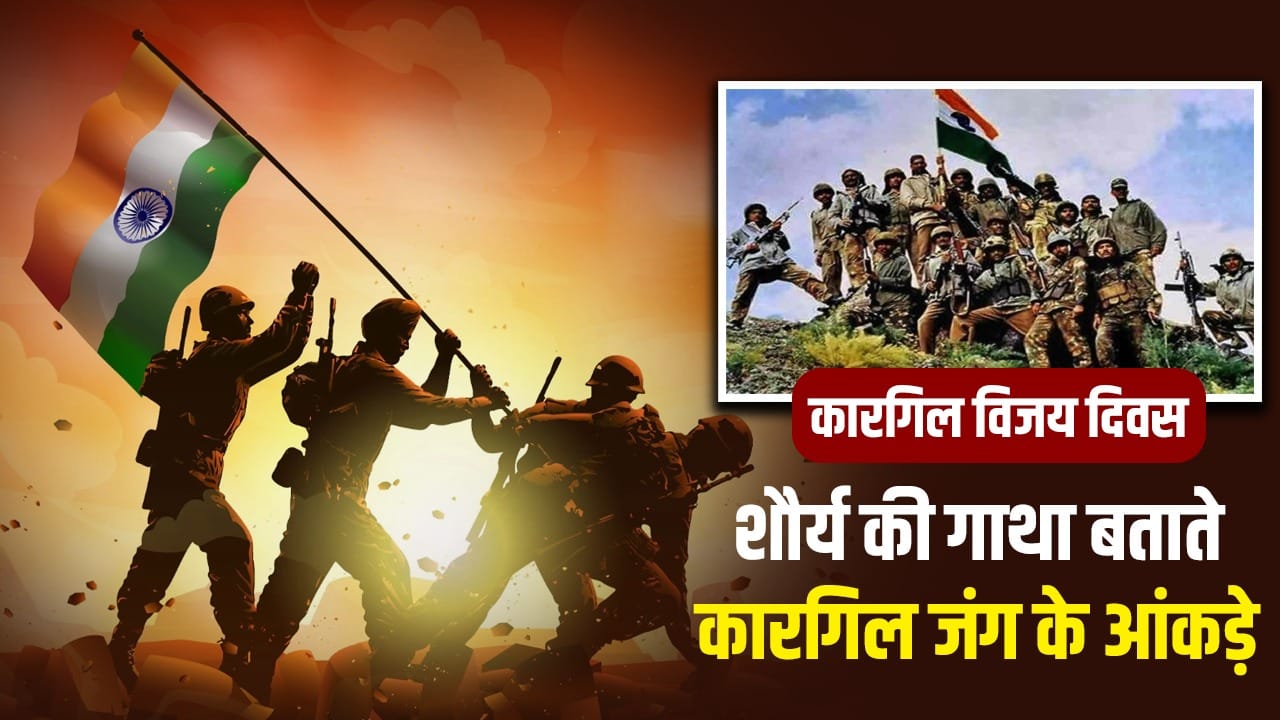
On 26 July 1999, India declared victory in the Kargil war.
27 years ago on this day, the Indian Army had announced victory over Kargil. Since then, Kargil Vijay Diwas is celebrated every year on 26 July in India. This day is a day to pay tribute to the courage, discipline and sacrifice of the Indian Army. On 26 July 1999, India declared victory in the Kargil war. For this reason this date is very important in the military history of the country. The Kargil war was not just a border conflict. Let us remember the valor of the Army on the pretext of Kargil Vijay Diwas and understand in the words of statistics how the Indian Army defeated the enemy?
The Kargil war was fought between May and July in the year 1999. The main area of the war was the Kargil area of Jammu and Kashmir. This included areas like Dras, Batalik, Kaksar and Mushkoh Valley. Around May 3, 1999, local shepherds reported suspicious activities in the high hills. Investigation revealed that infiltration was carried out at several heights across the Line of Control i.e. LOC. Initially it was considered a limited intrusion. Later it became clear that this was a planned military action. India started a big operation to drive out the infiltrators. It was named Operation Vijay.
Height became the biggest challenge of war
The Kargil war is counted among the toughest mountain wars in the world. The enemy was already sitting on high peaks. He was getting the benefit of keeping an eye on the Indian posts and roads below. Indian soldiers had to climb from bottom to top. The mountains were standing. The rocks were slippery. There was snow in many places. Attacks had to be made at night, so that they could be avoided by the enemy. Even breathing was difficult at altitude. The soldiers had to move forward with weapons, ammunition, ration and essential items. Transporting guns and supplies to many places also became a big challenge. Still the Indian Army overcame every obstacle.

Tiger Hill was the most famous front of the Kargil war, after the victory the tricolor was hoisted here.
527 soldiers were martyred, 1363 injured
India lost many of its brave sons in the Kargil war. Officially 527 brave Indian soldiers were martyred. 1,363 soldiers were injured in the war. These figures are not just numbers. Behind every number is a family. He is the son of one mother. One is the spouse of the wife. Is the father of a child. Kargil Vijay Diwas also honors the courage of all those families. There are different estimates of casualties on the Pakistani side, so it is difficult to give a definite number about them, but it is certain that several thousand lives were lost and soldiers were injured in the war.
question of safety of national highway
The Srinagar-Leh road could be monitored from some heights in Kargil. At that time this national highway was very important from strategic point of view. This was an important route connecting Kashmir valley with Ladakh. If the enemy had remained on these peaks, the pressure on this road could have increased. Due to this, there could be difficulty in the movement of army and supplies to Ladakh. This was the reason why it was strategically important to take back the Kargil peaks.

The victory was celebrated with the tricolor.
That’s why there was a need for Operation Vijay
The Indian Army launched Operation Vijay to drive out the infiltrators. The objective of this campaign was to take back the captured heights in Indian territory. The army gradually gained control over many important peaks. The fight was not straightforward. Every peak was a different challenge. The enemy was hiding in bunkers. He had the height advantage. Indian soldiers won the front on the basis of heavy fire, foot attacks and courageous mountaineering. This campaign is in front of us as a great example of the patience and professional capability of the Indian Army.
Air Force Operation Safed Sagar
The Indian Air Force also played an important role in the Kargil war. The Air Force operation was called Operation Safed Sagar. More than three hundred flights were flown in this campaign. The Air Force started action from 26 May 1999. Fighter planes targeted enemy positions, supply routes and strategic locations. Aircraft like MiG-21, MiG-23, MiG-27, Mirage-2000 and MiG-29 were used in the operation.
Precise bombing by Mirage-2000 aircraft caused damage to many important targets. The Air Force worked in difficult geographical conditions. High mountains, limited targets and weather made the operation extremely challenging. India also showed military restraint. The Indian Air Force did not cross the Line of Control while taking action.

Kargil Vijay Diwas was celebrated in Dras, Ladakh on Saturday.
naval operation talwar
During the Kargil conflict, the Indian Navy also played a role in creating pressure. The naval operation was called Operation Talwar. Indian Navy increased its presence in the maritime sector. Its objective was to create strategic pressure on Pakistan. This shows that the Kargil war was not limited to the mountains only. In this, the brave men of the Army, Air Force and Navy played their respective roles.
The victory of Tololing peak was decisive
Tololing peak was one of the first major successes of the Kargil war. It was very difficult to capture it. The enemy was on high ground and the Indian soldiers had to advance through open slopes. On June 13, 1999, the Indian Army captured Tololing. This victory boosted the morale of the soldiers. The country also got assurance that India is gradually taking back important peaks. In the battle of Tololing, many soldiers showed amazing courage and made supreme sacrifice.

Captain Vikram Batra.
Point 5140 and Captain Vikram Batra
Point 5140 was an important peak of the Kargil war. Captain Vikram Batra and his team played a big role in winning this. After this victory, his radio message, ‘Yeh Dil Maange More’ became famous throughout the country. Captain Vikram Batra later showed extraordinary bravery in the battle of Point 4875 also. He was martyred while trying to save his injured comrade. He was awarded Paramvir Chakra posthumously.
Conquest of Tiger Hill was not easy
Tiger Hill was the most talked about front of the Kargil war. Its height and position made it very important. A difficult and courageous campaign was conducted to capture this peak. On July 4, 1999, the Indian Army captured Tiger Hill. This victory became the turning point of the war. The soldiers completed the seemingly impossible climb. The attack was made from many directions. Finally the tricolor hoisted on Tiger Hill.
Four Paramveer Chakra winners of Kargil war
Four brave men were awarded Paramvir Chakra in the Kargil war. This is India’s highest military honour.
- Captain Vikram Batra: Posthumous
- Lieutenant Manoj Kumar Pandey: Posthumously
- Rifleman Sanjay Kumar
- Grenadier Yogendra Singh Yadav
The stories of these heroes inspire the youth even today. Apart from these, many soldiers received Mahavir Chakra, Veer Chakra and other military honors.
End of war and victory day
By July 1999, the Indian Army recaptured most of the important peaks. The Pakistani army had to retreat amid international pressure. On 26 July 1999, India announced the success of Operation Vijay and victory in the war. Since then, Kargil Vijay Diwas is celebrated every year on 26th July. On this day, tributes are paid to martyrs across the country including the Kargil War Memorial in Dras.
In simple words, Kargil Vijay Diwas is not just a day of celebration. This is also a day of responsibility. This reminds us how soldiers stand firm in difficult circumstances to protect the country. The sacrifice of 527 martyrs will always live in the memory of India. The courage of 1,363 injured soldiers is equally inspiring. The snowy mountains of Kargil even today testify to the bravery of the Indian Army.
Also read: How did India become the largest seafarer producing country after Philippines?