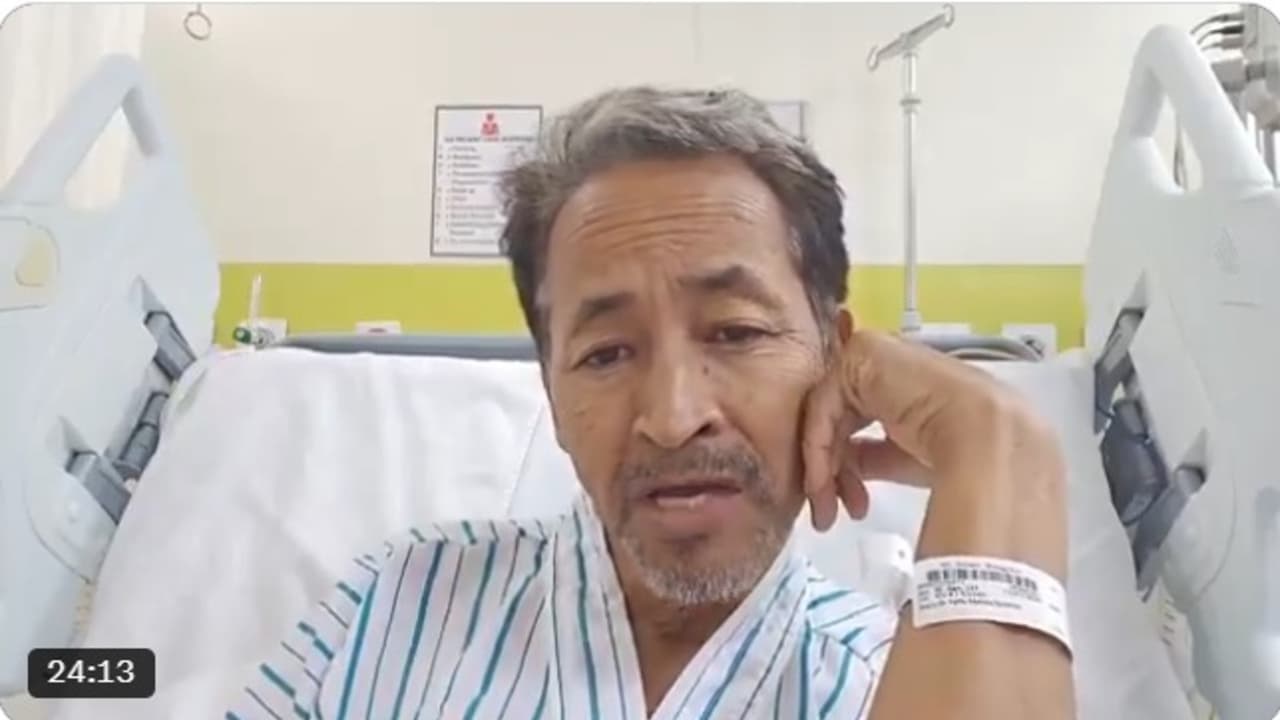
‘Feeled like North Korea’… Sonam Wangchuk revealed the secret of ending the fast in a 24-minute video. Called the hospital a ‘prison’ and cited the safety of the students as the biggest reason for the decision.
New Delhi: : Noted climate activist Sonam Wangchuk, who was on a 26-day long hunger strike for the environment and constitutional rights of Ladakh, has finally ended her fast. But after his decision, a round of criticism started from social media to political circles. Now to answer all these critics and questions, Wangchuk has released a very sensational 24-minute video from the hospital bed itself. The story he has narrated inside Delhi’s Safdarjung Hospital in this video has shocked the entire nation.
Hospital or dungeon? ‘There our country had become North Korea’
Sonam Wangchuk has made very serious and shocking allegations against the administration of Safdarjung Hospital and Delhi Police in her video. Wangchuk said, “It was not a normal hospital, but it was like a prison for me. I was imprisoned in a way.” Comparing the situation to a dictatorial country, he said that in the ICU ward of the hospital, he was treated as if he was living in ‘North Korea’. He was not allowed to even step out of his room.
Scroll to load tweet…
Messages written on napkins: Was this the whole conspiracy to cut off from the world?
Referring to that dreadful period, Sonam Wangchuk said that she was completely stopped from meeting the outside world, her supporters and even her close friends from Ladakh. There was no entry of anyone except three relatives in the hospital room. Wangchuk alleged, “I neither had a mobile phone nor a laptop. I had to resort to tissue paper and napkins on which I wrote by hand to send out my messages.” This revelation has created a new mystery by pointing towards efforts to suppress the movement.
‘Not a hospital, I was in jail’
In the video, Sonam Wangchuk said that she was not allowed to leave her room after being admitted to the ICU. He alleged that only three relatives were allowed to meet, while his supporters and colleagues from Ladakh were also not allowed inside. Not only this, there was also a ban on keeping mobile phones and laptops. He says that he had to send his messages by writing them on napkins.
‘Felt like North Korea’
Wangchuk compared the hospital system to that of North Korea and said that complete freedom of communication had ended there. According to him, there was almost complete loss of contact with the outside world. For this reason he described that experience as extremely painful.
Scroll to load tweet…
Dharmendra Pradhan’s resignation: Why did Wangchuk withdraw his biggest demand?
During this movement, the most prominent demand was for the resignation of Union Education Minister Dharmendra Pradhan, for whose sudden resignation Wangchuk is being criticized the most. Removing the curtain from this suspense, Wangchuk said that taking the resignation of the minister was never his personal or main objective. Wangchuk argued, “The government is already paying a heavy political price for this whole matter. His reputation is being tarnished across the country and there is huge anger among the public. I was confident that he would not be able to last long under this pressure and sooner or later his resignation would follow.”
The truth behind the scenes: The security of students and that midnight agreement with ministers
Wangchuk made it clear that there was no weakness behind ending the fast, rather the safety of the protesting students and protecting them from legal actions like FIR against them was his biggest concern. He did not want the future of the youth to be at stake. It is noteworthy that Wangchuk broke his fast late Thursday night at Medanta Hospital in Gurugram by drinking juice from the hands of his wife Gitanjali Angmo in the presence of BJP National President and Union Minister JP Nadda and Union Minister Jitendra Singh. However, he has also warned that even if he has ended the fast, this movement and the demand for the resignation of the Education Minister will continue unabated.