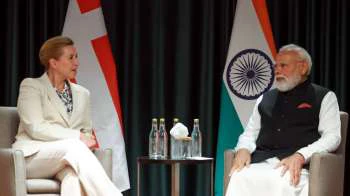
Denmark Prime Minister Mette Frederiksen on Tuesday strongly highlighted India’s growing influence, calling it “one of the biggest powers” and that it is no longer the traditionally seen “middle power”, while calling for increased cooperation between New Delhi and the Nordic nations to bring stability and prosperity to a rapidly changing geopolitical order.
The remarks came during the joint presser at the Third India-Nordic Summit in Oslo during Indian Prime Minister Narendra Modi’s visit to Norway. Speaking in PM Modi’s presence, Fredriksen said all the leaders standing on the stage believe the old world order is going in the wrong direction, which makes it even more important for nations that believe in democracy to work together for global stability and unity.
“We cannot say that India is a middle power. You are one of the biggest powers. It’s not very easy to say that the Nordic countries are a middle power because we are too small to be a middle power. But when we are united, the Nordic countries, then we are a middle power. Working together with one of the greatest powers on these very clear ideas and values, I think we can bring stability, prosperity and unity into a world that is changing rapidly,” she said.
“So we have had discussions today on how to integrate India and the Nordic countries even further, especially when it comes to democracy, AI, new technologies, green transition, defence and security,” she added.
What is a middle power in geopolitics?
A middle power is a sovereign state that is not considered a global superpower but still holds considerable influence in international affairs, positioned between smaller nations and major powers.
Such countries possess moderate economic, military and diplomatic strength, and generally rely on soft power, multilateral engagement and coalition building to influence global developments.
Middle powers strongly prefer cooperative and institution-based approaches rather than unilateral actions. They often serve as neutral mediators or facilitators, helping bridge differences between superpowers and smaller nations in efforts to resolve conflicts and promote consensus.
PM Modi stresses cooperation with Nordic nations
Delivering his remarks during the joint statement, PM Modi said India and the Nordic countries exchanged views on key global issues and reaffirmed their commitment to a rules-based international order amid rising global tensions and conflicts.
“In this era of global strains and conflict, India and the Nordic countries will continue to emphasise a rules-based global order. Whether it is Ukraine or West Asia, we will support efforts aimed at early cessation of conflicts and restoration of peace,” PM Modi said.
He also stressed the urgent need for reforms in multilateral institutions and reiterated a united stand against terrorism.
“We agree that reform of multilateral institutions is both essential and urgent. On terrorism, our position is clear and united, no compromise and no double standards,” he said.