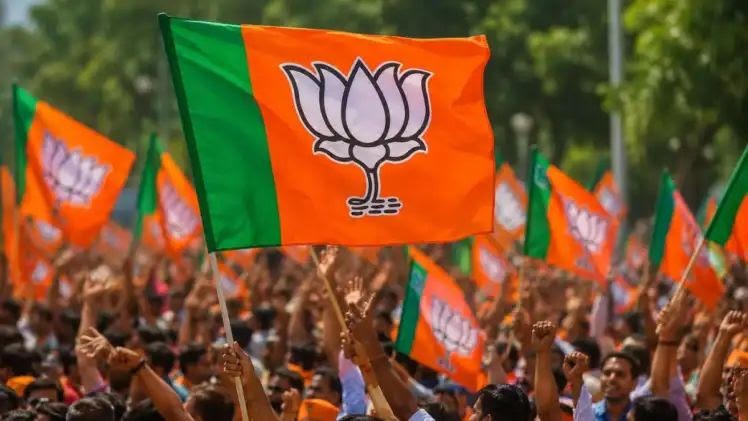
After winning the West Bengal Assembly elections for the first time, the Bharatiya Janata Party is now eyeing the Punjab Assembly elections 2027. As part of its strategy to expand at the national level, the party is trying to strengthen its political hold in Punjab.
In this sequence, on Thursday, BJP appointed Kewal Singh Dhillon as the first Sikh president of Punjab unit. The results of urban body elections on Friday further boosted the morale of the party.
This time, BJP has registered a significant lead in the elections held in a total of 1,977 wards of eight Municipal Corporations, 75 Municipal Councils and 20 Nagar Panchayats of Punjab. While the party could win only 49 wards in the 2021 elections, this time the victory figure reached more than 170 wards. Although the BJP stood fifth in terms of total wards won, ahead of the Aam Aadmi Party (AAP), Congress, Shiromani Akali Dal (SAD) and independent candidates, the election results indicated the growing influence of the BJP in the urban and semi-urban areas of Punjab.
BJP’s dominance in Abohar
BJP’s biggest success was seen in Abohar Municipal Corporation, where the party achieved majority by winning 28 out of 50 seats. At the same time, Aam Janata Party had to be satisfied with 20 seats. Abohar is a politically important area for the BJP as it is the home constituency of former state BJP president Sunil Jakhar. His nephew Sandeep Jakhar is the MLA here. In the 2021 civic elections, Congress had almost made a clean sweep by winning 49 wards here.
Allegations of irregularities in vote counting
BJP leaders have also raised questions on the vote counting process. Party spokesperson Preetpal Singh Baliawal claimed that initial trends showed the BJP winning more than 200 wards, but the figures suddenly dropped after the State Election Commission (SEC) website allegedly crashed. “We are not disappointed. We expected such steps. Preparations for 2027 have started and we will work in that direction,” he said.
It is noteworthy that this time BJP’s performance was not limited to traditional Hindu dominated urban areas only. The party also registered good presence in the municipal councils and nagar panchayats of districts like Mohali, Hoshiarpur, Fatehgarh Sahib, Mansa, Patiala and Fazilka. Apart from this, BJP also opened its account in Bathinda Municipal Corporation, which is considered to be the area of influence of farmer movements. Mansa district was the main center of farmers’ movement, where BJP had to face opposition for a long time. In such a situation, winning six Municipal Council seats is considered important for the party.
According to local social activist Gurlabh Singh Mahal, “People were angry with the lack of development work and AAP’s style of functioning on local issues. These results should be seen as a message to all political parties.”
Victory in Muslim dominated Malerkotlaimportant
One of the BJP’s most symbolic victories came in Malerkotla Municipal Council, where the party won a ward, defeating the AAP candidate by 265 votes. This victory in Muslim-dominated Malerkotla can give BJP an opportunity to strengthen its claim of increasing its acceptance among minority communities. BJP’s performance was relatively weak in Barnala, the home district of newly appointed state president Kewal Singh Dhillon. Here, out of 50 seats in the Municipal Corporation, BJP could win only seven seats, while AAP captured 36 seats.
Dhillon alleged that AAP used unfair means to win the elections. However, in Pathankot, which is considered to be the constituency of BJP working state president Ashwini Sharma, the party performed well by winning 18 out of 50 seats. Here Akali Dal got 12 seats and AAP got only four seats.
Challenges remain before 2027
Despite better performance in civic elections, BJP faces many big challenges. The party still relies primarily on urban Hindu voters in many areas and has limited organizational hold in rural Sikh-dominated areas. The Akali Dal and independent candidates remain dominant in the semi-urban areas, while the AAP also has the advantage of being in power.
The shadow of the farmers’ movement has also not completely ended. However, BJP leaders believe that opposition to the party has reduced significantly in the last five years. A BJP leader said, “In 2021, due to the farmers’ movement, many of our candidates could not even campaign. This time we campaigned openly in villages and towns. This is the biggest change in five years.”
BJP is now working on a strategy to strengthen its political base in Punjab, considering these results as the basis for the 2027 assembly elections.