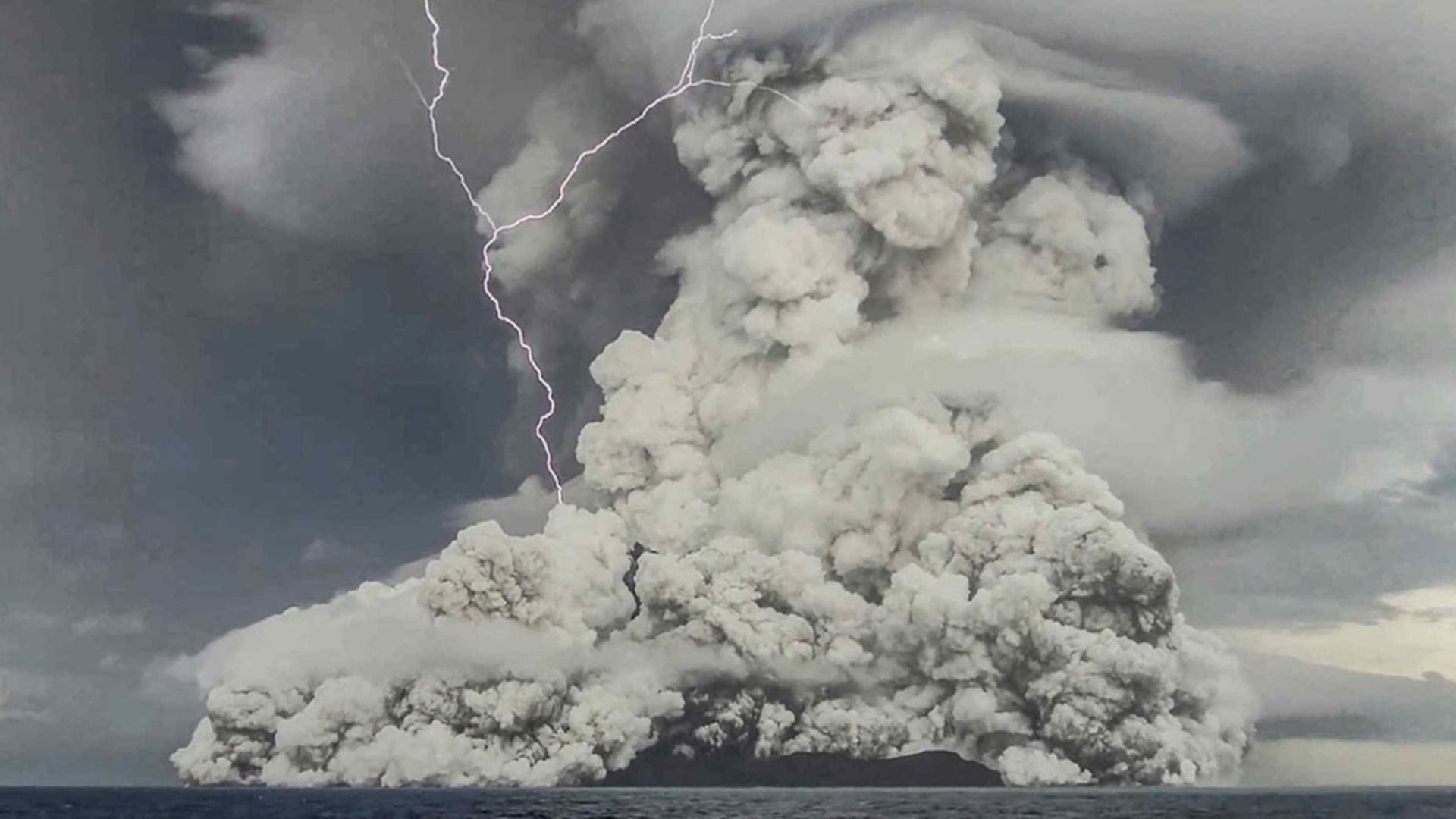
New Delhi: The eruption of the submarine Hunga Tonga–Hunga Ha’apai volcano eruption, in the South Pacific, in January 2022 was one of the most violent eruptions in modern times, producing the most violent lightning ever recorded, with a seismic wave associated with the eruption recorded 750 kilometres away. New research shows that the volcano did something scientists did not expect at all, scrubbing up some of the methane pollution it released. Satellite observations indicated unusually high concentrations of formaldehyde in the volcanic plume following the eruption, indicating the destruction of methane and the formation of a short-lived intermediate, in the form of formaldehyde.
The scrubbing process can provide valuable insights into how humans can mitigate global warming. Scientists were able to track the cloud with high concentrations of formaldehyde over 10 days, with the material reaching all the way to South America. As formaldehyde only lasts for a few hours, the observations indicate that the cloud must have been destroying methane continuously for over a week. While scientists knew that volcanoes emit vast quantities of methane, they did not know that volcanic ash partially cleans up the methane dumped into the atmosphere.
Unexpected chemistry observed in volcano plume
Scientists had first discovered the process in 2023, when dust from the Sahara blown over the Atlantic Ocean mixed with sea salt from sea spray, forming iron salt aerosols, that then produced chlorine atoms under the influence of sunlight. The chlorine then breaks down the methane in the atmosphere. The researchers were surprised to observe the same process occurring in a volcanic plume, lofted to the stratosphere. Along with the volcanic ash, the eruption injected vast quantities of seawater into the stratosphere. Methane is currently responsible for about a third of global warming. The research can guide strategies to scrub methane from the atmosphere. A paper describing the research has been published in Nature Communications.