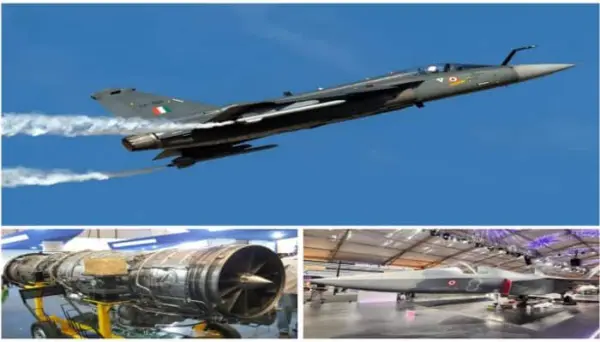
New Delhi: Nearly four decades after India launched the ambitious Kaveri fighter engine programme, the project is getting a new push with a redesigned version that could play a role in the country’s next generation of combat aircraft.
Once seen as a programme that failed to meet the requirements of the Light Combat Aircraft (LCA) Tejas, the engine is now being developed in a new form, popularly referred to as Kaveri 2.0, with the aim of supporting future platforms such as the Advanced Medium Combat Aircraft (AMCA) and advanced unmanned combat aircraft.
The effort comes as India continues to reduce its dependence on imported defence technologies. While Tejas flies with General Electric’s F404 engine and the Tejas Mk-2 is expected to use the more powerful F414, the long-term objective is to build an indigenous fighter engine capable of powering advanced military aircraft.
Recent updates from the defence establishment suggest that work on the Kaveri programme has gained momentum, with engineers working to improve thrust, reduce weight and incorporate modern engine technologies.
Officials have also said that foreign collaboration for select technologies may be considered, while the larger goal continues to be an indigenous engine.
A project that began in 1986
The Kaveri engine programme was launched in 1986 by the Defence Research and Development Organisation’s (DRDO) Gas Turbine Research Establishment (GTRE). The mission was to develop an Indian fighter jet engine and reduce reliance on overseas suppliers.
However, building a modern fighter engine turned out to be one of the toughest technological challenges. Such engines must generate high thrust, keep the weight low, operate reliably at extremely high temperatures and perform consistently under demanding combat conditions.
Over the years, the programme crossed several development milestones, but achieving all the performance targets proved difficult.
Why Kaveri could not fly with Tejas
The original Kaveri engine completed several tests but fell short of the thrust required for the Tejas fighter. It produced around 70-72 kN of thrust with the afterburner, while the aircraft required about 83-85 kN.
The engine was also heavier than expected, and its overall performance did not fully match the IAF’s operational requirements.
After extensive evaluation, the government decided in 2008 to separate the programme from the Tejas project. The Tejas fleet went on to use the GE F404 engine, while the more advanced Tejas Mk-2 was designed around the GE F414.
The decision did not end the Kaveri programme. Scientists continued development, using the experience gained from years of testing to redesign the engine.
What is different about Kaveri 2.0?
The new version is far more than an upgrade of the original engine. It is being developed using improved metallurgy, more efficient turbine technology, a redesigned high-pressure compressor, a modern Full Authority Digital Engine Control (FADEC) system and advanced manufacturing techniques.
The engine is also expected to be lighter than the earlier version while delivering better thrust-to-weight performance and improved reliability.
Defence experts believe these changes could help overcome the shortcomings that prevented the original Kaveri from meeting fighter aircraft requirements.
AMCA now takes centre stage
Kaveri 2.0 is no longer being developed with Tejas in mind. Its primary objective is to support India’s future combat platforms, including the fifth-generation AMCA stealth fighter and advanced unmanned combat aerial vehicles (UCAVs).
Projections suggest the redesigned engine could initially produce around 81-83 kN of thrust with the afterburner, with scope for further improvements in later versions. While the AMCA’s final production configuration is expected to require a more powerful engine, Kaveri 2.0 is viewed as an important step towards developing a fully indigenous fighter engine.
If successful, the programme could strengthen India’s defence manufacturing ecosystem and reduce dependence on overseas engine suppliers for future aircraft programmes.
A long road towards self-reliance
Only a handful of countries have mastered the technology needed to design and manufacture modern fighter jet engines. India has spent decades building expertise in this field, and the Kaveri programme is one of its most ambitious efforts.
Much of the technology developed during the project has already been used in other defence and aerospace programmes. The latest version builds on those lessons while taking advantage of advances in materials, digital controls and manufacturing.
Kaveri 2.0 still has technical milestones to cross before it can enter operational service. Even so, the programme has moved well beyond the stage where many believed it had ended. India’s defence planners now see the project as more than an effort to revive an old engine. The aim is to develop an indigenous capability that can support future fighter aircraft and give the country greater flexibility in its long-term air power plans.