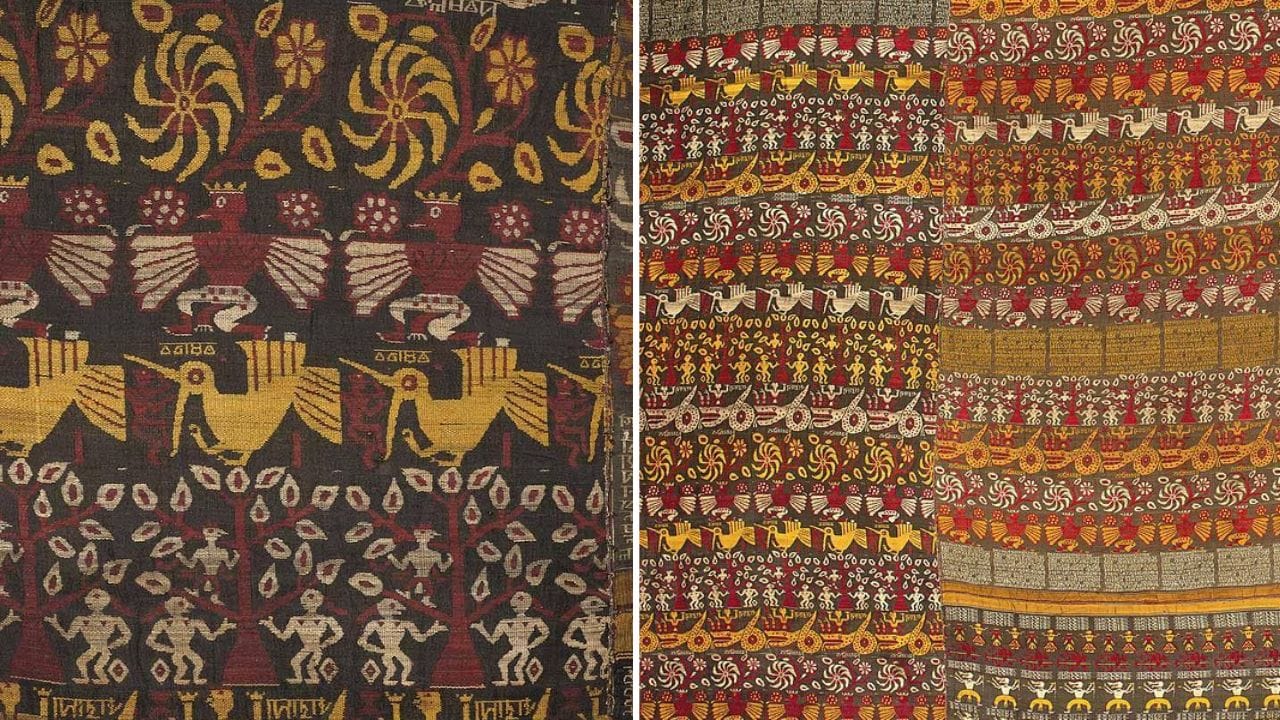
New Delhi: The Vrindavani Vastra stands as one of Assam’s most remarkable textile traditions, combining devotion, art and storytelling into silk. Created in the 16th century under the vision of Srimanta Sankardev, this sacred textile captures scenes from Krishna’s life along with narratives linked to Ram and the Kalki avatar of Vishnu. Commissioned by Koch king Naranarayana and woven near Barpeta, the Vastra reflects a rare fusion of craftsmanship and spiritual expression.
Over time, this Assamese silk travelled far beyond its origin, moving through Bhutan and Tibet before reaching Europe, where it was preserved in major museums. Despite its global recognition, the textile remained distant from the land that created it for decades. Today, renewed efforts are bringing the Vrindavani Vastra back into focus, not just as a historic artefact but as a living symbol of Assam’s cultural identity, craftsmanship and devotion that continues to hold relevance in both heritage studies and contemporary cultural discussions.
Use of Vrindavani Vastra
Altar covering
The Vrindavani Vastra was traditionally used to adorn the Simhasana or Guru Asana within Sattras, where sacred texts such as the Bhagavat Purana were placed. This use elevated the textile beyond decoration, giving it a central role in spiritual practice. Draped carefully, it became part of ritual settings, reinforcing its sacred value within Vaishnavite traditions in Assam.
Visual storytelling
In a time without printed books or digital tools, the Vastra served as a powerful medium of visual storytelling. Through detailed woven imagery, devotees could understand episodes from Krishna’s life while monks recited prayers and performed rituals. This made the textile an accessible spiritual guide, especially for those who could not read or write.
Theatrical backdrop
The textile also found use in cultural performances such as Ankiya Naat and Bhaona. It acted as a backdrop, adding depth and authenticity to these traditional plays. Its presence helped connect performance, devotion and storytelling, making it a key element in Assam’s theatrical heritage.
Weaving technique
The Vrindavani Vastra showcases exceptional technical skill through the Lampas weaving method, which combines twill and plain weave in intricate patterns. This approach allowed artisans to create detailed imagery with varying textures and precision, a level of craftsmanship that remains rare even today. Experts have identified two stylistic variations among the surviving pieces.
Chepstow type
This style is marked by detailed and expressive designs, including depictions of Vishnu’s avatars. One well-known panel features imaginative scenes such as a three-headed demon and monkeys in combat, reflecting strong narrative energy. The style also shows influences linked to the Pala School and Western Indian manuscript traditions.
Newark type
The Newark type presents a simpler composition, using fewer motifs and a more limited colour palette. While less intricate, it still carries the essential visual and cultural elements of the Vastra, offering a different perspective on its artistic range.
Inscriptions
A striking feature of the Vrindavani Vastra is the inclusion of woven inscriptions alongside its imagery. These inscriptions label characters and may also connect to Sankardev’s Borgeet, devotional songs associated with ragas such as Dhanasri, Gauri and Asavari. Scholars believe some of these woven texts could represent original compositions, turning the textile into a visual and literary expression of devotion.
Its long journey: Assam to Tibet to Europe
After its creation in Assam, the Vrindavani Vastra travelled to Bhutan and then to Tibet, where the silk strips were stitched together under a Chinese dragon brocade. In Tibetan monasteries, it was used as a hanging textile, continuing its religious significance in a different cultural setting. During the early 20th century, Perceval Landon brought the textile to England as part of a British expedition. It was later housed in the British Museum, initially labelled as Tibetan silk before being correctly traced back to Assam.
Fragments of the Vastra are now preserved in institutions such as the Victoria and Albert Museum in London and the Musée Guimet in Paris. A related piece was auctioned at Christie’s in New York in 2004, while another is held at the Philadelphia Museum of Art. Among these, one unusual example includes a coat lined with Vastra fabric, suggesting it may have been repurposed, possibly to conceal its origin during transit.
Decades of failed attempts
For many years, efforts to bring the Vrindavani Vastra back to Assam did not succeed. In 2013, Assam’s cultural affairs minister Pranati Phukan noted the difficulty in even accessing the textile. Requests for its return faced challenges due to strict conditions set by the British Museum regarding preservation and insurance. Although it was displayed in 2016 in a major exhibition, it remained outside India.
Breakthrough in November 2025
A significant development came in November 2025 when Assam CM Himanta Biswa Sarma initiated its return through an agreement with the British Museum. The Vastra is expected to be displayed on loan for 18 months starting in 2027 under controlled conditions. A dedicated museum is being developed in Guwahati with support from the JSW Group, with the foundation ceremony held in February 2026. Before reaching Assam, the textile will be showcased in Mumbai at the Chhatrapati Shivaji Maharaj Vastu Sangrahalaya, marking a major step in reconnecting this historic artefact with its roots.
The Vrindavani Vastra today stands not only as a masterpiece of Assamese weaving but also as a symbol of cultural continuity, carrying its story across regions, centuries and communities.