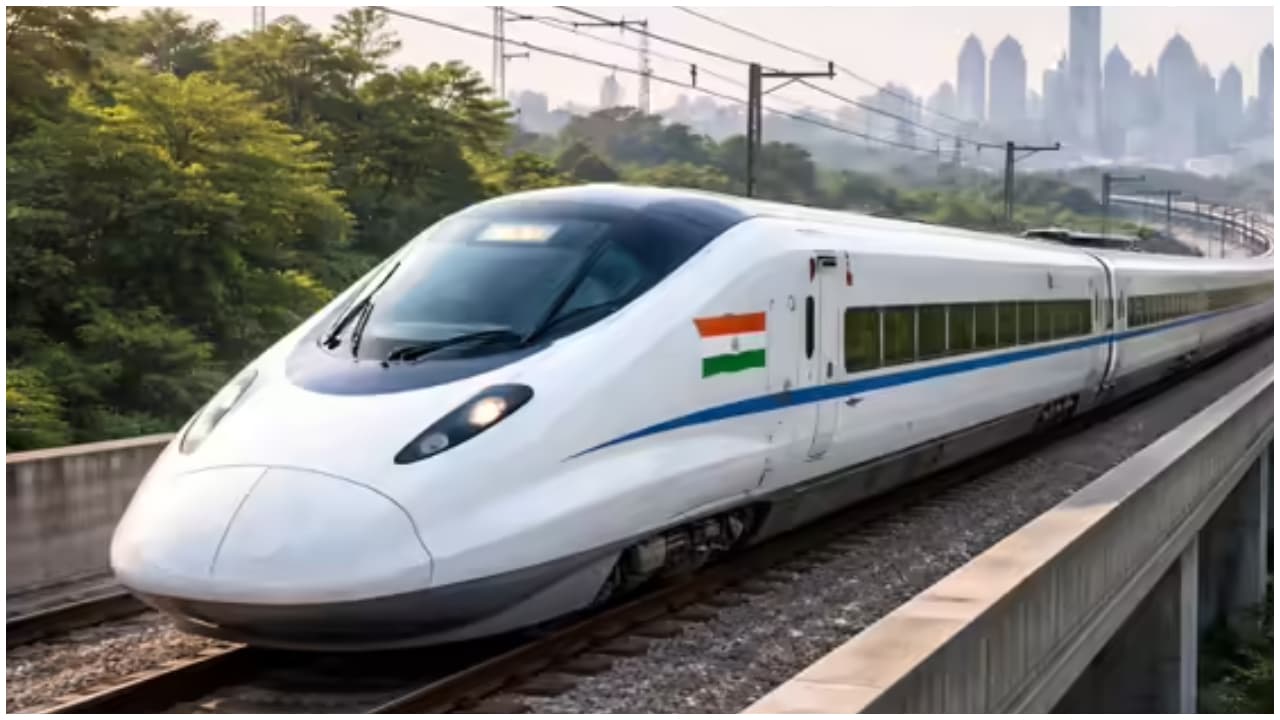
B-28 Bullet Train India: Construction of India’s first indigenous bullet train B-28 has started. This high-speed train with a speed of 280 km per hour can run on the tracks by 2027. Know its features, route, cost and complete information about BEML project.
India’s First Bullet Train: Indian Railways is moving forward at a fast pace not only on the tracks but also in the direction of technology and self-reliance. After years of depending on foreign countries for high-speed rail technology, India has now taken a big step on its own. The construction of the country’s first indigenous high-speed bullet train B-28 has formally started. Railway Minister Ashwini Vaishnav inaugurated BEML’s ‘Aditya Plant’ in Bengaluru, with the construction work of India’s first bullet train officially gaining momentum. This is not just a train, but is being considered as a new direction for the future of Indian Railways.
New momentum started from BEML’s Aditya plant
Two high-speed trainsets capable of running at a speed of 280 kilometers per hour will be manufactured at BEML’s Aditya plant in Bengaluru. The construction of these trainsets is considered to give a new identity to India’s railway technology at the global level. According to the Railway Ministry, the first trainset is expected to be ready by March 2027, while it is expected to be operational by August 2027. The project came into limelight in October 2024 when Integral Coach Factory (ICF), Chennai, awarded the contract to BEML for the design, manufacturing and commissioning of these high-speed trainsets.
Also read: Sandeep Pathak: Why will Sandeep Pathak’s departure hurt Arvind Kejriwal more than Raghav Chadha?
The project costing more than Rs 866 crore
BEML got the contract to manufacture two high-speed trainsets in October 2024. This entire project is estimated to cost approximately Rs 866.87 crore. Integral Coach Factory (ICF), Chennai and BEML will jointly work on the design of the train. This partnership is considered an important step towards making India self-reliant in high-speed rail technology. Experts believe that this project can create a strong domestic model of bullet train manufacturing for India in future.
First train will run on Surat-Vapi route
In the initial phase, there is a plan to run this high-speed train on a 97 km long route between Surat and Vapi. This route is part of the Mumbai-Ahmedabad Bullet Train Corridor. It is being told that the train may be rolled out between the first quarter of 2027 i.e. March-April. After this, trial runs will be started, so that all the processes related to safety, speed and operation can be tested. If everything is completed on schedule, India could see its first indigenous high-speed train running on tracks in 2027.
Features of the train: Not only speed, but also luxury
This bullet train is being made special not only for high speed but also for passenger facilities. It will have fully AC chair-car coaches, which will make long distance travel more comfortable. The train seats will have 360 degree rotation and tilt, which is expected to provide airline-like facilities to the passengers. Apart from this, onboard infotainment system, modern safety technology, better suspension, low noise and world class facilities will also be included in it. Railway experts say this experience could change the definition of train travel in India.
Big step towards reducing dependence on Japan
Till now, India’s bullet train projects have been heavily dependent on foreign technologies like Japan. Especially in the Mumbai-Ahmedabad Bullet Train Project, Japanese Shinkansen technology has played an important role. But the creation of indigenous high-speed trains like B-28 is a strong signal towards reducing this dependence. This initiative also strengthens the ‘Make in India’ and ‘Self-reliant India’ missions. In the future, India can develop the capacity to manufacture high-speed trains not only for its own needs, but also for the global market.
Why is this historic for Indian Railways?
India has one of the largest rail networks in the world, but high-speed train technology has seen limited progress until now. B-28 is not just a new train, but a symbol of Indian engineering, design capability and technological confidence. This project proves that India is no longer just a country that buys technology, but is also becoming a country that develops it. In the coming years, when this train will run on the tracks at a speed of 280 kilometers per hour, it will take not only the passengers but also the self-reliant future of India forward.
Also read: Punjab government removed security, Center immediately sent CRPF! Big game regarding Harbhajan Singh?