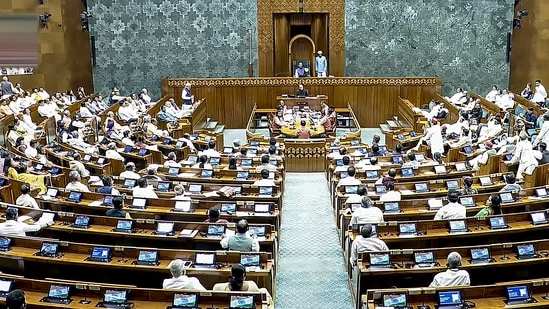
Our Parliament is discussing a Constitution amendment bill to increase the size of the Lok Sabha to 850 lawmakers, from the current cap of 550 – a change that has to be approved by two-thirds of members present and voting in both Lok Sabha and Rajya Sabha.
The government has clarified that while 850 is the ceiling, the plan is to increase the number of seats from 543 to 816.
If this proposal goes through, our Lok Sabha will become the largest directly elected legislative body in the world. China’s National People’s Congress, which has roughly 3,000 deputies, is an indirectly elected House.
A closer look at the current functioning of the Lok Sabha offers insights into what a larger House might entail. This examination can be divided into two broad categories: first, the day-to-day operational functioning; and second, the underlying institutional issues.
One of the most visible aspects of Lok Sabha’s functioning is the Question Hour. It is the first hour of the House when MPs ask oral and written questions to ministers about the work done by the government. The purpose is to hold the government accountable on behalf of the people. In the 2025 monsoon session, Lok Sabha MPs submitted roughly 30,000 questions that they wanted answered. The Lok Sabha secretariat then examined these questions to check if they conform to the rules of procedure. Then a randomised lottery selected 400 oral and 4,800 written questions, which were sent to different ministries. Each day, ministers tried to answer roughly 20 questions in person – comprising large chunks of the lively exchanges in the House that viewers catch on television – and provided written answers to 230 other questions.
Then comes Zero Hour, when MPs highlight issues from their constituencies on a national forum. In the ongoing budget session, on average, 140 MPs gave notices for raising the concerns of their constituents. Another lottery led to 20 MPs getting the opportunity to read out a prepared statement in the House, spanning anywhere between three and five minutes.
This is followed by discussion on the government’s bills and budget proposals. A business advisory committee chaired by the Speaker and comprising members from all political parties allocates time to each debate. The allocated time is split between parties based on their relative strength; parties divide their time amongst their members, who speak on the party’s behalf. On Fridays, MPs get 2.5 hours to champion legislation that they think is important – even though a large majority of them don’t even come close to passing.
Speakers of Lok Sabha and its MPs have repeatedly said the House does not meet often enough, given the scale of its responsibility. For the last decade or so, the House has met between 55 and 70 days a year. There is simply no time for everyone to have a say. As a result, the current system is barely held together by constraints such as timed debates and lottery selection.
Imagine now, that the Lok Sabha has 816 or 850 MPs. If drastic changes are not done in the way the Lower House functions, it might become ineffective in holding the government accountable, scrutinising laws and analysing budgets. A large proportion of our representatives might not also be able to get themselves heard meaningfully in their five-year term.
The UK’s House of Commons – which has 650 MPs – does things differently. The House splits its time between two chambers. A main chamber, where all MPs meet together, is where Question Hour and other national debates take place. In a second chamber, MPs discuss other topical issues. UK parliamentarians also can ask an unlimited number of written questions to the government. And once every week, British MPs question their Prime Minister for an hour. Most importantly, the UK Parliament meets for 150 days. Out of these, 20 days are set aside for the Opposition to set the agenda for debate. It also has a comprehensive committee system that ensures that government bills are scrutinised thoroughly before they reach the House floor for debate.
To be sure, our parliamentary system has some innate institutional challenges. Our Lok Sabha MPs shoulder duties that are quasi executive in nature. For example, they are appointed to different boards, advisory councils, technical bodies, authorities, universities and AIIMS under the central and state government. Over decades, successive governments have amended the office of profit law to add more offices that MPs can hold without incurring disqualification.
Then, there is the MP Local Area Development Scheme that directly involves elected legislators in recommending public works in their constituency. These offices and schemes pitch the MPs into domains that should be the government’s responsibility. In addition to co-opting parliamentarians in the local administration, such systems also distract them from their primary responsibility as a lawmaker.
Then, there is the anti-defection law that mandates that MPs have to follow what their political party dictates them to do in Parliament. Whether it is the removal of a judge or a constitutional amendment bill, lawmakers are bound by their party’s whip and cannot exercise independent judgement. If they do so, they risk losing their seat. Whether the number of MPs is 550 or 850, party bosses will ultimately decide what stance an MP takes on an issue.
Most countries keep MPs out of executive positions and don’t have mandatory whips. These two institutional issues, if not addressed, risk amplifying the Lok Sabha’s current problems in a larger House. Irrespective of the outcome of the current debate in Parliament, fixing these issues is critical in having a well-functioning Lok Sabha. A larger House might not always translate to a better-functioning House. To make the Lok Sabha truly work for the betterment of the people whose votes form its foundation, structural changes will be required.