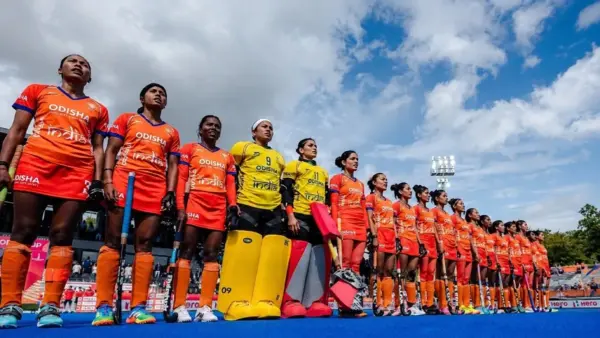
Amstelveen, Aug 20: England had 12 penalty corners, increased the pressure after half-time and even removed their goalkeeper in the closing stages.
Yet India refused to concede.
The 0-0 draw between India and England in their final Pool D match at the FIH Women’s Hockey World Cup was ultimately shaped by India’s ability to withstand sustained pressure, with goalkeepers Savita Punia and Bichoo Devi at the centre of a disciplined defensive effort.
India’s performance was particularly notable because the match followed two very different patterns. For much of the first half, India were the side asking the questions. They created opportunities, won penalty corners and controlled the tempo.
After the break, England changed the complexion of the contest. They pushed higher, generated repeated entries into India’s circle and earned 12 penalty corners. But India’s defence, backed by its two goalkeepers, prevented England from converting that territorial dominance into a goal.
India lose attacking momentum after half-time
India coach Sjoerd Marijne acknowledged the contrast between the two halves.
“Very happy with the result. We were in full control of the match in the first half. We created chances, got PCs and defended very well, but in the third and fourth quarter we could not maintain that,” Marijne said.
That inability to sustain the attacking momentum meant India spent much of the latter stages defending rather than controlling possession and territory.
But the defensive response was strong enough to compensate.
England’s 12 penalty corners represented a significant examination of India’s defensive structure. The Indian players repeatedly dealt with the set-piece pressure, while Savita and Bichoo provided the final layer of protection.
Marijne specifically praised the two goalkeepers for complementing each other.
“Yes, we have given many PCs but kudos to the goalkeepers who have defended well. It is an example in top sports that two players can complement each other and I am very happy with them and the way they support each other,” he said.
Savita and Bichoo make the difference
Savita, who has more than 300 international caps, described the match as a “knockout match” because of the pressure surrounding India’s qualification.
“We already knew that it would be a tough match. We dominated the first half and earned many PCs. We have to continue attacking hockey and convert those chances. It was like a knockout match for us and there was pressure, but as a team we played well,” she said.
The veteran goalkeeper was particularly pleased with India’s defensive effort. “Our defence was at its best today,” Savita said.
The biggest moment came in the final 30 seconds. With England having withdrawn their goalkeeper in search of a winner, the pressure on India increased further. Bichoo produced a crucial save to deny the hosts and preserve India’s clean sheet.
Savita singled out the moment for special praise. “Bichoo’s save in the last 30 seconds was one of the best I have seen. I have hugged her many times. We are the strength of each other,” she said.
Bichoo, meanwhile, said she anticipated England’s all-out assault after the goalkeeper was withdrawn.
“When they removed the goalkeeper in the last minutes, I felt that they would go for full press. I was prepared for that and was just looking at the ball. I am very happy with the performance of the defence,” she said.
England’s pressure produces no breakthrough
The key analytical takeaway from the match is that England’s territorial pressure did not translate into the one thing that ultimately mattered – a goal.
India conceded 12 penalty corners and struggled to reproduce their first-half attacking intensity, but they managed the decisive moments inside their own circle.
That allowed India to walk away with a goalless draw and progress to the second round.
For a side featuring 11 World Cup debutants, the ability to survive a prolonged spell of pressure against England was an important test of composure.
Savita has also taken on a mentoring role within the young squad, helping the less experienced players deal with the pressure of playing at a World Cup.
“I keep telling them that you will make mistakes but the most important is to make a comeback well. Being a mentor and senior I always try to make them feel relaxed. I am very happy with their performance,” she said.
Netherlands now await India
India’s reward for negotiating England is a second-round meeting with hosts Netherlands on Friday (August 21). The turnaround is a demanding one, with Marijne admitting that additional rest would have been preferable.
“It would have been better if we got some rest before the second round but it is the way it is and we can’t change it,” he said.
The Netherlands will present a different challenge, particularly with the home crowd expected to create a packed and hostile atmosphere.
Marijne, a Dutchman himself, is familiar with the opposition but expects the match to be an entirely different experience for his young team.
“Tomorrow we play Netherlands in a packed stadium and that would be altogether a different experience. I know them very well and it is a very, very good team. All the learnings would be great for us,” he said.
India will also need to be more clinical with their own penalty-corner opportunities. Marijne backed Navneet Kaur and Deepika to improve their execution in the next match.
“Navneet and Deepika both are very good. PC is about injection, push, stop, everything. They will work hard and come good in the next match,” he said.
For Bichoo, the England game was also valuable preparation for another likely examination of India’s penalty-corner defence against the Netherlands.
“We have to play the Netherlands tomorrow and it was good PC defence practice for us as goalkeepers,” she said.
India may not have controlled the second half, but they controlled the most important statistic: the scoreline. England’s 12 penalty corners, late goalkeeper withdrawal and sustained pressure all produced the same outcome – no goal.
And that defensive resilience has taken India into the next round of the Women’s Hockey World Cup.