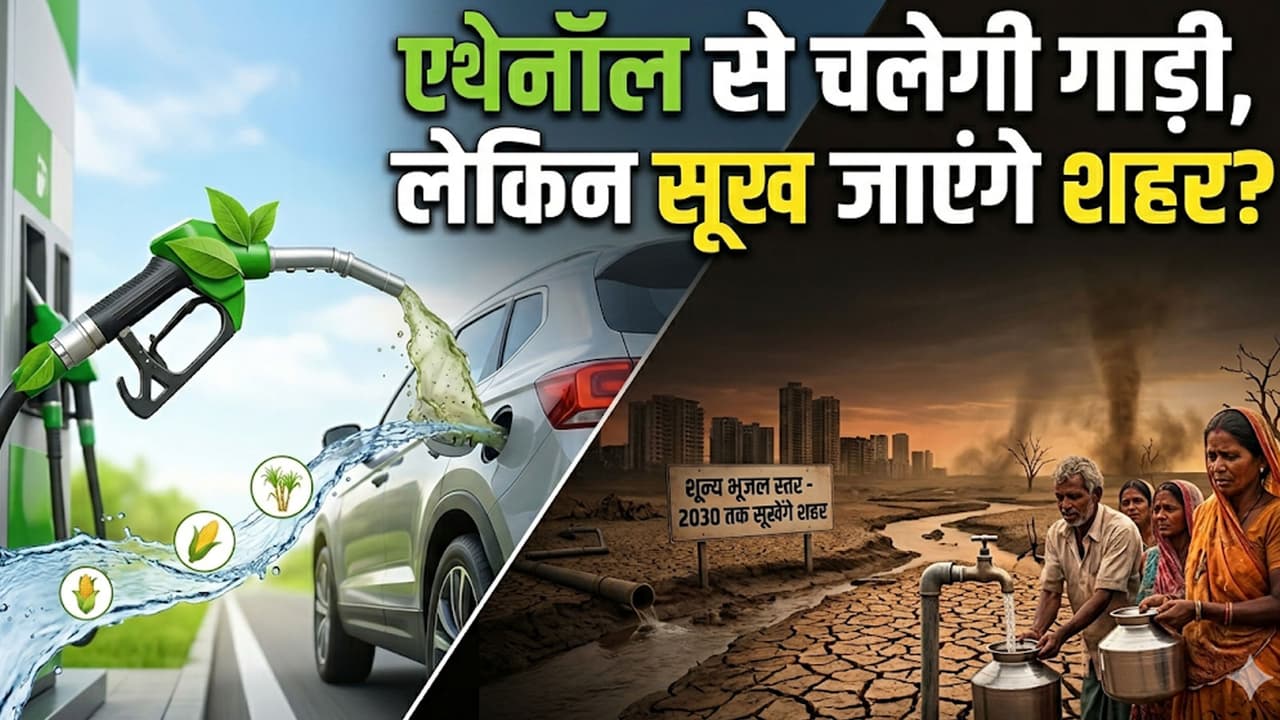
Ethanol Blending in India: India is trying to save foreign exchange by mixing ethanol in petrol, but it may have to pay the price in the form of water crisis. The shocking thing is that in making just 1 liter of ethanol from rice, 10,790 liters of water is being wasted. According to the NITI Aayog report, if this indiscriminate exploitation of water continues, 21 cities may dry up by 2030.
Ethanol Production Water Consumption: Do you know that many cities in India are paying the price of running your car on ‘clean energy’? What we are promoting by calling it ‘Green Fuel’ is actually pushing the groundwater level into the underworld. Recent reports and warnings from experts have painted a scary picture. Approximately 10,790 liters of water is being consumed to prepare 1 liter of ethanol made from rice. In such a situation, the question arises, is ethanol blending taking the country towards a major water crisis? Let us understand…
What is ethanol blending?
The Government of India is carrying forward the program of blending ethanol in petrol to reduce dependence on crude oil imports. Although its objective is to save foreign exchange and reduce carbon emissions, the price behind it is being paid from water. Major crops used to make ethanol such as rice, sugarcane and maize are the most water-guzzling crops in India. According to experts, this could further deepen India’s water crisis, as the process of growing and processing these raw materials is completely water-based.
How much water is being wasted in making ethanol?
The figures of water consumption in ethanol production are enough to scare anyone. According to data shared by Food Secretary Sanjeev Chopra in 2024, to produce just one liter of ethanol from rice, about 10,790 liters of water is consumed, which includes both irrigation and processing. If we talk about maize, it requires 4,670 liters of water per liter, whereas for sugarcane this figure is 3,630 litres. The most surprising thing is that about 3,000 liters of water is required to grow 1 kg of rice, but only 470 liters of ethanol is obtained from one ton of rice. This ratio can be dangerous for a country like India, where there is already a shortage of drinking water.
Danger of ‘Day Zero’ in 21 cities of India by 2030
According to the ‘Composite Water Management Index’ (CWMI) report of NITI Aayog, the groundwater level of 21 major cities like Delhi, Bengaluru, Chennai and Hyderabad may reach zero by the year 2030. The surprising thing is that most of the ethanol plants are in the same states which are already facing water stress. Maharashtra’s plant has a capacity of 396 crore litres, while farmers in Vidarbha and Marathwada are craving drinking water. Ground water is also being exploited indiscriminately in Uttar Pradesh and Karnataka. Energy expert (IEEFA) Swati Seshadri says that the contaminated waste water (Vinasse) coming out of these plants is polluting the land and rivers, which puts a big question mark on the claim of ‘Green Energy’.
Impact on the plate of the poor
The government has set a target to allocate 90 lakh tonnes of rice ethanol for the year 2025-26. For this, the share of broken rice given to the poor under the Public Distribution System (PDS) is being reduced from 25% to 10%. Many more questions are arising from this.
Another danger of pollution
Experts warn that ethanol mills produce large amounts of waste water (Vinasse). If it is not addressed properly, it can poison both surface water and groundwater. What we are calling ‘green energy’ can become a new source of water pollution.