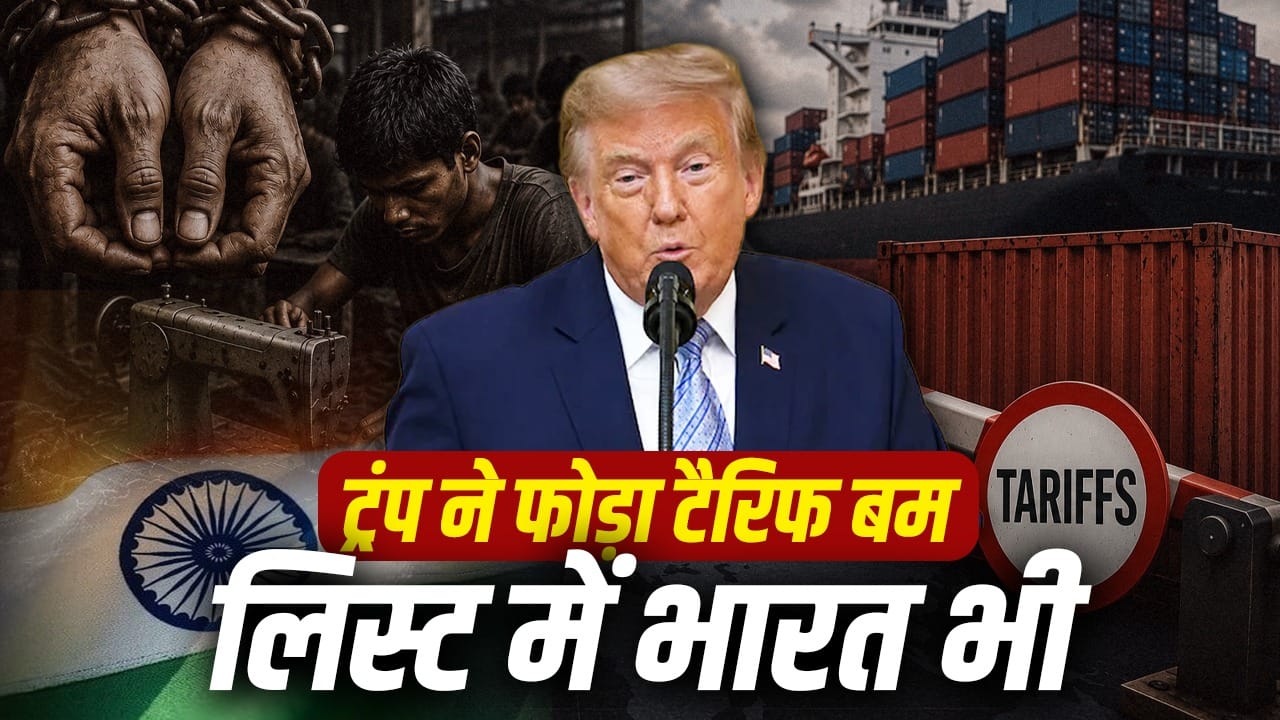
Making a person work without his consent comes under the category of forced labour.
America has announced to impose 10 percent additional tariff on some goods coming from India. This action has been taken on the basis of concerns related to forced labour. America has taken this step after reviewing the policies of many trading partner countries. India has been placed in the group with a relatively low rate of 10 percent.
This tariff has been imposed on many Asian countries including Bangladesh, Pakistan, Sri Lanka, Britain as well as some Latin American countries. Let us understand with this excuse what is forced labor in international business?
What is the definition of forced labour?
Making a person work without his consent comes under the category of forced labour. If a worker wants to leave the job but is not allowed to leave, this may be forced labour. Even if he is forced to do the work by threatening him, the matter can become serious. The International Labor Organization considers forced labor a violation of human rights. The consent of the person working in this is not really free. He is working under some pressure.

The International Labor Organization considers forced labor a violation of human rights. Photo: AI PIC
Not just low wage forced labour.
Not every low wage job can be called forced labour. In many countries, workers get low wages. Working hours can also be long. This may certainly be an issue of labor rights, but to prove forced labour, concrete signs of pressure or control are seen. For example, a person may be working at a lower salary than he wishes and may leave the job at any time. Such a situation will not always fall within the legal definition of forced labour. But if he is threatened with non-payment of salary, police action, violence, loan or confiscation of passport, then the matter becomes different.
What are the main signs of forced labour?
Forced labor is identified by many signs. These include not having the freedom to leave the job, threatening the worker, showing fear of assault or violence, snatching passport, identity card or other documents, withholding salary, tying him/her by giving huge loans, restricting the movement of workers, charging huge fees in the name of recruitment, making children do dangerous or compulsive work, controlling the workers by keeping them isolated etc. One or more of these signs can bring a case under suspicion.

Forced labor is identified by many signs. Photo: Pexels
labor trap through debt
A common form of forced labor is debt-related. This is also called bonded labour. Suppose, a recruitment agent gives a big loan to a laborer in the name of getting him a job abroad. Later the worker is told that he cannot leave the job without repaying the loan. His salary is also deducted. In such a situation, the laborer gets caught in a financial trap. Many times the loan is increased so much that the worker is unable to repay it for years. This situation becomes a matter of serious concern in international trade.
Seizing documents is also a big sign
In cases of foreign labourers, confiscation of passport is considered a serious sign. Without a passport, a person finds it difficult to leave the country or find a new job. The employer can take advantage of this situation. Even if the company keeps the documents for safety, the worker should have the right to get them back easily. When a worker’s freedom is limited by withholding documents, it creates the fear of forced labour.
children forced to work
Child labor and forced labor are related issues, but they are not the same. Not every child labor is forced labour. Nevertheless, if children are forced to work due to threat, debt, trafficking or coercion, it is a serious human rights violation. The use of children to work in hazardous factories, mines, farms or in illegal activities is a matter of particular concern. The liability of companies and countries increases when such materials are found in international supply chains.
Why is this issue important in international trade?
Today a product is manufactured through many countries. Cloth may be made from cotton grown in a country. The thread may be prepared in another country. The cloth can be stitched in a third country. The final product can then be shipped from a fourth country to America or Europe. This is called global supply chain. In this system, allegations of forced labor at any one level can make the entire product controversial. Buying countries raise the question whether the rights of workers were respected in the manufacturing of the product or not?
US President Donald Trump. (file photo)
What is America’s stance?
America has long had a policy of banning or taking action against the import of goods made with forced labor. His argument is that such products are cheaper because workers do not get proper freedom, wages or security. This may give unfair advantage to companies that do not follow labor laws. On the other hand, the costs of companies that follow the rules increase. For this reason, America considers forced labor as a human rights issue as well as a fair trade issue. Using this as its basis, America has imposed new duties on many countries including India. This action has been taken under Section 301 of the American Trade Act, 1974.
Reference to 10 percent tariff on India
America has placed India in the group of countries on whose imports an additional tariff of 10 percent has been imposed. The US has asked countries that have not been able to take adequate action to stop the import of goods related to forced labor, to take more strict measures. It would not be correct to say that every product or every industry in India is accused of forced labour. At the broader policy level, this tariff is an instrument of pressure. Its objective is said to be to increase supply chain investigation, transparency and adherence to labor standards.
How much will Indian exporters be affected?
Additional tariffs may make Indian goods costlier in the American market. If the product will be expensive, American buyers may look for alternatives from other countries. Exporters may also feel pressure to reduce their prices. This may affect their profits. Sectors like textiles, garments, leather, gems and jewellery, agricultural products and some engineering goods are expected to be affected. However, the actual impact will depend on the product, the market, the charges already in place and the behavior of buyers.
In this way it can be said that forced labor is an issue of both human rights and business. It means making a person work through pressure, fear or control. The international market no longer just looks at the price of the product. He also looks at the conditions under which the product is made. America’s additional tariffs are a sign of this changing business environment. The challenge for India is to strengthen the protection of labor rights, make the supply chain transparent and prepare exporters to meet international standards. This will not only reduce the risk of tariffs but will also increase confidence in Indian products.
Also read: Why do we end hunger strikes with juice or coconut water only? Sonam Wangchuk ends her fast