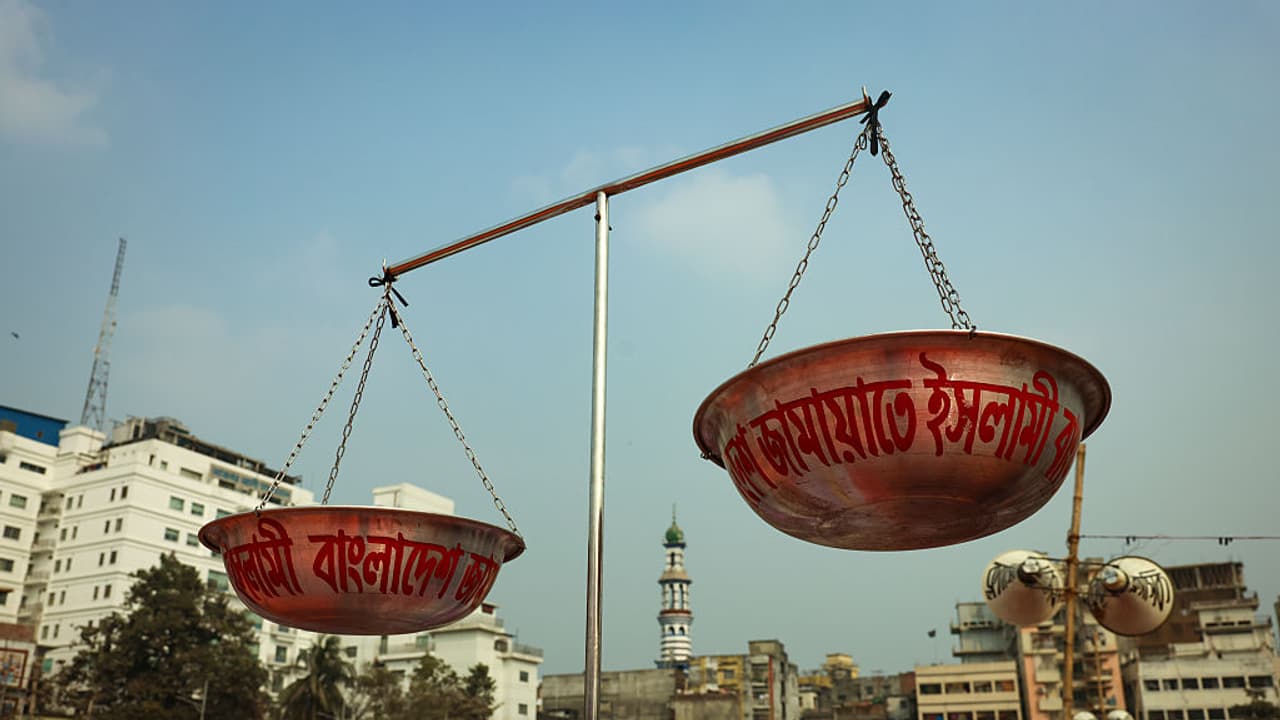
Muhammad Yunus’s alliance with Jamaat-e-Islami sparks fears of rising Islamic fundamentalism in Bangladesh, threatening secularism, women’s rights, minorities, and the nation’s progressive legacy.
New Delhi: Jamaat’s fundamentalist ideas are seeping into Bangladeshi polity after Yunus’s compromise for political gains, challenging secularism and widening the social divide.
Bangladesh’s future trajectory is at a critical juncture as the nation heads to a general election on February 12 to elect the next government, nearly a year and a quarter after then-Prime Minister Sheikh Hasina was ousted through student protests.
But what is gathering international attention right now is Nobel laureate and present head of the interim government in Bangladesh, Muhammad Yunus’s political machinations and alliance with the Islamic fundamentalist group, Jamaat-e-Islami.
Yunus’s Political Turn and the Jamaat Question
The Yunus-Jamaat alliance is now an attempt to uproot Bangladesh from its ideological moorings in secularism and transition it into an Islamic hardline nation.
For decades, Yunus has maintained a positive image as a social entrepreneur and expert in development economics. But post tasting power in Dhaka, Yunus has succumbed to the lure of political authority.
This affliction for political power has led him to join hands with Islamic fundamentalists, represented by the pro-Pakistan Jamaat. This has surely raised concerns over the ideological trajectory of Bangladesh: whether it would shed its hard-earned secular and modernist foundations to embrace Islamic radicalisation, dictated purely by power politics.
Jamaat’s ideological agenda has historically been rooted in hardline Islamism—not just within Bangladesh’s social framework, but also in its polity and governance approaches.
It has emphasised strict Islamic law for social norms, conformity with religious tenets, and a greater say in governance and social behaviour for Muslim clerics.
Though its political fortunes have varied over decades, it continues to hold sway over its grassroots networks, especially in interior, semi-urban, and rural areas.
Secularism Under Pressure
Yunus, by tacitly aligning with Jamaat, is aiming to achieve political legitimacy and boost his electoral fortunes by pledging allegiance to its Islamic fundamentalist ideology—one that had remained subdued due to the 1971 war crimes trials and overwhelming public outcry against its religious politics.
Even if Yunus’s approval of Jamaat is merely strategic or symbolic, it still amplifies the Islamic fundamentalism of the outfit in the broader discourse of Bangladeshi polity. This short-term strategy risks marginalising progressive elements within Bangladesh in the long term.
Women, minorities, and secularism advocates within Bangladesh could find themselves alienated, and their development story suppressed permanently if this Yunus strategy succeeds, even as part of an immediate electoral game plan.
Despite its Muslim-majority status, Bangladesh has, over the decades, successfully kept itself out of the Islamic fundamentalist orbit. This has encouraged women’s empowerment, secular education, workforce participation, and community engagement.
If Islamic conservatism takes deeper root in Bangladesh, the progress made by these marginalised sections of society could be eclipsed, and their achievements reversed.
Rising Social Divisions and Long-Term Risks
The current electoral and political debates in Bangladesh already show signs of Islamic conservatism taking root, as religious hardliners target women’s rights and education while advocating policy reversals on these fronts.
These debates have voiced opposition to women’s leadership in politics and have sought religious education over science-based schooling, while opposing poverty alleviation and improvements in human development indicators.
If these Jamaat ideas take root and gain greater political support—as they do with Yunus’s backing—the long-term cost for Bangladesh could be social fragmentation and a loss of economic competitiveness.
The Yunus-Jamaat alliance also risks entrenching social divides, as witnessed in religion-driven hate crimes against minority communities such as Hindus, Christians, Buddhists, and others in Bangladesh over the past year.
Bangladesh’s secular identity, enshrined in its Constitution and forged in its 1971 Liberation War, takes a beating if these tendencies are allowed to entrench themselves further.
In a diverse society like Bangladesh, the unifying principle has always been its secular and progressive foundations. However, the current normalisation of religious fundamentalism and identity politics threatens all of Bangladesh’s people.
When a non-politician seeks political legitimacy by riding on the back of religion, the collateral damage is the nation itself.
When the polity is polarised along religious identity, the defence of Yunus’s alignment with Jamaat under the banner of “political pragmatism” is nothing but hogwash. In politics, not just intent but perception matters—especially when a Nobel laureate sheds his modern and progressive outlook to indulge in narrow religious pandering.