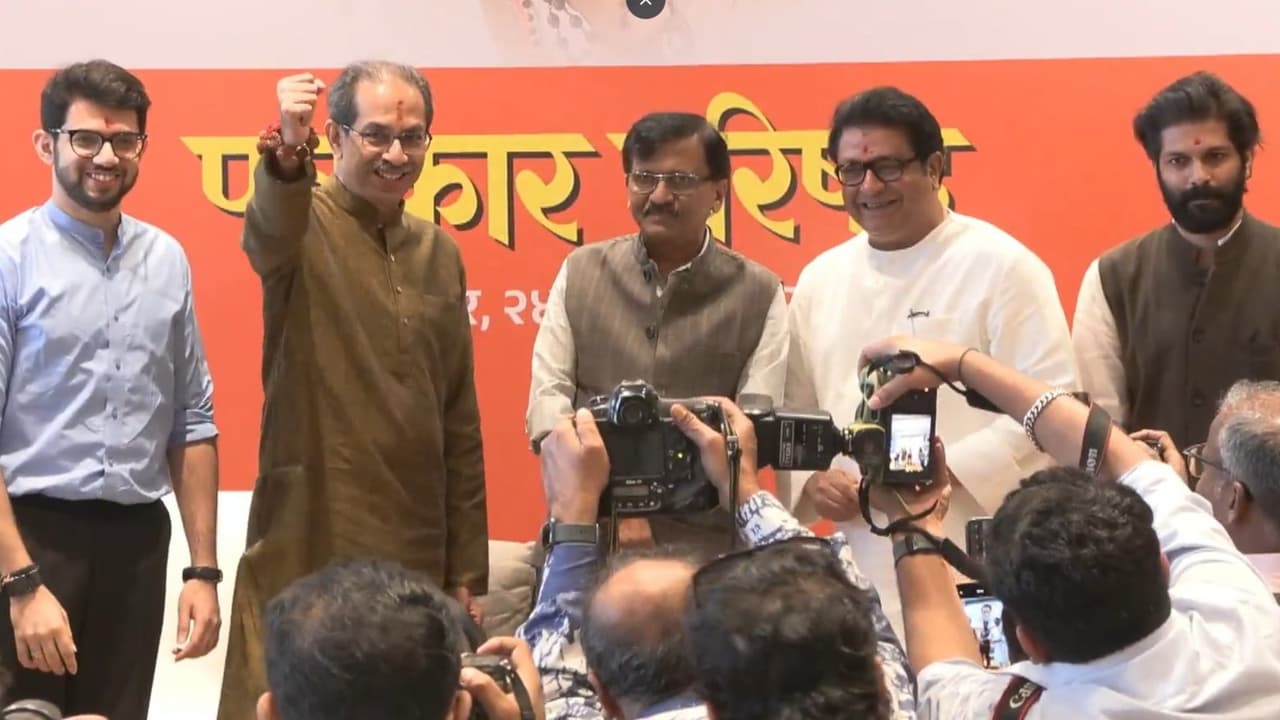
Maharashtra’s 2025 was marked by major political shifts, including the reunion of Uddhav and Raj Thackeray, strong gains by the BJP-led Mahayuti in local polls and opposition struggles. Law and order, caste and controversies shaped the year.
The year 2025 was a defining one for Maharashtra politics. It saw old rivalries soften, new alliances take shape and the ruling coalition strengthen its hold on power. From the dramatic reunion of the Thackeray cousins after two decades to the steady rise of the BJP-led Mahayuti alliance, the state’s political story was full of twists, tensions and high-stakes decisions.
As Maharashtra heads into crucial local body elections, including the Brihanmumbai Municipal Corporation (BMC) polls, the developments of 2025 have reshaped the political landscape in lasting ways.
Thackeray cousins reunite after 20 years
One of the most striking moments of the year came on December 24, when Uddhav Thackeray and Raj Thackeray announced an alliance for the upcoming civic elections. The move ended a 20-year political separation between the cousins.
Raj Thackeray had quit the undivided Shiv Sena in 2005 after differences with Uddhav Thackeray and later formed the Maharashtra Navnirman Sena (MNS). Their reunion ahead of the January 15 Mumbai municipal corporation elections, along with polls in 28 other civic bodies, was widely seen as a major political gamble aimed at survival and revival.
The alliance added fresh uncertainty and excitement to Maharashtra’s already competitive civic poll season.
Mahayuti government completes stable first year
The BJP-led Mahayuti government, headed by Chief Minister Devendra Fadnavis, completed one year in office on December 5. The government came to power after a decisive victory in the November 2024 assembly elections.
Despite facing controversies, defections and occasional friction among its partners, the Shiv Sena and the Nationalist Congress Party (NCP), the alliance largely remained stable through 2025.
The Mahayuti’s organisational strength was reflected clearly in the December local body elections.
Strong performance in local polls boosts ruling alliance
In the municipal council and nagar panchayat polls, the ruling alliance secured 207 municipal president posts and 4,422 seats. The strong showing underlined Mahayuti’s deep reach at the grassroots level.
In contrast, the opposition’s poor performance highlighted its organisational weakness and lack of coordination, especially after setbacks in the assembly elections.
These results helped the ruling coalition consolidate power across districts and build momentum ahead of the BMC elections.
Year began with murder case and law and order worries
The year started on a tense note. The murder of Massajog sarpanch Santosh Deshmukh in December 2024 sent shockwaves through the state and dominated early 2025 politics.
The situation worsened when NCP leader Dhananjay Munde resigned from the state ministry after his close aide Walmik Karad was arrested as the prime accused in the murder case. The episode put the government on the defensive and sparked debates about law and order in Maharashtra.
Hindi language decision sparks protests
Another major controversy erupted when the state government announced that Hindi would be made mandatory from Class 1, citing the National Education Policy. The move triggered widespread protests from political parties, education groups and language activists. Facing mounting pressure, the government rolled back the decision.
It later announced a committee headed by economist Narendra Jadhav to study the implementation of the three-language formula more carefully.
Mahayuti strengthens grip through defections
Despite early setbacks, the ruling alliance continued to expand its influence. During the year, 43 runner-up candidates from the opposition Maha Vikas Aghadi (MVA) crossed over to the Mahayuti. These defections further weakened the opposition and helped the ruling alliance strengthen its presence across key constituencies.
In the assembly, the BJP emerged as the single largest party with 132 seats, its highest ever tally in Maharashtra. Allies Shiv Sena and NCP won 57 and 41 seats, giving Mahayuti a commanding 235 seats in the 288-member House.
Opposition struggles to regain footing
For the Maha Vikas Aghadi, which includes Shiv Sena (UBT), Congress and NCP (Sharad Pawar), 2025 was largely a year of regrouping. The alliance struggled to project unity, even while trying to capitalise on government controversies. Differences over strategy and leadership often surfaced.
A key moment came when Uddhav and Raj Thackeray shared a platform during protests against the Hindi language policy. Many saw this as a tactical move rather than a full-fledged opposition unity effort.
Congress keeps distance from MNS
While Raj Thackeray later joined opposition protests against the Election Commission over alleged ‘vote theft’, the Congress stayed away from the MNS.
Congress leaders cited the MNS’s anti-migrant stance and shifting political positions as reasons for not aligning with the party. This hesitation added to the complexity of opposition realignment efforts.
Communal tension in Nagpur raises concerns
In March, Maharashtra witnessed communal clashes in Nagpur following demands by right-wing groups for the removal of a structure linked to Mughal emperor Aurangzeb.
The violence left one person dead and led to strong criticism from the opposition, which blamed the government for policing failures and poor handling of sensitive issues.
Maratha quota agitation returns
Caste-based politics returned to the spotlight with Maratha quota activist Manoj Jarange-Patil launching another statewide agitation. His protest included a hunger strike in Mumbai and drew large crowds. The government’s decision to implement the Hyderabad Gazette, allowing Kunbi certificates for eligible Marathas, drew criticism from OBC groups, who feared dilution of their quota rights.
Welfare schemes remain government’s focus
The Mahayuti government continued to highlight welfare programmes that helped it win elections. Key among them was the ‘Ladki Bahin’ scheme, which provides direct cash support to women.
However, the opposition accused the government of failing to fulfil promises, including raising monthly assistance from Rs 1,500 to Rs 2,100 and implementing a farm loan waiver.
Alliance tensions surface within Mahayuti
Cracks within the ruling alliance appeared from time to time. In November, Shiv Sena ministers briefly boycotted a Cabinet meeting, leading Deputy Chief Minister Eknath Shinde to rush to Delhi for talks with Union Home Minister Amit Shah.
Disputes also arose over the appointment of NCP leader Nawab Malik to a civic poll-related post and over seat-sharing arrangements for municipal elections.
Economy and investment narrative pushed strongly
On the economic front, the government struck a confident tone. Chief Minister Fadnavis repeated his vision of making Maharashtra a trillion-dollar economy.
The state recorded Rs 1.64 lakh crore in foreign direct investment (FDI) in 2024-25, a 32 per cent rise over the previous year. The government said this was the highest inflow in a decade.
Civic polls take centre stage at year end
As 2025 ended, attention shifted firmly to the long-pending local body elections, especially the Brihanmumbai Municipal Corporation, Asia’s richest civic body.
The Congress announced it would contest the BMC polls alone, while Shiv Sena (UBT) indicated it would field new faces after many corporators defected.
Speculation over a Shiv Sena (UBT)-MNS alliance finally ended with their announcement on December 24, adding fresh drama to the contest.
Controversies involving MLAs and ministers
The year also saw several political embarrassments. In July, a video showing Shiv Sena MLA Sanjay Gaikwad assaulting a canteen staff member over ‘stale’ food went viral.
Scroll to load tweet…
Chief Minister Fadnavis condemned the act, while Deputy CM Shinde warned the MLA.
Another controversy erupted when a video showed state minister Sanjay Shirsat sitting near a partially opened bag that appeared to contain bundles of cash. The video surfaced amid reports of scrutiny over a sharp rise in his declared assets.
Scroll to load tweet…
Legal relief and old cases resurface
In December, the Supreme Court granted partial relief to NCP MLA Manikrao Kokate, staying his conviction in a cheating case to prevent his disqualification as an MLA.
The case dated back to 1995 and involved misuse of a government housing scheme meant for economically weaker sections.
Deaths of senior leaders mark sombre moments
The state also mourned the deaths of several senior leaders, including former Lok Sabha Speaker Shivraj Patil, and former ministers Shalinitai Patil and Surupsinh Naik.
As Maharashtra steps into 2026, the events of 2025 have left a deep mark. Power equations have shifted, old rivals have reunited, and civic elections now stand as the next major test.
Whether these alliances endure or break under pressure will decide the state’s political future.