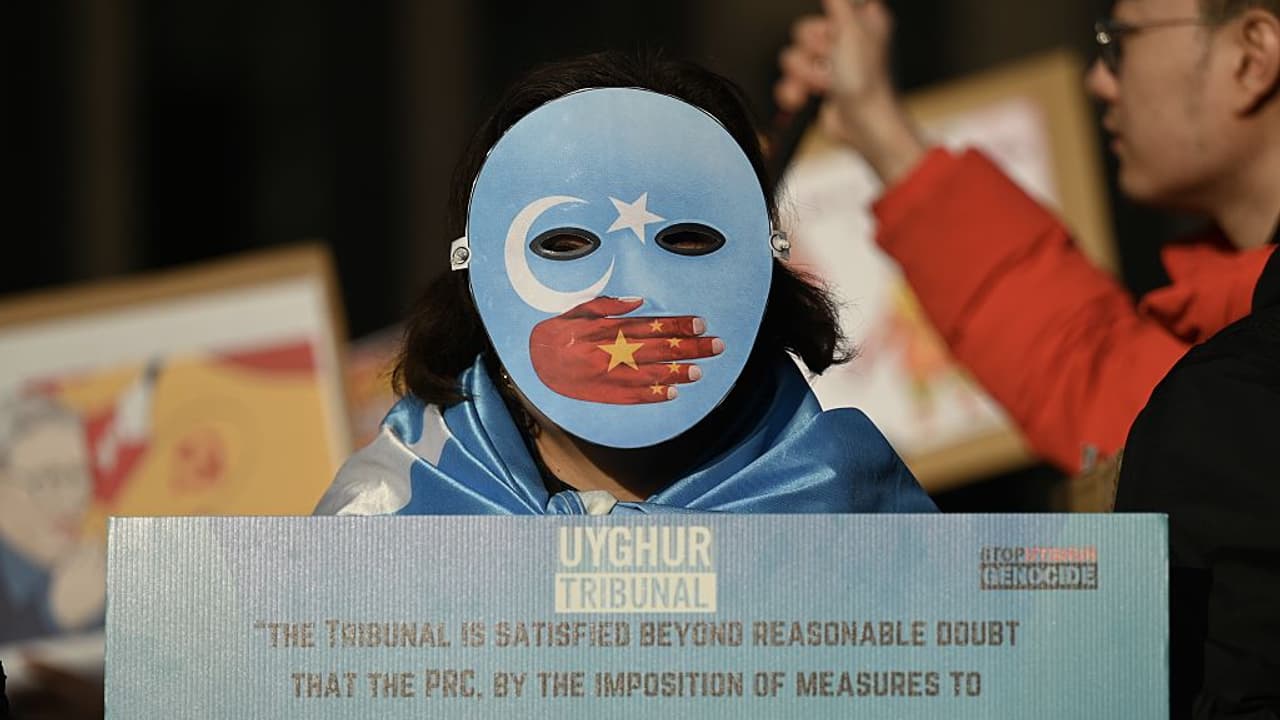
In March 2008, Uyghur protests broke out in Xinjiang after the death of businessman Mutallip Hajim in police custody. Protesters demanded cultural and religious rights, not independence. China quickly cracked down, restricted media access, and arrested many. Rights groups later raised concerns over repression.
New Delhi: In March 2008, hundreds of Uyghur demonstrators gathered in the oasis cities of Hotan and Karakax in China’sXinjiang region. Their protests followed the death in police custody of Mutallip Hajim, a respected Uyghur businessman whose burial had been ordered in secrecy.
The demonstrations came just days after unrest in Tibet had shaken China ahead of the Beijing Olympics. As police surrounded the marchers and arrested hundreds, information from the region became scarce, offering only a fragmented glimpse into tensions that had long been building beneath Xinjiang’s surface.
What Happened In Xinjiang 2008?
The protests were not spontaneous. By 2008, Uyghur culture had been under sustained pressure for years. The Chinese government had placed strict restrictions on Islamic practice, limiting the right to fast during Ramadan, banning certain religious texts, and placing mosques under state supervision.
Uyghur-language schools were being phased out in favour of Mandarin-only education. The mass migration of Han Chinese into Xinjiang, actively encouraged by Beijing through economic incentives, had progressively pushed Uyghurs to the margins of their own homeland, economically and culturally.
When the protests broke out, the demonstrators were not asking for independence. They were asking to exist on their own terms. To speak their language. To observe their faith. To pass their history on to their children.
The Uyghur Voices China Tried To Silence
China’s response was swift and revealing. Security forces moved in immediately. Foreign journalists who attempted to reach Xinjiang were turned back or detained at checkpoints. International media coverage was thin, fragmented, and heavily filtered.
Human Rights Watch and Amnesty International documented the crackdown in subsequent reports, noting that dozens of Uyghurs were arrested and that the full scale of events was deliberately kept from public view.
What made the state’s reaction significant was not only its speed but its blueprint. The media blackout imposed in March did not lift in the weeks that followed. Instead, it became a template.
China had learned that it could suppress an event of this magnitude and face little lasting international accountability. The silence that descended on Xinjiang in March 2008 was not the silence of resolution. It was the silence of preparation.
In the years between 2008 and 2017, security spending in Xinjiang grew exponentially. Surveillance infrastructure was expanded. Algorithms were developed to flag Uyghurs based on their religious practice, travel history, and social connections. When the mass detention programme was activated after 2017, it slid into an apparatus that had been quietly assembled over nearly a decade.
The 2008 Uyghur Protests The World Overlooked
The international community’s muted response to the protests gave Beijing early confirmation that the world was willing to look elsewhere. China was the host of the 2008 Beijing Olympics, and political caution dominated Western foreign policy circles. Economic interdependence was already too deep for governments to risk a rupture over what many chose to frame as an internal security matter.
That framing has since collapsed. Leaked Chinese government documents, including the China Cables published by the International Consortium of Investigative Journalists in 2019, confirmed what survivors had been saying for years: the detention system was not remedial. It was punitive, systematic, and deliberate.
March 2008 was when Uyghur voices broke through. It was also the day Beijing decided those voices had to be permanently silenced. The world heard them, however faintly, and then moved on. That decision carries consequences that are still unfolding.