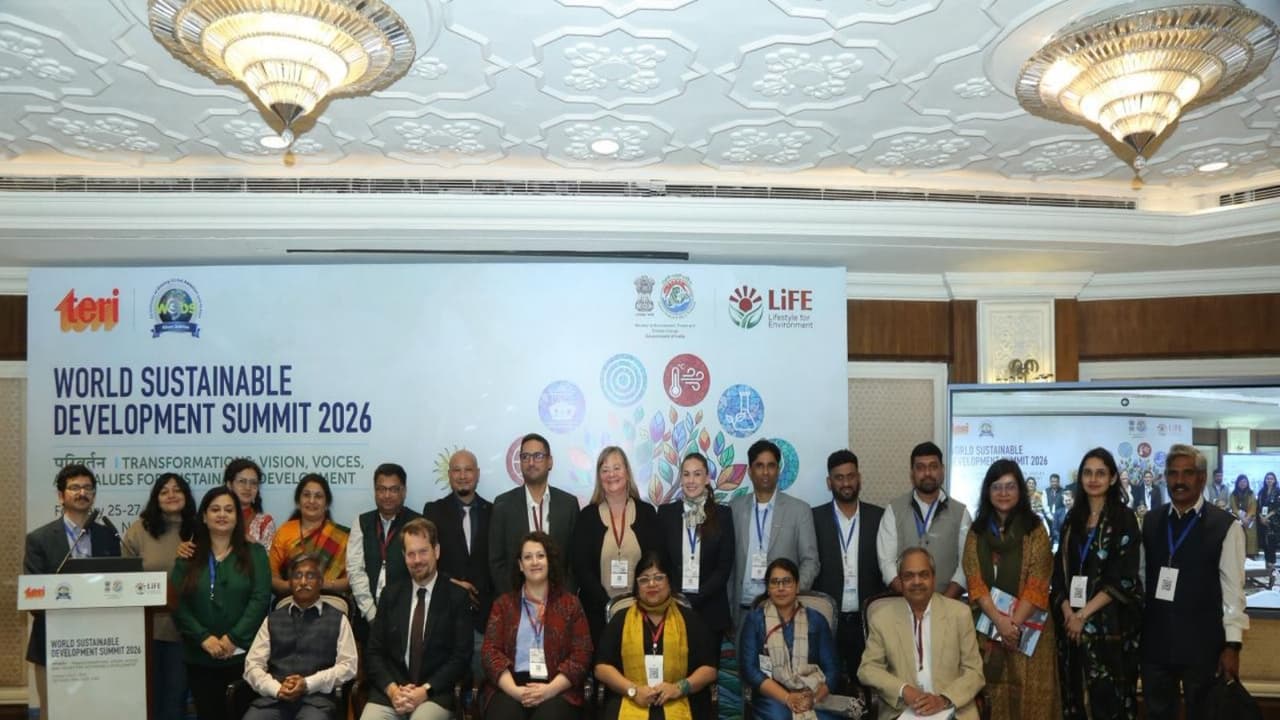
A session at the 25th World Sustainable Development Summit highlighted the India-Norway partnership’s science-led approach to tackling plastic and chemical pollution, with research showing how waste moves from land to sea to inform policy.
A thematic session at the 25th World Sustainable Development Summit underscored the growing importance of scientific research and international cooperation in strengthening laws and policies to address plastic and chemical pollution.
The session, titled “From Source to Seas: Science-informed pathways for transforming plastic and chemical pollution governance,” was held at Taj Palace and focused on findings from the India-Norway INOPOL project. The research tracks how plastic waste and persistent organic pollutants move from land into rivers and oceans, posing risks to human health, livelihoods and ecosystems.
India-Norway Partnership Extended
Norwegian Minister for Climate and Environment Andreas Bjelland Eriksen said the India-Norway marine litter partnership demonstrates how sustained global cooperation can tackle complex environmental challenges. He noted that the initiative has been extended to 2030 and continues to support science-led, policy-driven solutions.
Strengthening Policy with Data-Driven Studies
Tamil Nadu Additional Chief Secretary Supriya Sahu emphasised that data-driven studies are crucial for effective policymaking. She said Tamil Nadu, which banned single-use plastics in 2018, can use these findings to strengthen enforcement and adopt a more comprehensive strategy to tackle plastic and chemical pollution.
Officials from the Ministry of Environment, Forest and Climate Change welcomed the project’s research-based recommendations, noting that such scientific inputs can support stronger environmental regulation, monitoring and compliance.
Key Reports and Recommendations
During the session, two key reports were released: a Plastic Waste Strategy for Tamil Nadu and an Action Plan for managing Persistent Organic Pollutants. These reports offer evidence-based guidance to improve monitoring systems, enforcement mechanisms and pollution control policies.
Shift Toward Science-Based Governance
Experts noted that scientific evidence can help governments frame stronger environmental rules and support legal action by clearly establishing pollution pathways from land to sea.
The initiative reflects a broader shift toward science-based environmental governance, improved regulatory enforcement and greater accountability for pollution under environmental laws.
Panel of Experts
A panel discussion chaired by Girija Bharat, Managing Director of Mu Gamma Consultants, featured experts including Rachel Hurley, Sissel Brit Ranneklev, Smita Mohanty, Paromita Chakraborty, Piyush Mohapatra and Satish Sinha of Toxics Link, who discussed the methodology, findings and policy impact of the INOPOL project. (ANI)
(Except for the headline, this story has not been edited by Asianet Newsable English staff and is published from a syndicated feed.)