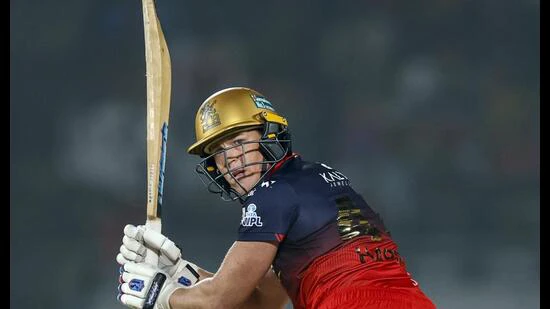
New Delhi: “Go for the cheese, not the cat” – That was the message Grace Harris received from Royal Challengers Bengaluru coach Malolan Rangarajan before the start of their WPL campaign.
It’s a simple line, but one that captures the mindset shift powering modern women’s cricket. Take the risk, don’t be afraid of getting out.
In a competition as short and sharp as the WPL, Harris believes sometimes you have to score runs even if it looks ugly. “It doesn’t necessarily feel the best at times,” Harris admitted, “but if you’re donning a role, then do it as good as you can.”
For Harris, power hitting is not about swinging blindly. She has the gift of athleticism and strength but it is also deeply intentional. Small technical changes such as where she takes guard, keeping her eyes level to track a moving ball better have helped her access different scoring areas and negate patterns of dismissal.
However, more than athleticism, she stresses upon unlocking a certain mental aspect: backing yourself to hit where you want to hit. That belief, she says, can only come from training for it.
“You might think, I’m just going to hit it here,” Harris explains. “But if you haven’t practiced it, you’re very unlikely to.”
That clarity of role has become central to the WPL’s evolution. Players, even if their USPs differ, now train after understanding that power is no longer accidental. It is necessary and must be rehearsed.
Beyond power
Smriti Mandhana’s journey reflects a similar shift. Traditionally known for timing and elegance, Mandhana acknowledged a conscious effort to expand her six-hitting range ahead of this season. Lap shots and reverse sweeps remain works in progress, but the intent is clear.
“There is a conscious effort to hit sixes,” she said to reporters just before the start of the season, while stressing that she is not willing to abandon timing for brute force. “Fancy shots are still far away, but if I can muscle those sixes, I’ll be happy.”
That balance between power and control is now being seen as central across teams. UP Warriorz captain Meg Lanning believes that it is one of the biggest developments in the women’s game in recent years. Clearing the ropes, once limited to a handful of players, has become a widespread skill.
“Now every team has a number of players who can really show they’ve got some great power,” Lanning notes, pointing to batters like Kiran Navgire as examples of how domestic form and strength are translating to the WPL.
Improved gym work
Phoebe Litchfield may come across as lean and slender but she is among the top six and boundary hitters in this edition. She also boasts a strike rate of 154.77, second only to Harris’ 180.95.
A couple of years ago, she admitted, the idea of hitting multiple sixes would have felt unrealistic. With strength improved, aided by hours in the gym, she believes timing remains the decisive factor in her case.
“If I try to hit a six, it never goes for six,” Litchfield said. “Instead, I try to time the ball and get all those movement patterns in order… And that’s what I’ve practiced outside the field. In the nets, practicing my swing. Sometimes, a nice relaxed swing and timing is all you need.”
That blend of strength and efficiency is something South African Chloe Tryon embodies. She started her career as a pinch-hitter but can now be an accumulator but also one of the most dangerous finishers in the game. Injuries forced her into a difficult phase, but also reshaped how she trained. Strength work, particularly explosive lower-body exercises like squats and hip thrusts, has given her a stable base that allows her to hit big sixes.
Coming clutch
Nadine de Klerk, who conjured some incredible rescue acts for South Africa in the ODI World Cup and continues to do so for RCB in the WPL, believes the greatest challenge is mental, especially since she bats in high pressure situations.
She thrives on that pressure, but understands how easy it is to overthink when you walk in knowing you have to go from the first ball. Conversations with RCB batting coach RX Muralidhar have reinforced a simple principle: stay calm, wait for the right ball and don’t overhit.
“I think sometimes when you’re walking in at the back end of an innings and you know you have to go from the get-go.”
“More often than not, if you get into good positions, you’ll hit it for six anyway,” de Klerk explained. Timing, she believes, will take care of the outcome if the process is right.
One thing remains clear – power in the WPL is not accidental or reserved to a select few anymore. It is planned, trained, encouraged and trusted. As the league grows, so does the comfort with power and what once felt rare is becoming routine.