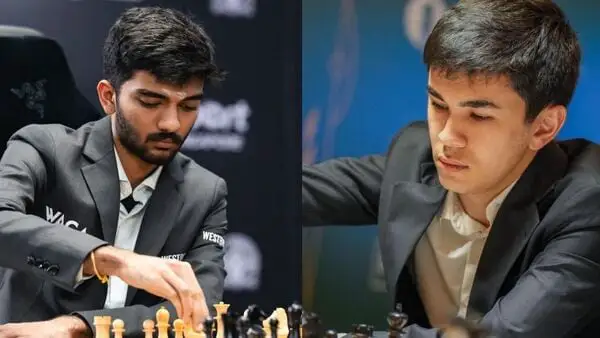
The 2026 FIDE World Chess Championship is set to feature a historic contest between India’s reigning champion D Gukesh and Uzbekistan’s challenger Javokhir Sindarov in Geneva, with the first game on Tuesday (24 November).
With both players aged 20, the match will be the youngest encounter for the undisputed classical world title.
Gukesh will be defending the crown he won against China’s Ding Liren in Singapore in 2024, while Sindarov earned his opportunity by winning the 2026 Candidates Tournament in Cyprus. The match will be held in Geneva, Switzerland, from 22 November to 12 December, with the first classical game scheduled for 24 November.
The contest will comprise a maximum of 14 classical games, with the first player to reach 7.5 points declared the winner. If the scores are level at 7-7, the title will be decided through tiebreaks.
Here are five factors that could determine the winner of the Gukesh vs Sindarov World Chess Championship 2026 match.
Recent form and confidence
Sindarov enters the contest with an impressive run of results. The Uzbek grandmaster won the 2025 FIDE World Cup in Goa before producing an unbeaten performance at the 2026 Candidates Tournament. He scored 10 points from 14 games, finishing 1.5 points ahead of runner-up Anish Giri.
Gukesh, meanwhile, has experienced a comparatively difficult period since becoming world champion. His rating dropped to 2710 in November 2026, leaving him 26th in the world rankings, while Sindarov entered the match ranked fourth with a rating of 2782.
The contrasting trajectories make current form an important factor, although a world championship match presents a different challenge from tournament chess.
Opening preparation and understanding
Preparation will be crucial in a match featuring 14 classical games. Both players and their respective support teams will need to develop opening variations that can put the opponent under pressure while avoiding well-prepared positions.
Gukesh’s experience from his 2024 championship match against Ding Liren could help him understand the demands of preparing for an extended contest. Sindarov, meanwhile, will look to use his recent momentum and preparation to challenge the defending champion.
The ability to introduce new ideas, identify weaknesses in the opponent’s repertoire and adapt after each game could prove decisive.
Head-to-head record
Sindarov holds the advantage in their classical encounters. The two grandmasters have met three times in classical chess, with the Uzbek winning twice and the remaining game ending in a draw.
Sindarov’s victories came at the 2018 Moscow Open and the 2022 Sharjah Masters, while their most recent classical encounter at the 2026 Tata Steel Chess Tournament in January ended in a draw.
The duo’s performances in Geneva will be determined by how effectively they handle the specific demands of a world championship match.
Handling pressure and time management
The psychological demands of a world championship match can be significantly different from those of regular tournaments. A single mistake can change the momentum of the contest, particularly when the match is closely poised.
Both players will have 120 minutes for the first 40 moves, followed by 30 minutes for the remainder of the game. A 30-second increment will be added from move 41.
Managing the clock, maintaining concentration during lengthy games and recovering from difficult positions will be important. Gukesh has experienced the pressure of a title match before, whereas Sindarov will be making his debut at this level.
Performance in decisive games and tiebreaks
The ability to convert winning positions and defend difficult ones could ultimately separate the two contenders. With 14 games scheduled, consistency will be important, but taking opportunities in decisive moments could make the difference.
If neither player reaches 7.5 points after the classical games, the match will move to rapid tiebreaks on 12 December. The format begins with four rapid games at 15 minutes plus a 10-second increment per move.
Consequently, preparation for faster time controls could also become significant. The player who adapts better to the changing format will have an opportunity to claim the world title.