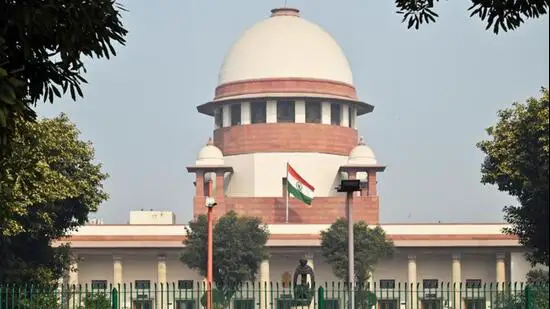
The Supreme Court on Wednesday took serious exception to the Election Commission of India’s claim that it could not trace the video recording of the 2023 vote count in Karnataka’s Sringeri assembly constituency, warning that it would draw an adverse inference against the poll body if it failed to produce the available records.
“How can the Election Commission of India (ECI) say that it has lost its record? Your whole purpose is to hold an election, and you need to have a document. Where is the question of you saying, ‘Yeah, we are trying to trace it’? You gave it to the elected candidate. There is no custody of records. Whatever you have, produce it on the next date. Otherwise, we will have to draw an adverse inference against you. We will not accept these kinds of lame excuses,” a bench of justices Sanjay Kumar and Sanjeev Sachdeva told the ECI.
The court was hearing a plea by Congress leader TD Rajegowda, who was unseated following a recount of postal ballots in the constituency, where he had defeated BJP candidate DN Jeevaraj by a narrow margin of 201 votes in the 2023 Karnataka assembly elections.
The bench pulled up the ECI over its inability to trace the original counting footage after Rajegowda sought access to the election observer’s report and video recordings of both the original counting in 2023 and the recount conducted in May this year.
When the court proposed directing the poll body to produce these records, senior advocate Seshadri Naidu, appearing for the ECI, said the video recording of the original counting could not be traced. The submission failed to convince the bench, which asked the commission to produce whatever records were available by the next hearing.
The court posted the matter for February 15, 2027.
The missing footage assumes significance because the dispute centres on the treatment of postal ballots and the legality of the exercise that overturned Rajegowda’s electoral victory. The Supreme Court had, in May, directed the ECI to produce the relevant records concerning the recount ordered by the Karnataka high court and kept all consequential steps taken by the returning officer in abeyance pending further examination.
The dispute originated in an election petition filed by Jeevaraj before the Karnataka high court, challenging Rajegowda’s victory. On April 6, 2026, the high court ordered a recount of postal ballots, including the re-verification of 279 ballots that had been rejected during the original counting.
However, Rajegowda subsequently approached the Supreme Court, alleging that the returning officer had exceeded the scope of the high court’s directions by re-examining postal ballots that had already been accepted as valid.
In an order on May 11, the Supreme Court noted that the returning officer had not only re-verified the 279 rejected postal ballots but had also re-examined 1,251 other postal ballots that had previously been declared valid. The court observed that the exercise appeared to have gone beyond the high court’s directions and that the consequential steps taken by the returning officer were, prima facie, without legal foundation.
The recount, completed in early May, resulted in 255 votes previously counted in Rajegowda’s favour being invalidated, while two votes were added to Jeevaraj’s tally. The revised count gave the BJP candidate a victory margin of 52 votes, reversing the original result. Jeevaraj was subsequently declared elected.
The Supreme Court’s intervention in May allowed Rajegowda to continue as the MLA while it examined the legality of the recount and directed that all steps taken pursuant to the exercise remain in abeyance.
Rajegowda has also questioned the high court’s decision to order a recount, arguing that the court’s findings on allegations of corrupt practices against him did not justify the exercise.
The controversy has also led to a criminal case alleging tampering with postal ballots during the recount. Jeevaraj, who has denied wrongdoing, secured an interim order from the Karnataka high court staying further investigation in the case.