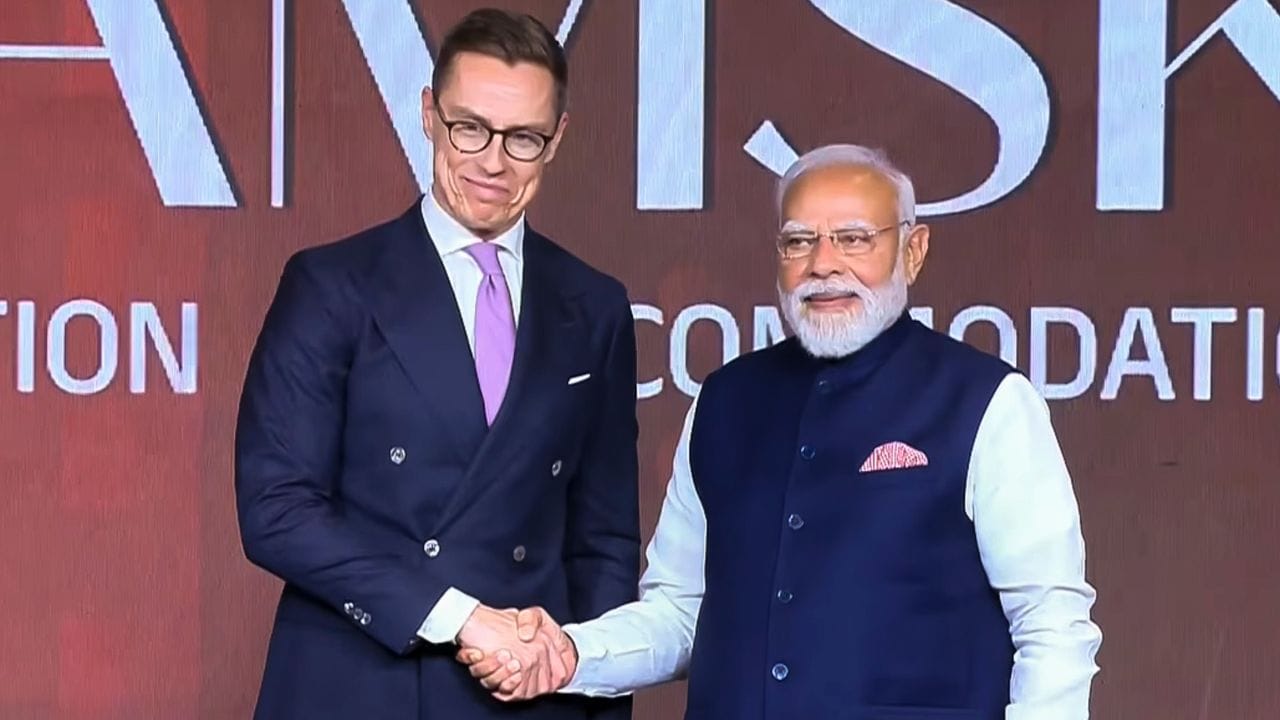
New Delhi: Prime Minister Narendra Modi on Thursday inaugurated the 11th Raisina Dialogue in New Delhi along with Finnish President Alexander Stubb, who attended the event as the chief guest.
External Affairs Minister S Jaishankar also joined the inaugural session of the annual conference on geopolitics and geo economics.
The Raisina Dialogue, which runs from March 5 to March 7, has drawn participants from around 110 countries. Ministers, former heads of state, members of parliament, military leaders, business executives, scholars, journalists, and youth representatives are taking part in the event.
India’s flagship geopolitical conference
The Raisina Dialogue is India’s premier conference on geopolitics and geoeconomics. It has been held every year in New Delhi since 2016.
The event is organised by the Observer Research Foundation in partnership with the Ministry of External Affairs.
About 2,700 people are attending the conference in person, while many more are expected to watch discussions on digital platforms.
The theme for the 2026 edition is “Samskara – Assertion, Accommodation, Advancement”.
Key discussions at the dialogue
In the next three days, discussions will take place across six major themes related to global politics and economic cooperation.
The themes include Contested Frontiers. Power, Polarity, and Periphery and Repairing the Commons. New Groups, New Guardians, New Avenues.
Other sessions focus on White Whale. The Pursuit of Agenda 2030 and The Eleventh Hour. Climate, Conflict, and the Cost of Delay.
Technology and trade will also feature through sessions titled Tomorrowland. Towards a Tech-topia and Trade in the Time of Tariffs. Recovery, Resilience, Reinvention.
Stubb warns about fragile world order
During his keynote address, Finnish President Alexander Stubb warned about the risks posed by weakening global institutions.
“Without a functioning world order, power vacuums will be filled by raw power, rogue behaviour, and predatory hegemons,” he said.
Stubb also spoke about how people misjudge global developments.
“I think we human beings make three mistakes. We over-rationalised the past. We think the world works in a certain way and juxtapose examples thereof. The second mistake we make is we overdramatise the present, and when we make these two mistakes, we underestimate the future,” he said.
He also expressed concern over conflicts in regions such as the Middle East, Sudan, and Ukraine.
“I’m deeply concerned about what we see today in the Middle East, Sudan and Ukraine, just to name a few. My worry, though, is that these conflicts are incrementally becoming global,” Stubb said.