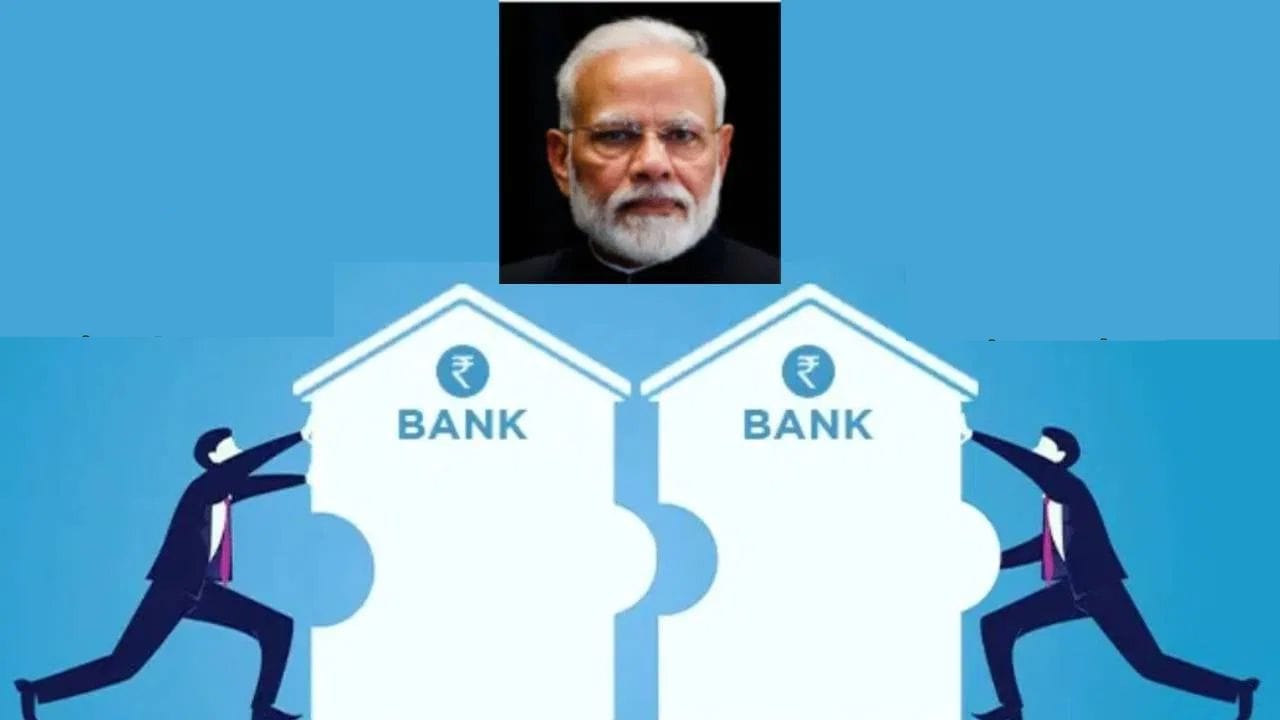
Under Bank Merger, there is a plan to have four government banks in the country.
A big update has come out on the mega merger plan of central government banks. The media report quoted a source as saying that the government is working on an ambitious public sector bank (PSB) consolidation scheme, under which the number of public sector banks will be reduced from 12 to just four in the financial year 2027. The merger of State Bank of India (SBI), Punjab National Bank (PNB), Bank of Baroda (BoB) and Canara-Union Bank is among the four possible banks.
This proposal is being considered in the Finance Ministry, the objective of which is to strengthen the balance sheet, improve operational capacity and strengthen the country’s public sector banks at the global level. Sources quoted Moneycontrol as saying that the plan is to reduce the number of public sector banks from the current 12 to four. First, small banks will be merged into big banks and then they will be further consolidated to form larger units capable of meeting the growth needs of India.
Canara-Union Bank will merge
According to the source, the central government is moving towards the merger of Canara Bank and Union Bank of India. This merger is expected to create one of four surviving entities. Indian Bank and UCO Bank are also being considered to be integrated into the same structure, which will create another big bank which will join SBI, PNB and Bank of Baroda as other major lenders.
Other mid-sized banks – including Indian Overseas Bank (IOB), Central Bank of India (CBI), Bank of India (BOI) and Bank of Maharashtra (BOM) – are expected to be merged with SBI, PNB or Bank of Baroda. No decision has been taken yet on Punjab and Sindh Bank. The source said that depending on the final outline, it may also be merged into any one of these four.
Investigation will be done at many levels
This merger plan will first be placed before the Finance Minister for approval. After getting approval, this scheme will have to go through several levels of scrutiny. This will include inputs from senior officials of the Cabinet Secretariat, scrutiny by the Prime Minister’s Office (PMO), and regulatory comments from the Securities and Exchange Board of India (SEBI). The source said that a record of the discussion will be prepared and taken forward in phases. Only after the approval of the Finance Minister, it will be sent to the Cabinet and Prime Minister’s Office. Considering the market effects, SEBI’s opinion will also be taken.
promote consolidation
The government expects this restructuring to be an important step in preparing the banking sector for increasing loan demand, given India’s continued high growth targets. Larger and stronger public sector banks are considered better placed to make larger loans, help finance infra projects and compete with private banks that have expanded aggressively in recent years. Officials also argue that consolidation will help rationalize the branch network, reduce costing and improve capital utilization across the system. According to the source, the government believes that this round of merger will be more smooth.