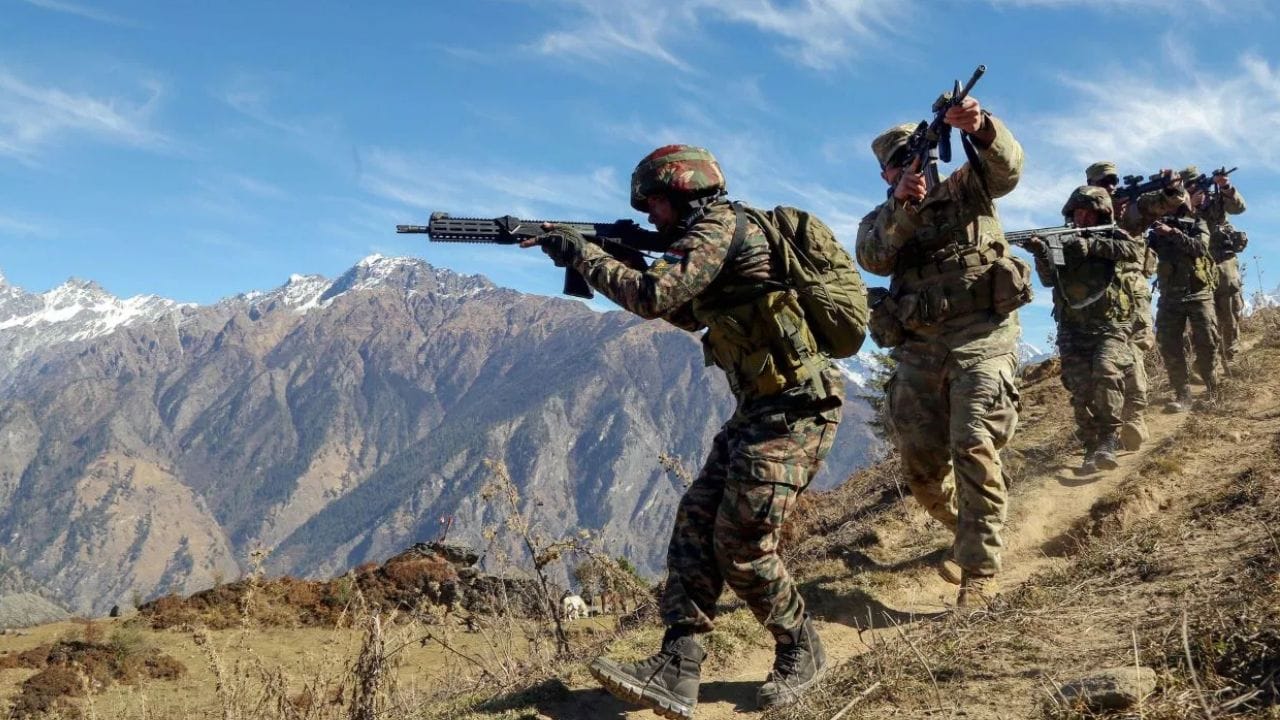
New Delhi: A joint team of security forces killed a Pakistani terrorist during an encounter in the dense forests of Kishtwar on Wednesday, even as operations continue to track down at least two other militants believed to be hiding in the area.
This marked the fifth gunfight in the past fortnight between security forces and a Jaish-e-Mohammad module operating inside the forests of Kishtwar.
The encounter took place at around 5.45 pm in the Dichhar area, where troops established contact with the militants and managed to neutralise one of them. The operation is part of Operation Trashi-I, which has been underway since January to track a Jaish group that slipped into the region last year.
Operation Trashi-I and recent encounters
The current phase of the operation traces back to January 18, when terrorists opened fire from elevated positions on approaching search parties in the Chatroo area. An Army Havildar was killed in that encounter, while seven soldiers were injured. The militants managed to escape, prompting an intensified search involving the Army, Jammu and Kashmir Police and the CRPF.
Since then, forces have repeatedly established contact with the group. On January 31, three soldiers were injured during another exchange of fire in snow-bound forest terrain.
During the operation, security forces also uncovered a carefully constructed underground hideout stocked with ration supplies, including a cooking gas cylinder, instant noodles, rice and vegetables. The militants, however, evaded capture at that time.
Hideout discovery raises alarm
Security officials said the discovery of fresh vegetables inside the hideout was particularly worrying, suggesting the presence of a strong local support network.
“It was not the rice or the Maggi packets found inside the hideout that surprised us,” said a senior police officer dealing with counter-insurgency. “What alarmed us was the presence of fresh vegetables. It indicates an elaborate network of sympathisers, supplying them with daily essentials.”
The three-member Jaish module, led by a Pakistani national identified as Saifullah, has been under the security forces’ radar for over a year.
Why Kishtwar remains a challenge
Kishtwar’s geography continues to pose serious operational difficulties. The district, spread across rugged mountains, dense forests and deep gorges, is roughly half the size of the Kashmir Valley. It connects Anantnag in the Valley with Doda in Jammu, while also bordering the Zanskar region of Kargil and parts of Himachal Pradesh through high-altitude forest routes covering nearly 2,000 square kilometres.
“The topography poses a significant operational challenge. Some of the villages are so far off that it takes two days to reach on foot,” said an Army officer. “These terrorists don’t use cell phones and hence leave no digital footprints. We have to rely on human intelligence. By the time it reaches us and we launch the operation, they often slip out of the area.”
Police officials noted that Kishtwar is the only district in the Jammu region that was never declared militancy-free and is believed to be a long-time hideout of veteran militant Mohammad Amin alias Jahangir Saroori. While there is no concrete evidence linking the current Jaish group to Saroori, officials said access to his network of hideouts cannot be ruled out.
Pakistani militants and jungle warfare
According to police, two groups of Pakistani militants, each comprising three to four members, entered Kishtwar around mid-2024. One group was eliminated in the Chatroo area in April 2025 after nearly a year-long pursuit, while the second group has continued to evade forces.
In January, authorities launched a major offensive across the Pir Panjal range linking the Kashmir Valley with Poonch, Rajouri, Doda and Kishtwar to flush out the militants. Trekking in the mountainous routes connecting these regions was also banned as a precaution.
A senior police officer said intelligence inputs remain limited because the militants avoid urban areas and operate almost entirely from forested zones.
“In jungle warfare, it is an advantage for the one who is stationary, and that is always the terrorist,” he said. “When we launch an operation, terrorists are often positioned strategically. They keep a watch on our movements and are the first to open fire.”