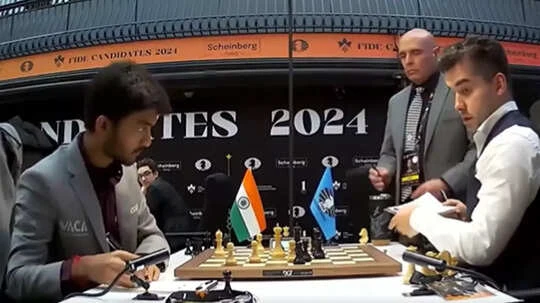
Boris Gelfand, winner of the 2011 FIDE Candidates, shares his thoughts on the role of luck in one of the toughest events in chess – and what it really takes to go all the way.
“I think maybe this year’s Candidates is the most interesting classical tournament. The Grand Swiss is maybe even more interesting because there are more games and more players. Obviously there are more than eight great players in the world, but the Candidates is always a tournament to follow, with a lot of great games. All players are highly motivated, so it will really be a pleasure to watch,” the veteran told FIDE.com.
Gelfand, however, dismissed the idea of predicting outcomes in such a volatile field.
“I don’t like this whole idea of predictions and trying to show that I am clever and know what will happen. There are always surprises. Maybe it’s best to go to bookmakers, because there people are responsible with their money. I don’t go to bookmakers, I don’t put money on anyone, so I have nothing to say.”
On what often separates contenders, he pointed to factors beyond pure preparation.
“Of course, luck is hugely important in every tournament, and this one even more. Luck can be not only when your opponent blunders, but also in pairings. You might face a player who has just lost one or two games, and that can give you a better chance.”
“In the second half especially, players take more risks because the difference between first place and any other place is huge, much bigger than between second and last. So people will take risks.”
Gelfand illustrated the point with his own title run in Kazan.
“The clearest example for me is the Candidates in Kazan, which I won. In the quarterfinal, I beat Shakhriyar with a brilliant game, and I think it was deserved. But in the semifinal against Gata Kamsky, after four classical draws and two rapid draws, I played one of the worst games of my career in game three with White. I lost in about 20 moves and had to win with Black to stay in the match.”
“Instead of playing his usual London System, he went for the Open Sicilian. I think it was incredible luck, because against the London and such a solid player like Gata, I would have had very little chance.”
Preparation and form, he stressed, still remain decisive.
“Of course, one has to reach peak form. I remember before that Candidates, a few days before, my head felt so clear. Some openings I analysed immediately showed the most interesting directions.”
“To be in good form is crucial. The one who reaches the best form has a clear advantage. But it is also important to stay cool throughout the tournament. It is unlikely someone will win convincingly all the way; there will be ups and downs.”
The mental side, according to Gelfand, is as critical as preparation.
“To stay calm, determined and focused in every situation is very important.”
Reflecting on high-pressure moments, he added:
“I remember spending about 40 minutes thinking in that game, going very deep and finding an amazing strategic idea. The follow-up was even more difficult.”
He also highlighted the culture of respect within elite chess.
“It was incredible how warmly Alexander Grischuk congratulated me, and the same with Shakhriyar after the quarterfinal. Even though they were very motivated to win, they showed great respect.”
“It is a good lesson for younger players, to respect the game of chess and treat it with the utmost respect.”