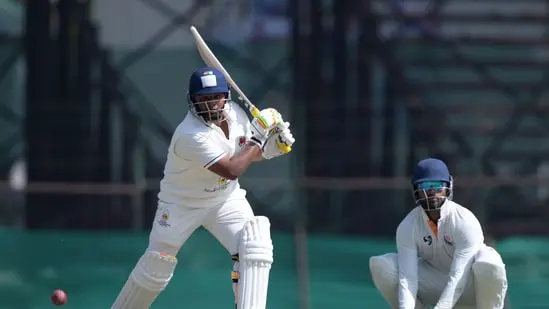
Sarfaraz Khan’s return to India’s Test squad may officially have been triggered by Sai Sudharsan’s injury, but the more significant development could unfold lower down the batting order.
With Devdutt Padikkal strengthening his claim to the No. 3 position after an unbeaten 142 in India’s warm-up game, Sarfaraz is unlikely to simply walk into Sudharsan’s slot. Instead, he has emerged as a genuine contender to Dhruv Jurel for a place in the middle order ahead of the opening Test against Sri Lanka in Galle.
That possibility requires explaining because Jurel has hardly been discarded by India. He has previously delivered under pressure in Test cricket, offers the additional value of being a wicketkeeper and, remarkably, scored an unbeaten 141 for India A at Galle only weeks before this series.
Yet India’s thinking appears to be moving towards Sarfaraz for a different reason altogether. This is less a judgement on who is the superior batter and more a decision about which batting method India believe is best equipped for the examination awaiting them in Sri Lanka.
Galle changes the selection equation
Few Test venues shape selection quite like Galle. Spin is not merely an important component there; it frequently becomes the dominant language of the match. As surfaces deteriorate, batters are required to negotiate considerable turn, variable bounce and long periods against slow bowlers operating with attacking fields.
That appears to have influenced India’s response to Sudharsan’s injury. Reports surrounding Sarfaraz’s recall have indicated that the selectors wanted a batter accustomed to playing on spinning surfaces. His ability against spin, and particularly the sweep, was reportedly part of the discussion when India considered their replacement options.
That immediately explains why his return should not be viewed simply through his Test numbers. Sarfaraz has 371 Test runs at 37.10, while Jurel’s 478 have come at 34.14. There is no enormous statistical separation between them at international level.
The distinction lies in how they score. Sarfaraz has spent years constructing an unconventional but highly productive method against spin in domestic cricket. He is comfortable leaving his crease, going deep inside it, sweeping, using soft hands and accessing areas square of the wicket that can make conventional fields difficult to maintain.
His 150 against New Zealand in Bengaluru in 2024 offered perhaps the clearest demonstration of that approach. Ninety-six of those runs came behind the wicket, an extraordinary illustration of a batter willing to invert traditional scoring zones rather than simply play in front of his body.
That sort of batting has particular value against spin. A spinner’s greatest advantage on a responsive surface comes when the batter permits him to settle into the same length repeatedly. Sweeps, paddles and aggressive use of the crease disrupt that rhythm. They force changes of field, alter length and, crucially, create scoring opportunities before the pitch makes survival progressively more difficult. India appear to believe Sarfaraz can provide precisely that disruption.
Jurel’s recent spin problems matter
Jurel’s case remains considerable, but his recent struggles against spin have probably complicated it. During South Africa’s Test series in India, he was used as a specialist batter but returned scores of 14, 13, 0 and 2. Simon Harmer repeatedly troubled India’s batters during that series, and Jurel was among those who found sustained high-quality spin difficult to negotiate.
His warm-up returns in Sri Lanka have not helped the optics. Jurel scored one in the first innings and 17 in the second, with off-spinner Ramesh Mendis dismissing him cheaply after tying him down.
Two practice innings should never determine a Test selection by themselves. But selectors rarely view such performances independently. India can instead see a pattern: difficulties against Harmer in their previous home Test assignment, followed by another uncomfortable encounter against off-spin immediately before a Test at Galle.
That does not mean Jurel cannot play spin. In fact, there is compelling evidence that he can. Only recently, captaining India A against Sri Lanka A, Jurel made an unbeaten 141 at Galle. Across that series, he registered scores of 141 not out, 14 and 53.
If India ultimately choose Sarfaraz, therefore, they would not be replacing a batter who has failed in Sri Lankan conditions. They would be choosing a different method despite Jurel having already succeeded in them.
That distinction is important. The 141 should not become the argument against the selection. Instead, it demonstrates how specifically India appear to value what Sarfaraz offers. Jurel has shown he can make runs at Galle. India may simply believe Sarfaraz gives them a more specialised weapon for the contest they expect.
India’s own recent history is influencing the call
There is another layer to the selection. India’s confidence against spin has been damaged over the last two years.
The defeats against New Zealand and South Africa at home exposed a weakness that would once have appeared almost unimaginable: Indian batters being repeatedly outmanoeuvred by opposition spinners on surfaces designed to assist slow bowling.
That experience is relevant to Sarfaraz’s recall. India are no longer approaching turning pitches with the assumption that their batters will automatically dominate because they have grown up playing spin. The evidence has forced them to think more carefully about technique, scoring options and match-ups.
Sarfaraz represents one possible response. He is a specialist batter with a first-class average around 64 and an enormous volume of domestic runs behind him. More importantly for this particular series, his method is proactive.
Jurel’s batting is generally more orthodox. Sarfaraz is more likely to manipulate lengths, sweep early and force Sri Lanka’s spinners to alter their plans. On a neutral surface, India might value Jurel’s adaptability, recent Test exposure and wicketkeeping ability more heavily.
At Galle, the weighting changes. That may also explain why Sarfaraz has immediately been seen working extensively against spin after joining the squad, while India’s training has featured considerable emphasis on sweeping and reverse-sweeping. The preparation itself offers a clue about the challenge the team expects.
Why Sarfaraz may ultimately edge Jurel
If India eventually select Sarfaraz, the decision should not be interpreted as a permanent movement in the middle-order hierarchy. It would be a conditions-based selection.
Padikkal’s warm-up century appears to have put him at the front of the queue for No. 3. That leaves India deciding what characteristics they want further down the order. Jurel offers recent runs at Galle, greater versatility and the insurance of a second wicketkeeper. Sarfaraz offers something narrower but perhaps more valuable for this particular Test: a batting game specifically designed to disturb spin. That is why the contest has suddenly become serious.
Sudharsan’s injury created the vacancy in the squad. Padikkal’s runs changed its consequences. Galle’s surface and India’s recent scars against spin have done the rest. Sarfaraz is not necessarily ahead of Jurel because India believe he is the better Test batter. He may be ahead because, for one of the most severe spin examinations in Test cricket, India believe they need the more specialised one.