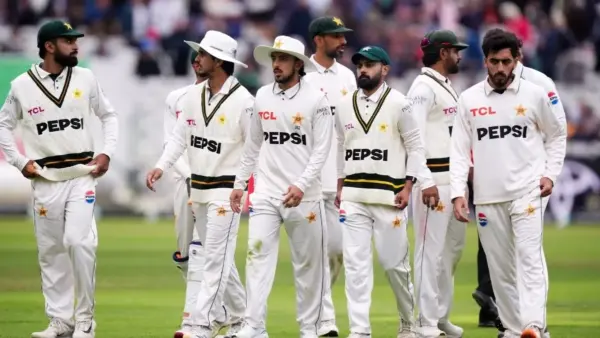
Fatima Sana’s five per cent fine for a one-over shortfall in the Women’s Asia Cup semi-final against Sri Lanka looks small on its own.
It isn’t, once you place it next to everything else Pakistan cricket has paid for the same offence this year. From a 50 per cent match-fee penalty and 11 lost WTC points against England at Edgbaston, down to this latest women’s team sanction, the pattern is the same: Pakistan keeps running out of clock, in both formats, across both squads.
The instinctive explanation – that a pace-heavy attack simply needs more time between deliveries – doesn’t hold up under the numbers. What does hold up is something less flattering: a repeated failure to manage time as part of the game itself, not an afterthought to it.
How the ICC Actually Penalises Slow Over-Rates
The rule sits under Article 2.22 of the ICC Code of Conduct. Every over a team fails to bowl within its allotted time costs each player five per cent of their match fee. The penalty scales fast – two overs short means a 10 per cent fine, five overs short means 25 per cent – and in Tests, it goes beyond money entirely. The ICC docks one World Test Championship point per over short, after time allowances are factored in.
That second part is what turned Pakistan’s Edgbaston shortfall into a genuine cricketing cost rather than a payroll issue. Eleven overs short against England meant 50 per cent match-fee fines and 11 WTC points gone – points the team could not afford to lose given where it already sat in the standings.
A Pattern Across Both Formats and Both Teams
The men’s side carries most of the recent damage – sanctions against England, Bangladesh, South Africa and Australia in Tests, plus limited-overs penalties on top of that. Edgbaston remains the clearest example of how bad this can get: 11 overs short, maximum fine, double-digit points gone from a WTC table where Pakistan were already struggling.
| Date | Format | Opponent | Overs Short | Match-Fee Fine | Other Penalty |
|---|---|---|---|---|---|
| November 5, 2023 | ODI | New Zealand | 2 | 10% | – |
| August 26, 2024 | Test | Bangladesh | 6 | 30% | 6 WTC points |
| January 7, 2025 | Test | South Africa | 5 | 25% | 5 WTC points |
| February 20, 2025 | ODI | New Zealand | 1 | 5% | – |
| March 29, 2025 | ODI | New Zealand | 2 | 10% | – |
| April 2, 2025 | ODI | New Zealand | 1 | 5% | – |
| April 5, 2025 | ODI | New Zealand | 1 | 5% | – |
| November 11, 2025 | ODI | Sri Lanka | 4 | 20% | – |
| May 2026 | Test | Bangladesh | 8 | 40% | 8 WTC points |
| June 2026 | Women’s T20I | India | 1 | 5% | – |
| September 14, 2026 | Women’s T20I | Sri Lanka | 1 | 5% | – |
| September 2026 | Test | England | 11 | 50% | 11 WTC points |
The women’s team has largely avoided that scale of punishment, but Sana’s fine shows the same discipline gap exists there too, even if the numbers are smaller. One over short is a minor breach on its own. It’s only notable because it fits a pattern the men’s team has already made expensive.
Why Pakistan Cricket Specifically Keeps Falling Behind
There’s no single culprit here, and reducing it to bowler fitness misses what actually eats the clock: field changes, captain-bowler-keeper huddles, tactical resets mid-spell. None of these look dramatic in the moment. Stacked over 90 overs of a Test innings, they add up to a deficit a team doesn’t notice until it’s already unrecoverable.
Pakistan’s recent Test cricket has leaned heavily into containment – long periods of trying to strangle an opposition partnership rather than end an innings quickly. That approach is not inherently wrong, but it’s expensive in exactly the currency the ICC is measuring. The longer a wicket takes to fall, the more field adjustments and tactical conversations get packed into the same fixed window, and the tighter the over-rate math gets.
The Fast-Bowling Excuse Doesn’t Really Explain It
It’s tempting to pin this on Pakistan’s pace-first identity – long run-ups, longer recovery – but over-rate calculations account for the whole fielding side, not just the bowler’s walk-back. Reviews, drinks breaks, injuries, strategic huddles: all of it counts against the same clock, and the ICC already builds in time allowances before ruling on an offence.
That the penalties keep happening anyway suggests the issue sits with match management as a whole, not with who’s holding the ball.
Why This Keeps Costing Pakistan More Than Money
In white-ball cricket, a fine is a fine – unwelcome, but contained. In Test cricket, it’s structural. Pakistan can lose WTC points without losing an extra match, which means results on the field and administrative discipline are now competing against each other for the same outcome. Already sitting near the bottom of the table, Pakistan can least afford to be shedding points to something other than an opponent’s batting.
So Is This a Discipline Problem?
Largely, yes – though not in the sense of teams needing to rush through overs recklessly. Captains still need time to think, bowlers still need recovery between spells, and tactical adjustments are part of legitimate game management. The issue is Pakistan’s apparent inability to track that time cost in real time, rather than discovering the shortfall only once an innings is nearly over.
Sana’s penalty in Colombo is minor next to Edgbaston’s 11-over disaster. But the message underneath both is identical: until Pakistan treats over-rate management as part of its tactical plan rather than a rule to worry about afterward, it will keep handing over time, money, and – where it hurts most – championship points it can’t spare.