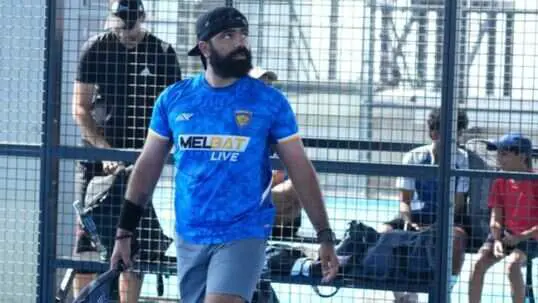
Usually, when an athlete steps away from a sport after spending years at the highest level, it can leave behind a difficult void. For Varun Thakkar, however, it opened the door to an entirely new challenge.
He represented India in the 2020 Olympics in sailing and now finds himself increasingly drawn towards padel. Initially, he discovered padel almost by accident, but it has helped him maintain the competitive instinct that drove him during his sailing career.
‘I just love competing’
He claims that he isn’t a professional padel player yet. But the desire to compete remains as strong as ever.
“I just love competing more than anything in the world,” Thakkar says.
His competitive spirit has been key to his transition to padel. He discovered padel during an off day while preparing for one of his sailing events. A coach was behind the introduction, and it began as a way of staying active, but soon it became an addiction.
The glass walls and cage surrounding a padel court gave him a familiar feeling, despite the sport being totally different from sailing.
Padel requires variables to account for, points to construct and constant decisions to make.
Just like sailing, padel offered an equally engaging mental challenge.
“In sailing, you’re wired in for 30 minutes,” he said.
“This is more like one set. The ability to reset after every point, even if you play a bad shot, is there.”
Sailing demands sustained concentration through long races. Meanwhile, padel needs a player to move constantly from one point to another.
The transition has not only been about learning something new. It is also about rewiring himself. Padel requires a different set of technical and tactical demands. He also realised that players with racket sports experience have significant advantages.
“I noticed guys who play racket sports are just way superior to me,” he says.
That has also made the challenge more attractive.
Chennai’s growing padel community
He describes himself as someone who becomes obsessed with anything he takes up, and constantly wants to improve too. The mindset has also brought him closer to the growing padel community in India.
He started playing in Chennai, and the sport has allowed him to meet talented new people and also reconnect with old friends. For him, the social element is one of the biggest strengths in the sport.
Players can compete intensely on court and then sit down and relax together.
“I think that’s what’s getting this community to really grow the sport a lot faster,” he says.
The developing phase of the sport also means that the playing field is competitive, with even lower-ranked players able to take games off the country’s best. This also creates a strong sense of community.
Thakkar also sees the sport growing nationally in the future. A growing number of players from tennis, squash and badminton have joined padel. He also praised the growth of the sport in Chennai.
“I think it is going to explode. It’s just a matter of time,” he says.
His own involvement in Indian sport has also given him a broader perspective on what athletes need to develop. He has dealt with the pressures of Olympic competition and challenges of building a career in a developing sporting ecosystem; he understands the importance of creating better pathways for the next generation.
But for now, though, padel is giving him a simple reason to compete. He might not sail professionally anymore, but the athlete within him has not disappeared.