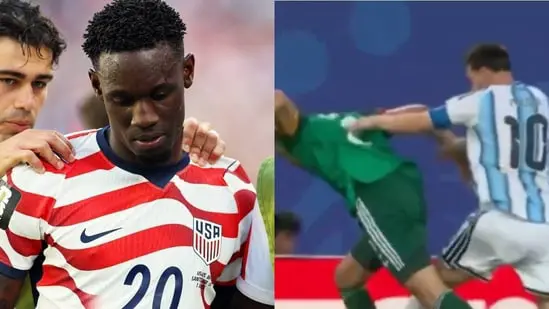
All three co-hosts of the 2026 FIFA World Cup have booked their places in the Round of 16, with the United States completing the trio after a 2-0 win over Bosnia and Herzegovina to set up a last-16 clash against Belgium.
Yet, despite the victory, the biggest talking point from the Round-of-32 contest in Santa Clara was the dismissal of Folarin Balogun.
One mistimed challenge, one trip to the pitchside monitor, and the striker who had put the United States ahead saw his night unravel. Balogun walked off in visible distress after referee Raphael Claus upgraded his challenge to a straight red card following a VAR review.
The decision immediately sparked debate. Television pundits questioned whether the challenge warranted a dismissal, while social media was flooded with comparisons to a remarkably similar incident involving Lionel Messi during Argentina’s group-stage match against Algeria. Messi escaped with only a foul, whereas Balogun now faces at least a one-match suspension.
What happened?
The incident occurred in the 61st minute, with the United States leading 1-0.
Balogun stretched to win the ball near the left touchline but caught the back of Tarik Muharemovic’s leg, with his studs sliding down from the calf towards the ankle. Referee Claus was instructed to review the challenge on the pitchside monitor before ruling it as serious foul play.
While the challenge did not appear deliberate and seemed more like an awkward landing than a reckless lunge, slow-motion replays highlighted the point of contact, prompting the referee to issue a straight red card.
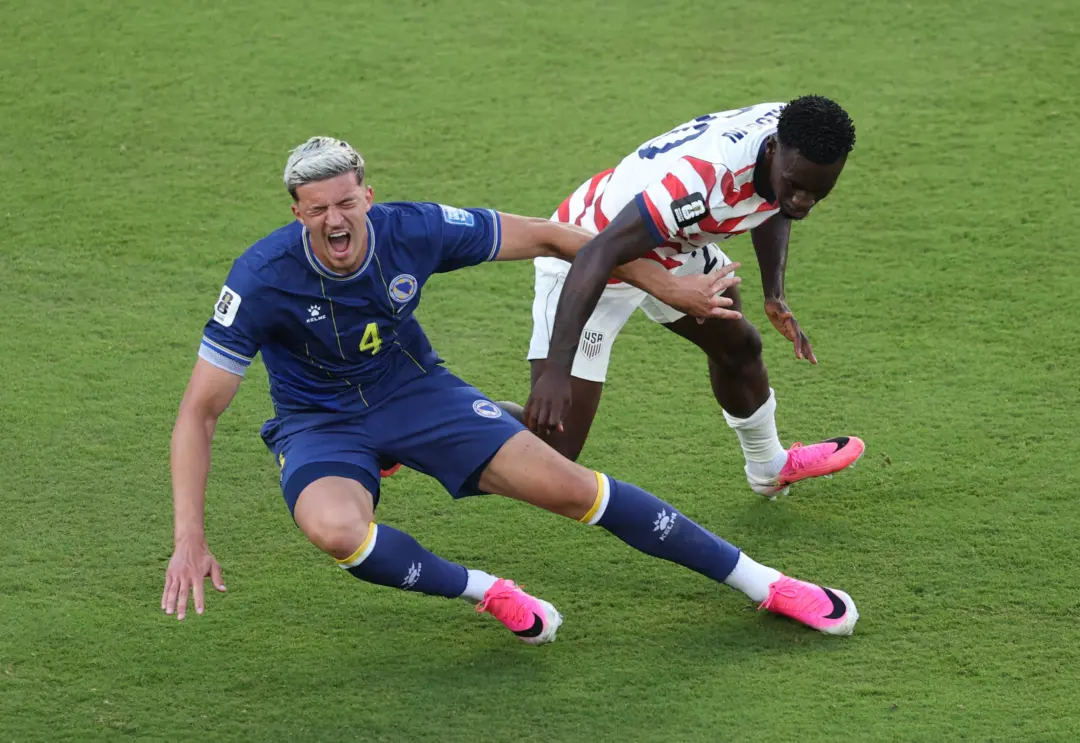
Under the International Football Association Board Laws of the Game, *”a tackle or challenge that endangers the safety of an opponent or uses excessive force or brutality must be sanctioned as serious foul play.”* The law also states that any player who lunges at an opponent with excessive force or in a manner that endangers an opponent’s safety is guilty of serious foul play.
The United States eventually held on to win, with Malik Tillman sealing the result from a late free-kick, but Balogun will miss the Round-of-16 clash against Belgium and could face additional punishment.
Article 10.5 of FIFA’s disciplinary regulations states that any player sent off automatically serves a one-match suspension, with the possibility of further sanctions depending on the disciplinary committee’s review.
Was it the right decision?
By the letter of the law, yes – and that is exactly why the incident has become so divisive.
Former Premier League referee Graham Scott described the decision as “unlucky but inevitable” in his analysis for *The Athletic*. Scott argued that Balogun never appeared out of control and that the contact looked accidental rather than malicious.
However, under modern VAR interpretation, intent is largely irrelevant. The focus is on whether the challenge endangered an opponent, and once the referee is shown repeated slow-motion replays of studs making contact high on the leg, a red card becomes far more likely.
Scott also argued that VAR has fundamentally changed how such tackles are viewed.
“Historically, the law was invoked when players launched themselves into reckless tackles at high speed and out of control. Since VAR arrived, the focus has shifted almost entirely to the point of contact. Slow-motion replays and freeze frames can make relatively innocuous challenges appear far more dangerous than they looked in real time,” he wrote.
Why has Messi’s challenge resurfaced?
Moments after Balogun’s dismissal, social media users began circulating clips from Argentina’s group-stage victory over Algeria.
In that match, Messi appeared to drag his studs down the calf and ankle of Algeria captain Aïssa Mandi in a challenge that looked visually similar to Balogun’s. Referee Szymon Marciniak awarded only a foul, while VAR reviewed the incident but chose not to intervene.
The decision angered the Algerian camp, with the country’s football federation lodging a formal complaint to FIFA. Algeria coach Vladimir Petkovic later admitted that “everyone saw it,” while several former players and pundits argued the incident could easily have resulted in a red card.
Nothing came of the complaint. Messi stayed on the pitch, went on to score his maiden World Cup hat-trick, and finished as the game’s standout performer.
The two incidents have since fuelled comparisons, with many fans questioning why two seemingly similar challenges produced two very different outcomes.
Ultimately, the difference may simply come down to VAR interpretation. One referee judged the challenge worthy of an on-field review and a dismissal. The other did not. Whether that reflects inconsistency or simply football’s subjective laws remains open to debate.