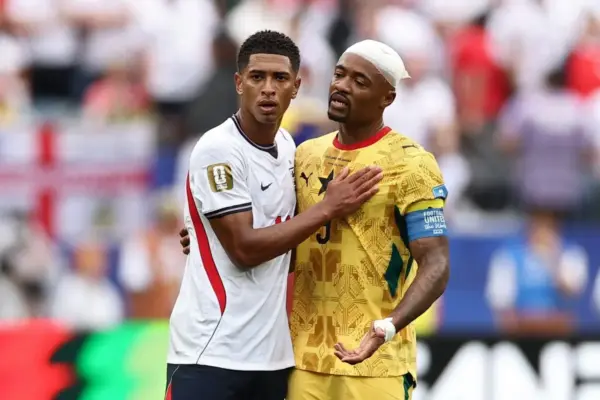
Aphotograph of England midfielder Jude Bellingham covering his mouth while speaking to Ghana forward Jordan Ayew during Tuesday’s 0-0 draw in Boston sparked debate among football fans following the introduction of a new FIFA rule for the 2026 World Cup.
The law allows players to be sent off if they cover their mouth while speaking to an opponent during a confrontational exchange. The rule was introduced after Benfica winger Gianluca Prestianni received a six-match UEFA ban for homophobic conduct towards Real Madrid’s Vinicius Jr during a Champions League match in February.
Miguel Almiron suspended for one-game for covering his mouth so why not Bellingham?
Paraguay midfielder Miguel Almiron became the first player dismissed under the new regulation during a match against Turkey at the weekend. Following a VAR review, the referee issued a red card, raising questions about why Bellingham was not punished in a similar manner. The key difference lies in the context of the interaction. Covering the mouth itself is not prohibited. FIFA’s concern is when it occurs during a heated confrontation between opponents.
Before the tournament, FIFA’s head of referees, Pierluigi Collina, clarified the rule. “Players can continue to cover their mouth with an arm and the shirt because they may chat with friends,” Collina said. “It’s normal to a chat before, during or after the match.
“So if the conversation is a friendly conversation, they can continue to do it without any problem. “When the conversation is confrontational, covering the mouth means that you are doing something wrong, potentially, and the sanction is the red card.”
During the England-Ghana match, there appeared to be no hostility between Bellingham and Ayew. The pair were simply engaged in conversation, meaning there was no reason for VAR to intervene. Almiron’s situation was different because it occurred during a tense moment in Paraguay’s match against Turkey. The incident followed a challenge involving Paraguay’s Isidro Pitta and Turkey’s Ismail Yuksek, which triggered a confrontation between players from both teams. Amid the commotion, Almiron covered his mouth while speaking to Turkey defender Mert Muldur. Although neither player was directly involved in the altercation, officials viewed the exchange as taking place within a confrontational context.
FIFA president Gianni Infantino reinforced the governing body’s position after Almiron’s dismissal. “This thing about covering the mouth is for us a very, very important rule,” Infantino told SNTV on Tuesday following Almiron’s dismissal. “It’s about respect. It’s about the example that we should give. “If you have nothing to hide, you don’t cover your mouth when you speak to somebody.
“The rules have been made very clear to everyone.”
The new regulation has generated debate over how consistently it can be applied. Critics argue that players could potentially exploit the rule by drawing officials’ attention to opponents during emotional moments. In Almiron’s case, he did not appear overtly aggressive, yet Muldur immediately alerted an assistant referee to the gesture. Almiron received a one-match suspension and will miss Paraguay’s final group-stage game against Australia.
FIFA confirmed that a longer ban could have been imposed if evidence of abusive language had emerged. The rule remains optional for competitions to adopt and is currently being used only at the World Cup. Concerns over consistency and the possibility of players manipulating the rule may prevent it from being widely introduced in domestic leagues.