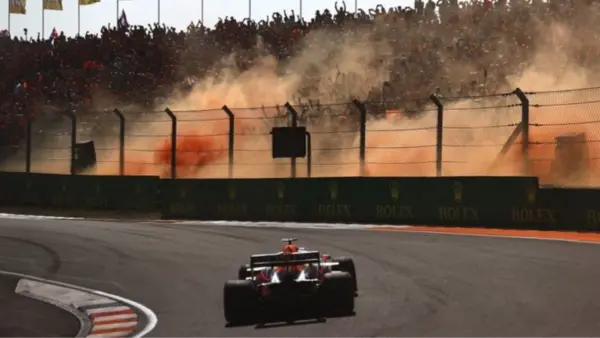
The Dutch Grand Prix will disappear from the Formula 1 calendar after the 2026 season, bringing an end to one of the sport’s most successful recent European revivals.
Zandvoort returned to F1 in 2021 after a 36-year absence and quickly became one of the championship’s most recognisable events, driven by the enormous popularity of Max Verstappen in his home country. But despite sell-out crowds and the spectacle surrounding the race, the organisers ultimately decided that continuing to host F1 was not financially sustainable in the long term.
The 2026 Dutch GP, scheduled for August 21-23, will therefore be the final F1 race at Zandvoort for the foreseeable future.
Why is the Dutch Grand Prix ending?
The central reason is financial risk.
The Dutch Grand Prix is privately owned and operated, meaning the organisers have to balance the cost of staging the event against the revenue it generates.
Dutch GP director Robert van Overdijk said the decision was made after considering “the opportunities presented by continuing to host the event” against the risks and responsibilities involved.
The event had become heavily dependent on maintaining exceptionally strong attendance and commercial performance. Reports have suggested that the race needed to effectively sell out across all three days to remain financially viable.
That became an increasingly difficult proposition as the cost of staging a modern Formula 1 Grand Prix continued to rise.
According to reports cited by Dutch media, hosting the event costs around €70 million per year.
The organisers had previously been able to operate with a financial reserve built up during profitable editions of the race. But that buffer had diminished considerably, increasing the risk involved in committing to another long-term F1 contract.
Rather than wait until the economics became more difficult, the organisers opted to leave while the event was still commercially strong.
## Was the Dutch GP not successful?
It was.
In terms of atmosphere and popularity, Zandvoort was one of F1’s standout events following its return.
The circuit regularly attracted huge crowds, with Verstappen’s home support creating the now-famous “Orange Army” atmosphere around the track.
Verstappen won the first three Dutch Grands Prix after Zandvoort’s return before Lando Norris ended that run.
The event also became more than just a race weekend. It incorporated F2, F3 and F1 Academy and was praised by F1 management for its entertainment value and sustainability initiatives.
That makes the decision to leave somewhat unusual.
The Dutch GP is not ending because fans stopped attending or because the event failed to generate interest. It is ending because maintaining the event at the level required by modern Formula 1 carries too much financial risk for its organisers.
## How much did it cost to host the Dutch GP?
Reports have put the annual cost of hosting the Dutch Grand Prix at around €70 million.
The race was profitable through 2024, according to reports, but the organisers’ financial position became a bigger concern as the cost of continuing increased.
One particularly contentious issue has been the reported €20 million dividend paid to shareholders and organisers.
The payment prompted questions over why the event would then cite financial risk as a reason for ending its F1 run.
The Dutch Grand Prix organisation defended the dividend, saying it was not unusual and that the payment had to be viewed against the annual cost and risks associated with staging the event.
The available information does not establish that the dividend itself caused the Dutch GP to end. Instead, it became part of a wider debate over the economics of an event that required a substantial annual investment to remain on the calendar.
## Did Max Verstappen’s popularity save the Dutch GP?
Verstappen was unquestionably central to the Dutch Grand Prix’s resurgence.
When Zandvoort returned in 2021, Verstappen was the dominant Dutch sporting figure in Formula 1. His championship battle with Lewis Hamilton that season created enormous interest, while his subsequent success made the Dutch GP one of the most heavily attended events on the calendar.
The race’s orange-themed atmosphere became one of its defining features.
But that also created a vulnerability.
A Grand Prix built around one national superstar is naturally exposed to changes in that driver’s form, popularity and future.
Verstappen’s dominance has also diminished. The 2026 season has not produced the same championship picture for Red Bull, with the Dutchman no longer occupying the position of overwhelming favourite that he held during the early years of Zandvoort’s return.
That does not mean the Dutch GP was only successful because of Verstappen, nor that his decline directly caused its cancellation.
But his presence undoubtedly helped make the economics of the event easier to justify.
## Could the Dutch GP have continued with a rotation deal?
Yes, and this was one of the possibilities considered.
Formula 1 has increasingly explored rotating European races as the calendar becomes more crowded.
With Madrid joining the schedule in 2026 and F1 continuing to explore new markets, there is increasing pressure on traditional European venues to share calendar space rather than expect an annual race.
There had also been discussion of potentially rotating the Netherlands and Belgium.
However, the Dutch Grand Prix organisers ultimately chose to end their run after 2026 rather than pursue a longer arrangement.
F1 CEO Stefano Domenicali said that alternatives, including rotation and annual events, had been considered.
The decision was ultimately respected by Formula 1.
## Is Zandvoort leaving Formula 1 forever?
Not necessarily.
The end of the Dutch Grand Prix does not mean Zandvoort itself is closing.
The circuit will continue to host other motorsport events, testing and racing categories.
What is ending is its place on the Formula 1 calendar.
There is always the possibility that circumstances could change in the future, particularly if F1’s calendar structure evolves or the commercial conditions surrounding the event improve.
For now, however, there is no confirmed plan for Zandvoort to return after 2026.
## Why is F1 letting the Dutch GP go?
Formula 1’s calendar has become increasingly crowded.
The championship is expanding into new markets, while Madrid is joining the calendar in 2026 and discussions continue over potential races in Africa, including Rwanda.
At the same time, F1 is trying to balance its global expansion with its traditional European races.
There are only so many weekends available.
Allowing Zandvoort to leave therefore gives F1 greater flexibility at a time when several countries and promoters are competing for places on the calendar.
For the championship, losing a popular European race is a blow. But the decision also creates space for new events and reduces some of the fixture congestion F1 would otherwise face.
## What makes the 2026 Dutch GP special?
The final Dutch GP will have several elements that make it different from the previous editions.
Most significantly, it will be the first and last Dutch Grand Prix to feature an F1 Sprint.
The 2026 event will run from August 21 to 23, with the Sprint taking place on Saturday before the main Grand Prix on Sunday.
That means Zandvoort’s final F1 weekend will not simply repeat the format of the previous five editions.
It will also provide Verstappen with his final scheduled home Grand Prix at the circuit.
The Dutchman’s special Delftware-inspired helmet for the weekend adds another layer to the farewell, with the design paying tribute to the Netherlands and Zandvoort.
## The end of an era for the Orange Army
The Dutch Grand Prix’s exit is ultimately a story about the changing economics of Formula 1.
Zandvoort proved that a historic European circuit could return to the calendar and immediately become one of the championship’s biggest spectacles.
But popularity alone cannot guarantee a race’s future.
The costs of staging a Grand Prix have continued to rise, the calendar has become more competitive and the event’s commercial model has carried significant risk.
Zandvoort’s organisers have therefore chosen to leave while the Dutch GP remains a popular and highly regarded event rather than continue until the economics become unsustainable.
For Verstappen and the Orange Army, the 2026 race will be the final chapter of a remarkable five-year comeback.
For Formula 1, it is another indication that even the sport’s most popular venues are not guaranteed a permanent place on an increasingly global calendar.