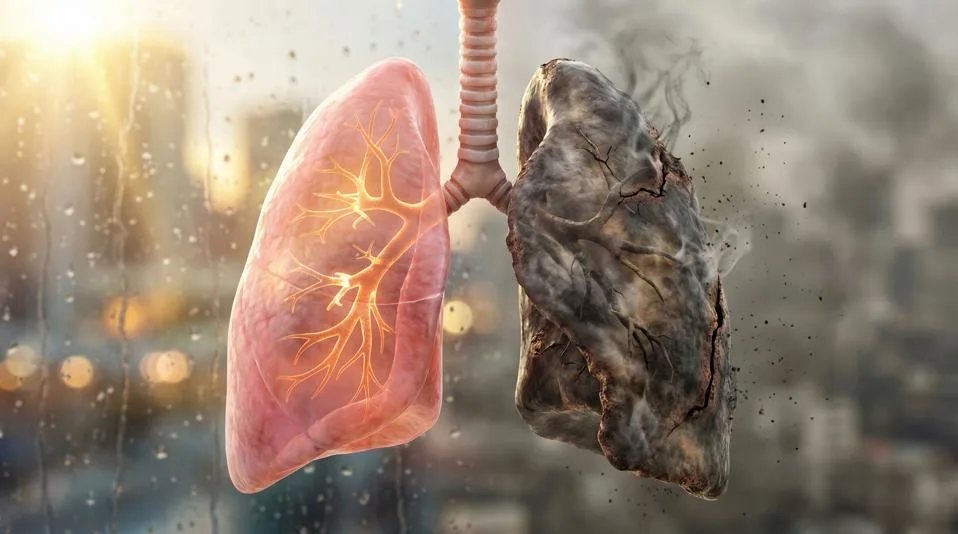
The first question almost every person with lung cancer hears is whether they smoked. For a growing number, the answer is no. worldwide occur in people who never smoked, and that share keeps rising as smoking declines.
A identifies one reason some of these cancers occur. A rare inherited change in a gene raises the odds of lung cancer about 25-fold overall, and in people who never smoked. In the same data, smoking alone raised the odds about fourfold.
A Growth Switch Primed To Fail
The gene called EGFR carries the instructions for a receptor on the surface of lung cells. It acts as a switch that tells the cell when to grow and divide. Changes that arise during a person’s lifetime are among the most common drivers of lung cancer in those who do not smoke, especially in East Asia. Several targeted drugs are built to block them.
The variant in the new study, called T790M, is different. It’s inherited. Therefore, it’s present in every cell from birth and passed from parent to child. It also appears in tumors as the change that lets cancers escape early drugs. In 2005, a with several cases of lung cancer found the same change passed down through generations. In four of six tumors examined, a second EGFR mutation had arisen on the same gene copy. That pattern suggests how the variant works. T790M doesn’t appear to cause cancer on its own. It primes the gene, so that one more EGFR error later in life can start a tumor.
Three Million Genomes
A variant this rare is hard to measure because so few families carry it. The study, led by with the 23andMe Research Institute, searched genetic data from more than 10 million consenting 23andMe participants and focused on 3.37 million with known lung cancer history, all of European ancestry.
The variant appeared in about Carriers had about 25 times the odds of lung cancer of non-carriers. The odds also increased about 10 times among smokers and more than 60 times among never-smokers. To be clear, the smaller number for smokers doesn’t mean smoking protects anyone. Smokers start from a far higher baseline risk, so the variant adds less on top.
The vast majority of carriers to one ancestral line of British and Irish settlers. About 200 to 225 years ago, the variant became concentrated in Southern Appalachia, where relatively isolated communities passed it down through generations. In parts of Southern Appalachia, it appears in about 1 in every 2,000 people. That’s more than seven times the national rate. The variant is also uncommon in people of Asian descent. This is particularly interesting because in parts of Asia, never-smokers make up a far larger share of lung cancer cases. Their risk likely comes from elsewhere.
Environmental exposures also matter. Radon, a colorless gas that seeps into homes from the ground, is the leading cause of lung cancer in those who don’t smoke and kills about each year in the United States. Fine particle air pollution leaves its own fingerprints. A 2025 of tumors from never-smokers found more mutations, including a pattern previously linked to tobacco smoking, in regions with dirtier air.
Screening Beyond Smoking History
Lung cancer screening in the United States is offered almost entirely based on smoking history. The Dana-Farber team recommends that people with several relatives who had lung cancer, multiple lung nodules or family roots in the Southeast speak with a . If further work confirms the benefit, carriers could receive regular CT scans that find tumors at their most curable stage.
Much remains unknown. The study didn’t measure a carrier’s absolute lifetime risk, and it still can’t say why some carriers develop cancer while others don’t. An inherited cancer gene . The study also looked only at people of European ancestry, so its findings may not apply to everyone.
The question “Did you smoke?” still matters. For families that have watched lung cancer strike relatives who never touched a cigarette, a more useful question may be what they inherited.